


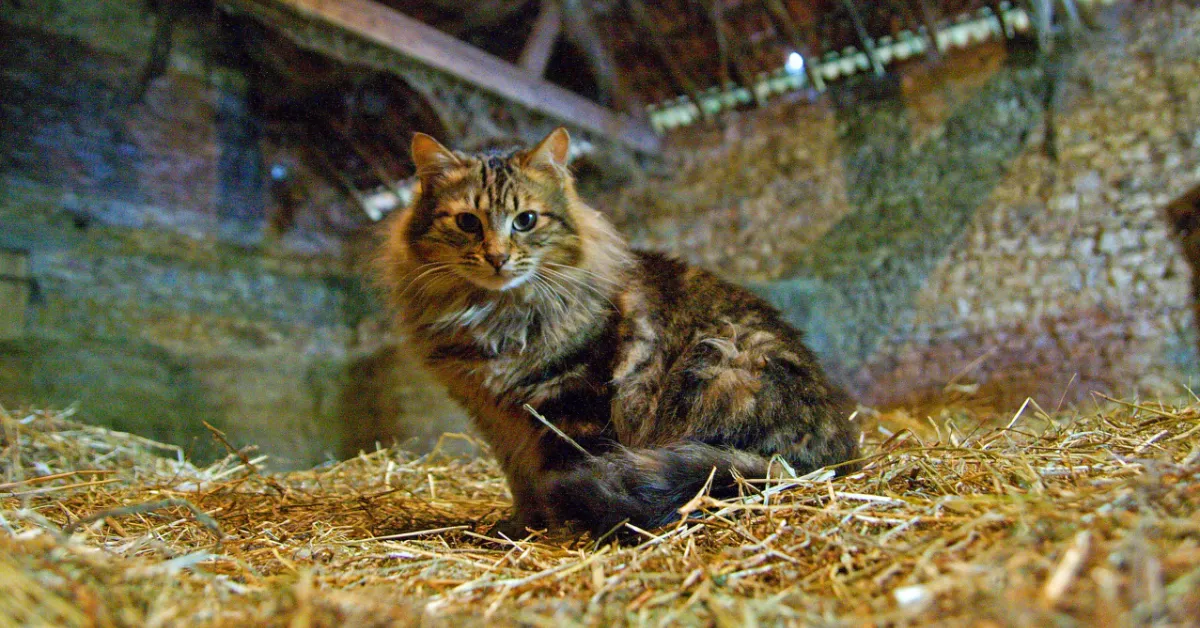
In 2015, Jennifer Cabral and Deb Mathews founded the Helping Animals Rescue Team, or HART Rescue, in Crossville, Tennessee. To date, they’ve helped adopt out 634 cats to local farmers.
“Our program has ended euthanasia for feral and semi-feral cats at our local shelter entirely,” Cabral told Good Good Good, referring to the Cumberland County animal shelter — which is run by director Andrea Henshaw.
HART Rescue is one of many nonprofits across the United States that rehome feral cats through barn cat programs.
It’s a win-win: Cats slated for euthanasia get a second chance, and farmers get help reducing rodent populations on their land.
“These cats are considered not adoptable to domestic homes,” Cabral explained. “Either they are feral, semi-feral, or completely antisocial. Some of the antisocial cats come around to be at least pet-able after settling into their barn placements.”
“Once we get the call, we set up with our vet to spay or neuter and vaccinate the cats, and they go back to the shelter if we don’t have immediate barns for them.”
Then, HART Rescue takes photos of the cats, gets a general idea of the cats’ personalities, and posts their listings on Facebook and PetFinder.
“When someone contacts us looking for barn cats, we give them a list of what kind of cats we have available,” Cabral said. “Some barns want cats to just be feral, and some want them to be more on the antisocial side. We try to match barns with what they are looking for.”
Evidence shows that cats do have a measurable impact on rodents and pests.
From December 2017 to May 2018, researchers tracked a rat colony and five feral cats over 79 days. They recorded over 306 videos and documented 20 stalking events and three “predation” attempts. Two were successful.
Even when the cats didn’t outright eliminate rats, they did affect their behavior. The same study found rats shifted their movement and spent more time in burrows when cats were present, so the cats acted as a deterrent.
Alexandre Delbos (CC BY 2.0)
Experts held the study up as an example to farmers and factory owners — indicating that cats are just one of many tools that should be used for clearing out active nesting sites.
Still, Cabral said she’s heard anecdotal evidence of positive results.
“We don’t always get updates from the barns, but we do get barns that come back for more cats, and when we do get updates, we have a lot of positive feedback that the cats are working well,” Cabral said.
“We advise the barns that cats who are well fed hunt for fun and they are better hunters when they aren’t just starving,” she continued. “We have had barns tell us that they’ve had rats clear out shortly after placing cats in the barn situation without the cats having to catch a single rat. We have had cats placed at a rock quarry where rats were so bold that they stole workers’ lunches, and cats placed there immediately went to work hunting.”
From time to time, Cabral has encountered a common misconception about the barn cat program.
“Often, people think the barn cat program is a way to get a free adoption or that we will adopt out little kittens to them as barn cats,” Cabral said. “These cats are always teenagers to adults and must be unadoptable as a domestic cat.”
“This is why we started the program,” she emphasized. “To give these cats a chance to live their lives, and to keep the shelter staff from having to euthanize cats just because they wouldn’t make a good couch ornament. The local shelter has found the program extremely helpful to their numbers, and their hearts.”
Cabral noted one farmer who had set up a “buddy system” for her barn cats.
“We have another barn that likes to have their barn cats in pairs so each one has a buddy,” Cabral told Good Good Good. “So she has gotten four so far, and each one has a friend, so we made sure to give her cats that already knew each other. She sends pictures of them in the barn with the goats supervising all the work.”
When asked if there were any rescue stories that stood out to Cabral, one immediately came to mind.
“We had a somewhat sad experience where a 12-year-old cat came into the shelter with kittens. This means this poor cat had been having several litters a year for 12 years,” Cabral recalled. “Because of this, she lost some control of her bathroom abilities and would pee or poop wherever she was because she couldn’t even tell she was doing it anymore.”
“She was somewhat antisocial but not entirely to the point where we would think of a barn,” she continued. “However, a cat who won’t be able to use the bathroom wouldn’t be easily adoptable. So we found a barn that stepped up to take her.”
At her new home, the cat had the lay of the land. The owner simply sprayed down the yard or porch with a hose if an accident occurred.
“The cat was not required to hunt in this place; they had other hunters,” Cabral said. “Her only job was to lie in the sunshine and get fed. She grew back her patchy hair and got nice and chunky. She lived there for another three years and passed in her sleep.”
“Barn life is a good life,” she said, “and better than euthanasia.”
You may also like: This dog is trained to sniff out invasive ‘sea vomit’ and protect oyster reefs: ‘She has enough drive for 3 dogs’
Featured Image: Alexandre Delbos (CC BY 2.0)
