


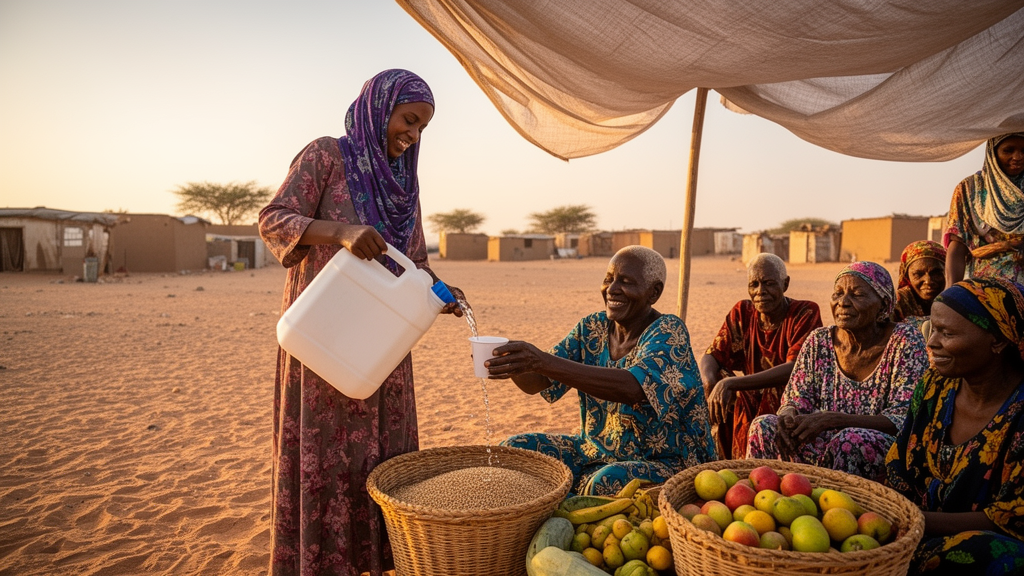
Food security, water security, and social support are each positively associated with higher psychosocial well-being among displacement-affected populations in Somalia, according to a cross-sectional study published in Discover Food. Surveying both internally displaced persons and members of vulnerable host communities, researchers observed that households with reliable access to food and water reported significantly higher psychosocial well-being scores than households experiencing food and water insecurity.
The investigation sought to address an underexplored dimension of humanitarian recovery: the relationship between essential resource security and the psychosocial well-being of displaced populations. Although adequate food and water are recognized determinants of general well-being, empirical research examining how resource shortfalls connect with psychological health in displacement contexts has remained limited. The study examined these primary associations while also assessing whether community social support functions as an intermediary mechanism between resource access and psychological outcomes.
Data for the investigation were gathered from a cross-sectional baseline survey encompassing 1,012 poor internally displaced persons and vulnerable host-community members residing in Baidoa, Somalia. The field assessment was conducted between July and August 2025, capturing living conditions and psychosocial indicators across both displaced families and the host populations living alongside them.
To quantify participants’ psychological status, the investigators utilized a seven-item psychosocial well-being scale adapted specifically to the Somali context. The research team evaluated associations between food security, water security, social support, and psychosocial well-being using ordinary least squares regression. To further determine whether social support acts as a mediator, the researchers employed structural equation modeling using 5,000 bootstrap replications.
In the regression models, food security emerged as a strong positive predictor of psychosocial well-being, yielding a regression coefficient of β = 11.397 (p < 0.001). Water security similarly demonstrated a statistically significant positive association with psychosocial well-being, with β = 4.681 (p = 0.027). In addition, social support was positively associated with well-being scores, recording a coefficient of β = 0.278 (p < 0.001).
The structural equation modeling revealed that social support partially mediated the associations between resource access and psychosocial outcomes, although the predominant share of the relationships operated through direct pathways. Specifically, indirect pathways through social support accounted for approximately 10.0 percent of the total effect connecting food security to psychosocial well-being, and approximately 13.3 percent of the total effect linking water security to psychosocial well-being.
The authors concluded that food security, water security, and social support are all positively associated with psychosocial well-being among displacement-affected populations in Somalia. Based on these observed associations, the study suggests that integrated humanitarian interventions that simultaneously strengthen food security, water security, and social support networks may help improve the psychosocial well-being of vulnerable displaced and host communities.
Subject of Research: Psychosocial well-being, food and water security, and social support among displaced populations in Somalia
Article Title: Food and water security, social support, and psychosocial well-being among internally displaced persons and host communities in Baidoa, Somalia
Article References: Murendo, C., Salat, A., Canocakacon, J., Nyeko, J. P., & Kimbrough, S. (2026). Food and water security, social support, and psychosocial well-being among internally displaced persons and host communities in Baidoa, Somalia. Discover Food. https://doi.org/10.1007/s44187-026-01273-5
Image Credits: AI Generated
DOI: 10.1007/s44187-026-01273-5
Keywords: food security, water security, psychosocial well-being, social support, internally displaced persons, host communities, Baidoa, Somalia, cross-sectional study, ordinary least squares regression, structural equation modeling, mediation analysis, bootstrap replications, well-being scale, displacement-affected populations, vulnerable households, resource security
