


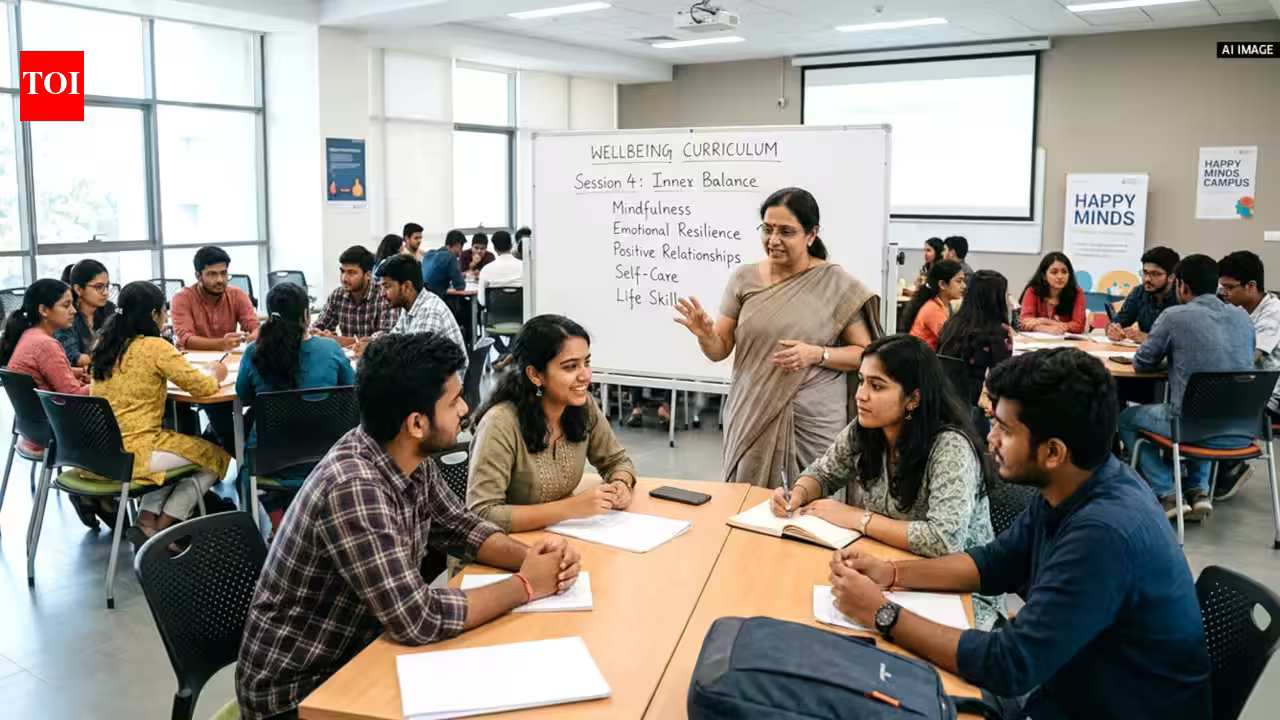
Emotional resilience, meaningful relationships and well-being deserve a place alongside academic achievement, writes Dr Prabhat Pankaj
Most students want to know which course will help them get a job, but very few ask if education will help them build a life.
Universities prepare young people to read balance sheets, write code, design machines, and analyse markets.
Yet many graduates leave campus without learning how to manage disappointment, sustain relationships, recover from failure, find meaning or live with their own restless minds. We train them to make a living, but not always to live.
Universities should teach happiness not as motivational entertainment or a once-a-year wellness event, but as a serious, evidence-informed, credit-bearing curriculum.
This idea is no longer outside the mainstream of policy.
In January 2026, the UGC circulated guidelines on mental health and well-being for higher educational institutions. Alongside counselling centres, helplines and mentoring systems, the guidelines recommended integrating well-being and happiness into the curriculum through credit or non-credit courses. India should not allow this idea to disappear into another policy document.
The UGC guidelines cite severe psychiatric conditions among 7.3% of Indians aged 18-29 years and report that students account for 7.6% of all suicides in the country. These are not just health statistics but educational indictments. When distress enters the classroom, the curriculum cannot pretend to be neutral.
Teaching happiness does not mean promising permanent cheerfulness or the end of grief, pressure or inequality.
It means developing the capacity to understand one’s emotions, cultivate supportive relationships, build resilience, align action with meaning and practise habits that improve well-being.
In other words, it is a learnable set of human capabilities.
Yale’s Psychology and the Good Life, introduced by Professor Laurie Santos, attracted nearly a quarter of Yale undergraduates in its first year and became the most popular class in the university’s history.
Its online version, The Science of Well-Being, combines the psychology of happiness with practical habit-building challenges.
At Harvard University, Arthur Brooks teaches happiness through philosophy, neuroscience and social science, while the Leadership and Happiness Laboratory treats well-being as a leadership competency rather than a private luxury. The University of Bristol launched what it describes as the United Kingdom’s first ‘Science of Happiness’ course in 2018, covering gratitude, sleep, exercise, kindness, social connection and comparison without conventional examinations.
The movement is not confined to elite Western campuses.
At Canadian University Dubai, a 14-week Happiness 101 programme brought together students from 39 nations; participants reported gains in life satisfaction and in both pleasure-based and meaning-based well-being compared with a control group. A Thai university’s online positive psychology course recorded improvements in perseverance, optimism and happiness, while a University of Melbourne intervention embedded well-being practices in undergraduate psychology classes and found that they buffered students against semester stress.
University of Bristol reported a 10-15% improvement in student well-being, yet its long-term study found that gains endured mainly among students who continued practising what they had learned. Prof Bruce Hood compared it to physical fitness: one class cannot keep people fit forever. A systematic review of 27 university positive psychology courses found that 85% reported at least one beneficial effect, but every study carried a moderate or serious risk of bias.
Consistency, therefore, remains key.
This is why happiness education needs theory, trained faculty, sustained practice, assessment and transparent outcome data. It must complement, never replace, professional counselling. Nor should it become a convenient way to tell students to meditate while leaving toxic competition, exclusion, unaffordable education or humiliating campus cultures untouched.
Bhutan’s Educating for Gross National Happiness initiative and UNESCO’s Happy Schools framework are among such initiatives.
Bhutan’s Gross National Happiness experiment should neither be romanticised nor dismissed.
Its 2022 survey produced a national score of 0.781, which improved over 2015, yet an Asian Development Bank analysis cited in The Guardian found that wealthier Bhutanese were happiest, while only a third of farmers were classified as happy. The lesson is that measuring happiness cannot substitute for creating fair opportunity.
But what a society chooses to measure influences what it chooses to value.
Several Indian colleges have introduced Science of Wellbeing and Happiness as a credit course, supported by perspective-building sessions, meditation and yogic practices, gratitude exercises, self-reflection and individual guidance. Pre- and post-course tracking examines changes in stress, anxiety, attention and relationships.
The experience has reinforced a simple truth: students do not need another sermon. They need time, language, practice and permission to examine how they are living.
- Make it foundational: Offer every undergraduate a credit-bearing course in the science and practice of well-being, bringing together psychology, neuroscience, economics, philosophy and Indian knowledge traditions without turning any one tradition into dogma.
- Build habits: Timetables should make room for reflection, gratitude, physical activity, mindful technology use, sleep, social connection, service and conversations about failure. These must be repeated habits, not decorative content in a PowerPoint presentation.
- Train teachers: Faculty members are educators, not therapists. They should know how to create humane classrooms, identify distress, and connect students with qualified professionals.
- Measure outcomes: Universities should track well-being, belonging, loneliness, resilience, and help-seeking alongside grades and placements. What gets measured gets managed, but what gets published can be challenged and improved.
Universities often declare that they prepare students for a future that demands technical intelligence. But that future also needs people who have emotional balance, moral imagination and the ability to remain human in an age of relentless acceleration.
Happiness is not a soft subject. It is a rigorous question economics must ask of itself: growth should be focused on human flourishing. A university that cannot help students confront that question may award successful degrees, but it will have left its deepest educational duty unfinished.
(The author is director, Academics, Jaipuria Institute of Management, Jaipur)
