


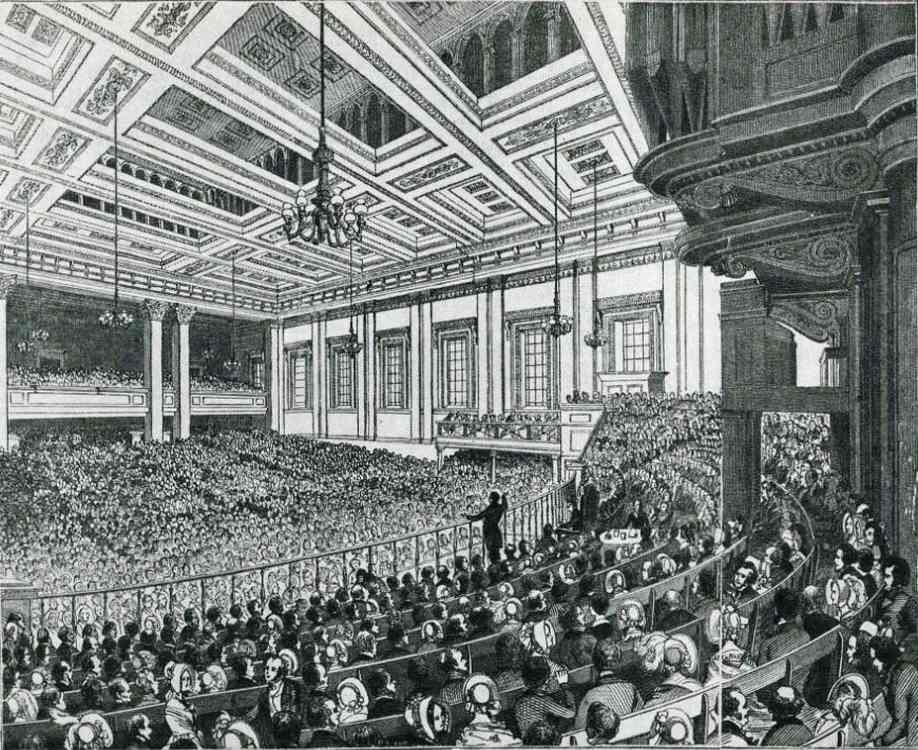
187 years ago today, the Anti-Corn Law League was established in England by the economics-savvy liberals who understood that protectionism is immoral and useless in benefiting the economy. The League, led by Richard Cobden and heavily influenced by economist Daniel Riccardo, succeeded in seeing the Corn Laws of 1815 abolished, laying out the first laizzez-faire arguments against mercantilism to be heard in Europe, and establishing for all time the case study one their use. READ more about this successful political movement… (1838)
A meeting of the Anti-Corn Law League
The Corn Laws imposed tariffs on imported cereals into England under the guise of protecting the domestic production (corn meant any grain at the time). As in all economic activity, the Corn Law tariffs had two effects, which renowned French economic journalist Friedrich Bastiat described famously as one which is seen, and one which is unseen.
The tax on imported wheat meant that producers of the more expensive domestic cereals were able to keep their jobs and production methods intact—a perceived good by the British Parliament.
That which was unseen was manifold. They resulted in a rise in the price of bread at a time when British factory owners were trying to reduce costs. It resulted in food scarcity among the poor as bakers and merchants could no longer import cheaper grains from abroad even in times of shortages. It stalled English farmers from further agricultural innovations, or moving into other industries, having a portion of their income all but guaranteed.
It also decreased the demand on manufactured goods, as suddenly the lower and middle classes were paying more for food they had gotten for less prior to the Corn Laws’ enactment. Lastly, as organizer Cobden saw it, it created unnecessary animosity between nations who might otherwise live in greater harmony if trade were partaken freely.
The lessons of the Corn Law were never lost to history, but rather must be reiterated every time a political administration attempts to re-establish protectionism and mercantilism according to naive desires of obtaining that good which is seen: the protection of a domestic market, and ignoring that which is unseen—the burden imposed on the rest of the economy in exchange.
MORE Good News on this Day in history:
- George Washington laid the first cornerstone of the Capitol building (1793)
- Tiffany & Co. was founded in New York City (1837)
- Daniel David Palmer administered the first chiropractic adjustment (1895)
- The Columbia Phonograph Broadcasting System made its broadcasting debut through its network of over 16 radio stations— later it took the name CBS (1927)
- President Reagan announced the destruction of nuclear warheads by US and USSR (1987)
- Ted Turner, the innovative founder of the first cable news network (CNN), donated 1 billion dollars to the UN, to create the United Nations Foundation, a charity that works to help the world’s poor and preserve the environment (1997)
74 years ago today, A Streetcar Named Desire, the film based on the play by Tennessee Williams, premiered in New York City. Starring Vivien Leigh, Marlon Brando, Kim Hunter, and Karl Malden, the film tells the story of a Mississippi southern belle, Blanche DuBois, who, after encountering a series of personal losses, seeks refuge with her sister and brother-in-law in a dilapidated New Orleans apartment building.
A Streetcar Named Desire – pub domain
Tennessee Williams collaborated with Oscar Saul and Elia Kazan on the screenplay. It received Oscar nominations in 10 other categories (including Best Picture, Best Director, and Best Adapted Screenplay), and won Best Supporting Actor (Malden), Best Supporting Actress (Hunter), and Best Art Direction (Richard Day, George James Hopkins), making it the first film to win in three of the acting categories.
In 1999, A Streetcar Named Desire was selected for preservation in the United States National Film Registry by the Library of Congress as being “culturally, historically, or aesthetically significant”.
In his 2020 autobiography Apropos of Nothing, director Woody Allen praises every aspect of the production. “The movie Streetcar is for me total artistic perfection… It’s the most perfect confluence of script, performance, and direction I’ve ever seen,” he wrote. (1951)
155 years ago today, a party of explorers from the Washburn-Langford-Doane Expedition traveled down the Firehole River and entered the Upper Geyser Basin, where they found an extraordinary natural feature they would call “Old Faithful“. Nathaniel P. Langford, the expedition leader wrote in his journal of the day’s discovery, noting “it spouted at regular intervals nine times during our stay, the columns of boiling water being thrown from ninety to one hundred and twenty-five feet at each discharge, which lasted from fifteen to twenty minutes. We gave it the name ‘Old Faithful.’”
Painting by Albert Bierstadt – 1881.
First things first, the regular intervals at which it discharges are due to it being separated from all the “plumbing” of the Upper Geyer Basin’s features. Intervals between eruptions can range from 60 to 110 minutes, averaging 66.5 minutes in 1939, and slowly increasing to an average of 90 minutes apart today due in theory to earthquakes altering the subterranean water table or other features.
In the early days of Yellowstone National Park, Old Faithful was often used as a laundry, with one employee writing… “Old Faithful is sometimes degraded by being made a laundry. Garments placed in the crater during quiescence are ejected thoroughly washed when the eruption takes place. Gen. Sheridan’s men, in 1882, found that linen and cotton fabrics were uninjured by the action of the water, but woolen clothes were torn to shreds.” (1870)
And, 77 years ago today, Margaret Chase Smith became the first woman elected to the US Senate. For more than three decades, she served as a role model for women aspiring to national politics; she was also the first woman elected to the U.S. House of Representatives and the first to have her name placed in nomination for the US Presidency of a major party.
Senator Smith bravely denounced the Communist witch hunt of McCarthyism at a time when others feared that speaking out would ruin their careers. On June 1, 1950, she delivered her courageous 15-minute “Declaration of Conscience” speech, defending every American’s “right to criticize…right to hold unpopular beliefs…right to protest.”
Breaking their paralysis of fear, six other moderate Senate Republicans signed onto her Declaration. She said McCarthyism had “debased“ the Senate to “the level of a forum of hate and character assassination… with the four horseman of… fear, ignorance, bigotry, and smear,” and Republicans had hurled unproved charges with reckless abandon.
[From her speech] “I think that it is high time that we remembered that the Constitution, as amended, speaks not only of the freedom of speech but also of trial by jury instead of trial by accusation. Whether it be a criminal prosecution in court or a character prosecution in the Senate, there is little practical distinction when the life of a person has been ruined… The exercise of these rights should not cost one single American citizen his reputation or his right to a livelihood nor should he be in danger of losing his reputation or livelihood merely because he happens to know someone who holds unpopular beliefs.” (1948)
15 years ago today, 42-year-old Frenchman Philippe Croizon became the first quadruple amputee to swim across the English Channel. He trained for years, hoping to demonstrate the abilities of handicapped people, and finished the swim in under 14 hours. With the aid of paddle-like prosthetics attached to the stumps of his legs, the French swimmer completed his dream of swimming between five continents two years later. (2010)
79 years ago today, Tonka Trucks was founded. First called Mound Metalcraft, they opened in a metal manufacturing plant in Mound, Minnesota. The three businessmen, Lynn Everett Baker, Avery Crounse, and Alvin Tesch changed their company’s name to Tonka Toys in 1955, using the Dakota Sioux word “Tanka” or Tonka, which means “great” or “big”.
The logo at this time was an oval, showing the Tonka Toys name in red above waves, honoring the nearby Lake Minnetonka.
Red truck from the 60s by Programmer13, CC license
A Museum in Winifred, Montana has collected more than 3,000 of the metal trucks, bulldozers, cranes, graders, and all varieties of construction vehicles.
The slogan ‘Tonka tough, built to last’ has been proven true as the steel toys are handed down from one generation to the next—and still holding up. (1946)
And, 175 years ago today, Harriet Tubman fled the plantation where she was enslaved, escaping to freedom in Philadelphia. Traveling at night so she would not be seen by slave catchers, she followed the North Star that guided her 90 miles toward the Mason-Dixon line. Once passing over that border from Maryland into Pennsylvania, she would be free.
The first person to help her was a white woman who was a Quaker. She sheltered her the first night and gave her instructions on where to go next. Tubman is quoted in a biography, as saying, “When I found I had crossed that line, I looked at my hands to see if I was the same person. There was such a glory over everything; the sun came like gold through the trees and over the fields, and I felt like I was in Heaven.”
Born into slavery, the five-foot woman named Araminta (‘Minty’) Ross grew to be strong and determined. She earned extra cash for her escape by working even longer than she was required to on the Poplar Neck Plantation in Dorchester County, Maryland. Because all her family and friends were still enslaved, she subsequently undertook 13 perilous missions back to the state to bring more than 70 people to freedom and help them find work…
Having changed her name to Harriet Tubman, she traveled in extreme secrecy, staying with members of the Underground Railroad—to which the original Quaker woman belonged. The network provided safe houses and transportation for fugitive slaves. Tubman (who came to be known as ‘Moses’) “never lost a passenger.”
During the American Civil War, she served as an armed scout and spy for the Union Army, advising officers on how best to attack the South. In her later years, Tubman was an activist, with her friend Susan B. Anthony, in the struggle for women’s suffrage, and established schools that would educate freedmen in South Carolina. After her death at age 90 or 91, she was buried in a ceremony with full military honors. (1849)
SHARE The Milestones, Memories, and Moments…
