


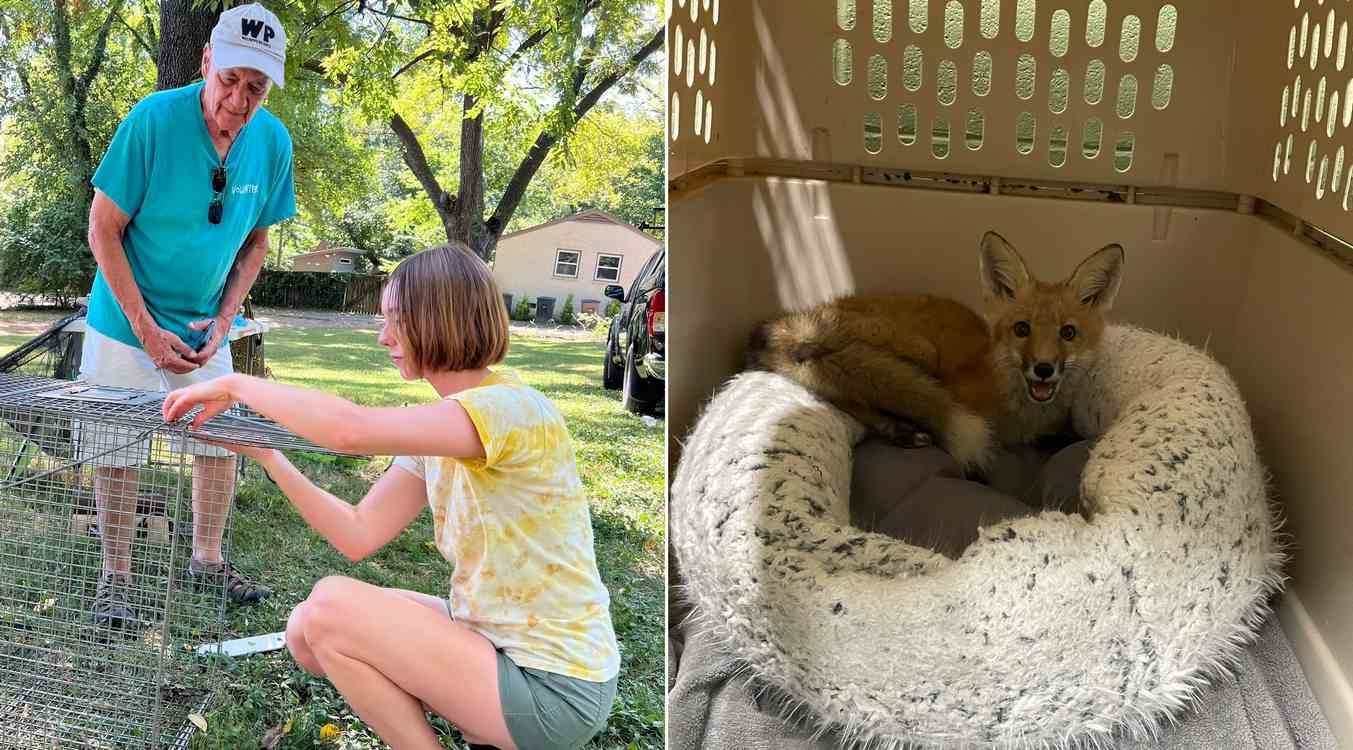
– credit, Jerry Vandiver, retrieved from Facebook
A Nashville singer-songwriter has become a star—but not because of his guitar playing.
Jerry Vandiver, whose songs have been recorded by country stars like Tim McGraw, moonlights as a volunteer hero to the local red fox population.
As Tennessee suffers from a serious mange epidemic, particularly bad in the area around Vandiver’s adopted home of Nashville, Vandiver has logged thousands of volunteer hours over the last 7 years baiting and trapping foxes before taking them into an animal rescue center.
Mange is not rabies; it doesn’t have to be fatal. Caused by skin mites and manifesting as persistent skin irritation and pain leading to hair loss, rashes, and scabs, it can kill foxes due to secondary infections and is highly contagious through physical contact.
Yet treatment for mange is rather straightforward. The problem is that usually, there isn’t a 78-year-old trapper with a heart of gold in the area who’s willing to wake up at any hour of the night to retrieve a fox trap from the woods and drive it half an hour to Walden’s Puddle Animal Rescue.
Coming to GNN via the Tennessean, Vandiver’s story is an inspiring reminder that beauty is more than just skin deep.
“I’m not the hero, I’m just the ambulance driver,” Vandiver told the paper. “Mange is treatable. If we can catch them, they can have a healthy, happy life. I know how to do that. I can’t walk away from them when I see those pictures.”
The pictures he’s referring to are the dozens he receives every month from concerned citizens of the Nashville suburbs who know that he’s the man to call if there’s a mangey fox in the area. But he wasn’t always the red fox first responder.
Moving to Nashville from his home state of Missouri, Jerry Vandiver built a career in the 1980s as a singer songwriter, with his tunes being recorded by the likes of Phil Vassar and Barbara Mandrell. He’s a Nashville country-scene staple, yet it was when he began to use his performing artist Facebook page as a place to post before-and-after videos of the foxes he would rescue that his star really began to shine.
The Tennessean reports that this change of tune saw his follower count grow from 325 to 5,000. Part of that is a sad story—the increasing number of foxes with mange—and so the increasing amount of content Vandiver was posting about it. In August, he logged 234 volunteer hours catching and driving foxes around. In the whole of 2025, Walden’s Puddle rehabilitated 44 red foxes. By September, they’ve already passed 60.
TENNESSEE TALES: Nashville Public Library Offers Free Digitization of Photos, VHS Tapes–Book Your Appointment Now
Part of this, the nonprofit believes, is a reduction in habitat pushing foxes into closer physical proximity to each other. A family of foxes, which can include a dominant male and female, their young, and even some distant relatives, is called a “leash.” They are family-oriented, and as such, require fairly substantial territories stretching several square miles.
Mange can quickly spread through a leash, and if multiple leashes need to overlap on a single territory because of suburban development, the risk is that much greater. Combined with ingestion of rat poison which can weaken immune systems, a leash faces a very great danger of being consumed by the disease.
Walden’s Puddle recommends to residents concerned for the foxes’ wellbeing to avoid using poisons or setting out food, and to tightly close garbage containers. Reliance on human settlements for food can draw multiple foxes together and risk spreading the disease faster than in the wild.
MORE HEROES TO THE ANIMALS: Couple Converts Their Home into ‘Hedgehog Haven’ to Rehabilitate Over 500 Spiky Critters
Vandiver monitors several areas around his house with trail cameras. If he sees a mange-stricken fox in the footage, he’ll set out a trap and bait. People all over Nashville will contact him on Facebook if they see a fox with mange, he told the Tennessean, and he finds it truly difficult to ignore the image of any fox suffering thusly.
A member at Walden’s Puddle said he puts “foxes before himself,” always; quite something at 78-years-old. Yet he loves the animals, and if the work ever becomes too much, he needs only see the “look back” after returning a fox into the woods to know it was worth it.
Though in his heart he knows it’s the fox checking to see if the perceived threat is pursuing them, he likes to think it’s a way of saying thank you.
WATCH Jerry in action below…
SHARE This Incredible Difference Maker In The Lives Of Tennessee’s Foxes…
