


How can sport contribute to the social inclusion, emotional resilience, and well-being of young people displaced by war?
Waves of Inclusion (WoI) is an Erasmus+ Small-Scale Collaborative Partnership in the field of Sport funded by the European Union that explores this question through an integrated approach combining water-based activities and mindfulness, and meaningful interaction between refugee and local youth.
The project brings together four organisations from Greece, Romania, and Poland: EULink, the National and Kapodistrian University of Athens (NKUA), Association Sport for All Suceava (AJSPT), and the Institute for the Development of Sport and Education (IRSIE).
The project focuses on Ukrainian refugee children aged 10-17, who may face disrupted education, loss of social networks, uncertainty, and difficulties developing a sense of belonging in their host communities. Rather than addressing physical activity, emotional well-being, and social inclusion separately, Waves of Inclusion brings these dimensions together through shared sporting experiences.
Over a six-month implementation period starting this September, 40 Ukrainian refugee youth and 40 local young people in Romania and Poland will participate in weekly water-based activities and regular mindfulness sessions.
Water-based activities can provide opportunities to develop confidence, teamwork, trust, physical resilience, and positive social interaction, while mindfulness activities support self-awareness, emotional regulation, stress management, and resilience. By bringing refugee and local young people together in mixed groups, the project places inclusion at the center of the activity itself, creating opportunities for friendship, intercultural dialogue, and mutual understanding.
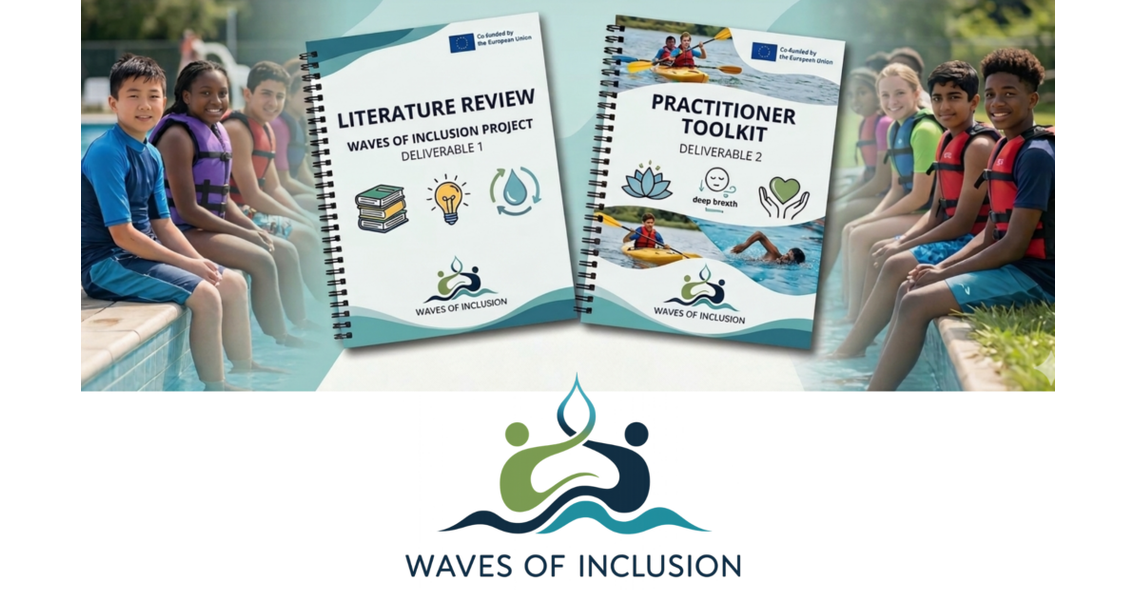
An important part of the project is ensuring that practice is grounded in evidence. Two key resources have already been developed:
- Literature Review: The review examines existing evidence on the role of water-based physical activity in supporting the well-being of displaced and vulnerable youth, alongside the contribution of mindfulness to emotional resilience and self-regulation among adolescents. It provides the evidence base underpinning the project methodology.
- Practitioner Toolkit: The Toolkit translates this evidence into practical resources for trainers and facilitators. It includes activity proposals, mindfulness exercises, session plans, facilitation guidance, and recommendations for adapting activities to participants with different backgrounds, experiences, confidence levels, and needs.
The resources are designed not as a fixed program, but as flexible tools that can support practitioners in creating safe, inclusive, and meaningful opportunities for participation.
We warmly invite professionals across the Sport community, whether working in youth sport, refugee support, adapted physical activity, mindfulness, education, or community development, to explore these resources and connect with us as we continue building more inclusive and supportive environments for young people across Europe.
You can read more and access the resources here: https://eulink.gr/waves-of-inclusion-first-two-key-deliverables-published-introducing-the-literature-review-and-practitioner-toolkit/
The Waves of Inclusion project aims to demonstrate how sport can go beyond physical activity and become a practical vehicle for connection, participation, resilience, and social inclusion.
📲 Follow Waves of Inclusion on Facebook to keep updated on project activities, resources, and results: Waves of Inclusion on Facebook
Funded by the European Union. Views and opinions expressed are however those of the author(s) only and do not necessarily reflect those of the European Union or the European Education and Culture Executive Agency (EACEA). Neither the European Union nor the EACEA can be held responsible for them.
