


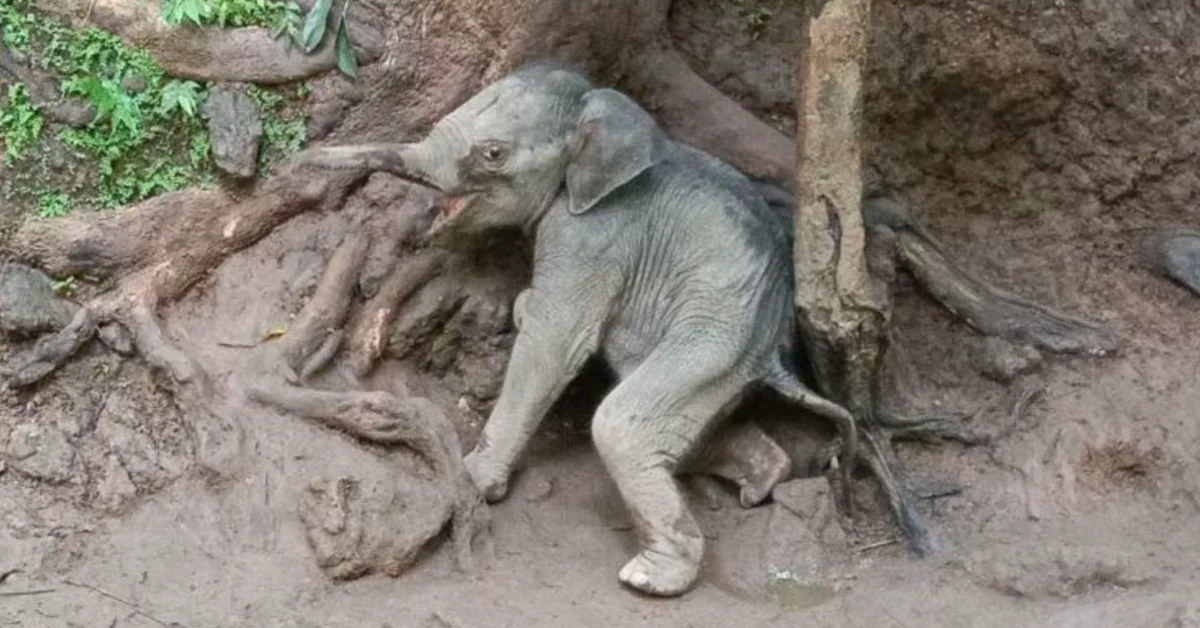
On July 30, locals in Kanchanaburi, Thailand reported sightings of a wild baby elephant that had been separated from its herd in Sai Yok National Park.
The same day, park rangers sprang into action and found the Indian elephant calf along the Huai Mae Nam Noi riverbank in critical condition.
“I have received the report about the lost wild elephant calf and am very concerned about its condition because it is still very young and is in a critical state,” Suchart Chomklin, Minister of Natural Resources and Environment, said in a statement.
Officials believe that the baby elephant may have been swept downstream from its herd due to storms and strong currents. When the rangers found it, the calf was severely dehydrated and weakened, leading the rangers to estimate that it had been stranded there for about two days.
Indian elephants are known to roam near freshwater sources so that they can drink 150 to 200 liters a day.
Thailand’s Department of National Parks, Wildlife and Plant Conservation Department
The average Indian elephant weighs roughly 11,000 pounds. The baby elephant was only 88 pounds, putting its age at around two weeks old.
Like all species of elephants, the Indian elephant is listed as endangered by the International Union for Conservation of Nature.
In recent decades, Thailand has joined other South Asian countries in constructing wildlife crossings to prevent traffic collisions.
The government has also increasingly invested in GPS tracking, camera trap monitoring, and drone surveillance to combat poaching and better monitor vulnerable populations.
When a young animal is found in the wild, experts typically wait to see if reunification is possible. On July 30, the Sai Yok National Park rangers stayed overnight near the calf’s side to see if its herd would return.
Thailand’s Department of National Parks, Wildlife and Plant Conservation Department
When the calf’s cries went unanswered, the rangers knew they had to intervene for its safety.
The elephant was then transferred to Sai Yok National Park headquarters for medical treatment, where it has been under around-the-clock care for dehydration, malnourishment, and wounds and abrasions on its trunk and mouth.
At the time of publication, the baby elephant was in stable condition under close monitoring in a temporary enclosure.
“I would like to offer my encouragement and thanks to every officer and member of the veterinary team who has made sacrifices and devoted their efforts to reach the calf through the rain and strong currents and provide it with the fullest possible care,” Chomklin said on August 2.
“I have also instructed the Department of National Parks, Wildlife, and Plant Conservation to mobilize specialist veterinarians to closely oversee every stage of its treatment so that the calf remains safe and its condition improves as soon as possible.”
Thailand’s Department of National Parks, Wildlife and Plant Conservation Department
You may also like: When leopard cubs get separated from their mother, these wildlife experts step in with ‘overnight boxes.’ They’ve saved over 100 cubs
Featured Image: Courtesy of Thailand’s Protected Area Regional Office 3
