


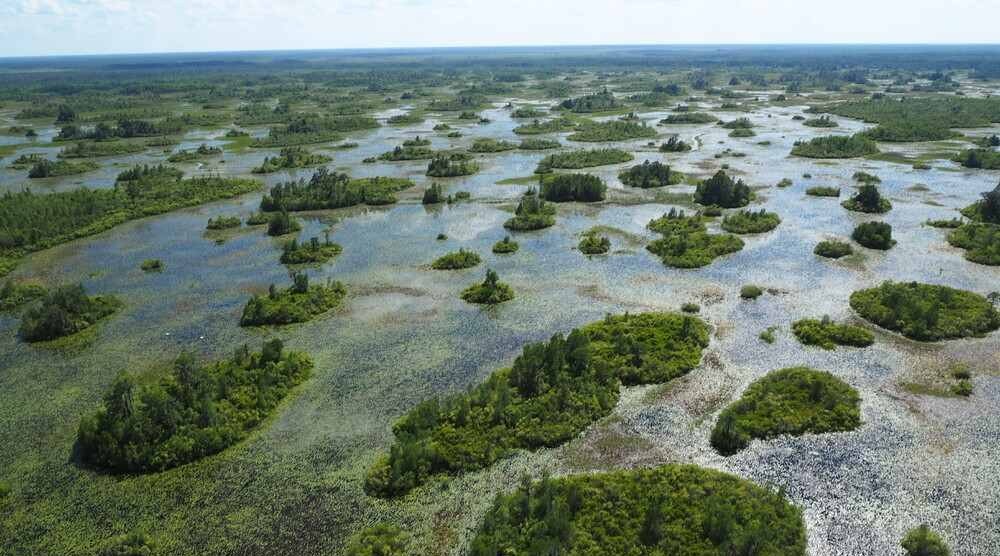
Okefenokee terrain – credit, public domain, via UNESCO
Georgia’s Okefenokee Swamp is the latest wild wonder of the USA to make UNESCO’s hallowed World Heritage Site list.
It joins the Grand Canyon, Sequoia, Everglades, and Yellowstone national Parks on the same list, and reflects the stunning biodiversity of American “blackwater” swamps.
Most of the Okefenokee Swamp is included in the 403,000-acre (163,000 hectare) Okefenokee National Wildlife Refuge, the most-visited NWR east of the Mississippi.
Conservation in the swamp dates all the way back to 1918, by which time 1 million cubic meters of timber had already been logged. The federal government acquired most of the swamp for refuge purposes in 1936, and designated it an NWR a year later.
It would go on to collect the designations of Federal Wilderness and Wetland of International Importance under RAMSAR, before the Georgia organ of the National Parks Service announced in 2023 it would be nominated to be the state’s first ever prospective entry on UNESCO’s World Heritage List.
Okefenokee Swamp is the largest, lowland, freshwater peatland in the subtropical zone worldwide, and one of the largest and most intact ecosystems within the North American Coastal Plain global biodiversity hotspot.
The UNESCO Natural Heritage Site area comprises a diverse mosaic of wetlands, savannahs, and forests, including significant areas of endangered longleaf pine (Pinus palustris) of which less than 3% remains, supporting high concentrations of plant species endemic to the region.
An American alligator in Okefenokee – credit, public domain, via UNESCO
Its extensive peat deposits provide an important archive of paleo-environmental history and critical carbon storage. The property supports exceptional biodiversity as well, including at least 856 plant species, 48 mammal species, 238 bird species, 39 fish species, and 90 reptile and amphibian species, and provides important habitat for migratory birds, threatened species, a significant population of American alligators, and a truly noteworthy diversity of carnivorous plants.
OTHER NEW UNESCO HERITAGE SITES: Little Known Ancient Site in Ohio Crowned by UNESCO–for Incredible Alignment with Moon and Sun
Shaped by the ongoing interaction of water, fire, vegetation, and wildlife, with alternating fire and rainfall processes driving peat formation, vegetation structure, and biodiversity, a 20-to-30-year cycle of drought and fire has allowed the Okefenokee to exist as the unique wetland it is.
SHARE This International Recognition Of America’s Beautiful Swamps…
