


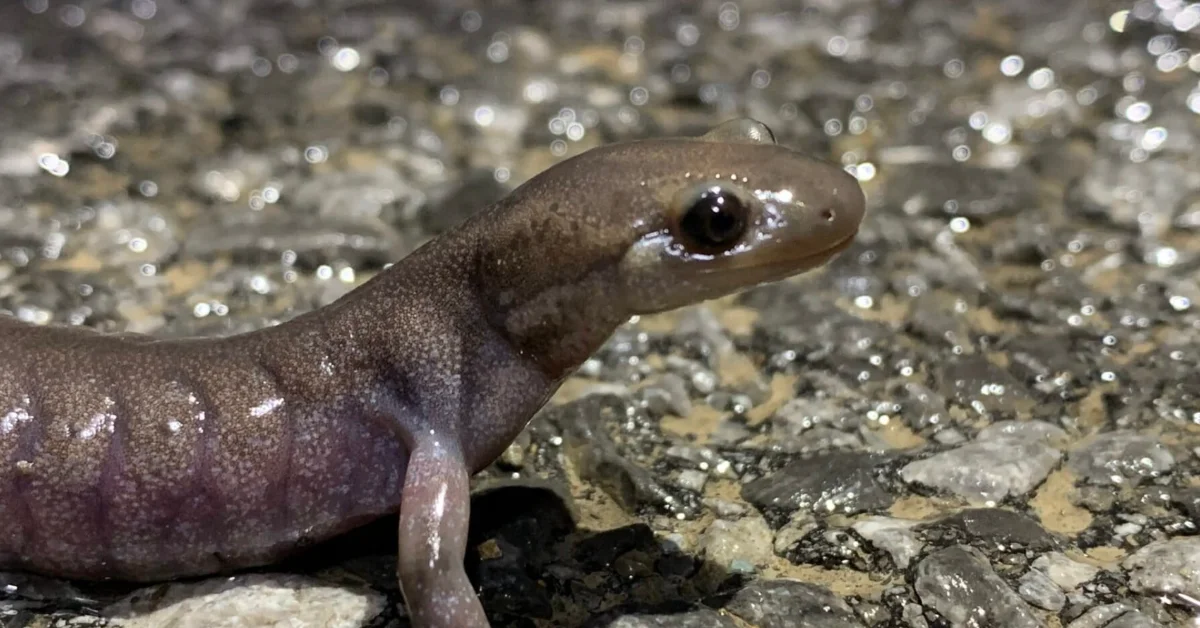
- In the small U.S. city of Keene, New Hampshire, plans are underway to build small underpasses to help amphibians safely cross a road, including hybrid Jefferson/blue-spotted salamanders, an imperiled species complex.
- In the neighboring state of Vermont, salamander crossings constructed in 2015 have reduced the number of amphibian deaths at that site by 80%.
- Habitat connectivity is crucial: Animals need to move to find water and food, to mate or to escape extreme, climate-change-driven weather events.
- With growing human populations, wild lands are increasingly fragmented and relinking habitat with wildlife crossings has become an important conservation tool.
NEW HAMPSHIRE, U.S. — It’s a mild March night in Keene, New Hampshire, and the salamander brigade is out in full force.
A constellation of flashlight beams wink and flash along a dark street, as rain falls onto the jackets and reflective vests of the assembled crew. Tonight, a veritable army of amphibians is trekking from the upland forests, where they spend the winter, toward the wetlands where they breed. In their path lies a two-lane asphalt road, North Lincoln Street.
Animals need to move for a variety of reasons, but in a world crosshatched by motorways, that’s not an easy task.
Each spring in Keene, wood frogs (Lithobates sylvaticus), spring peepers (Pseudacris crucifer), red-backed salamanders (Plethodon cinereus), and spotted salamanders (Ambystoma maculatum) must navigate roads to reach their natal spawning grounds.
This particular road in Keene is routinely closed to cars during nights of amphibian migration. At other crossing sites in the region, volunteers are the only thing standing between these slow-moving critters and the danger posed by passing traffic. Carrying animals across the road by hand gets the job done, but it’s limited by human availability and energy.
The hope has always been that “crossing brigades are the first step, not the last step,” said Brett Amy Thelen, who organizes these efforts and serves as science director for the Harris Center for Conservation Education, a regional nonprofit.
That hope is being realized: Thelen and her salamander squadron are at the center of a new initiative to build small tunnels under Jordan Road, a crossing site in Keene known for Jefferson complex salamanders, a hybrid combination of Jefferson (Ambystoma jeffersonianum) and blue-spotted salamanders (Ambystoma laterale), which are classified by the state as most in need of conservation.
These underpasses will grant safe passage to amphibians without closing the road or relying on hand-carrying by volunteers. In the U.S. and across the globe, crossing structures are an increasingly prevalent and effective way to reconnect fractured wildlife habitat.
“Just like we need to go to the grocery store or the doctor . . . animals have the equivalent,” Thelen said.
“They need to be able to move across the landscape to find food, to access different habitat at different times of year. Even when there’s conserved land on both sides of a road, roads interrupt that ability to move across the landscape. They create a barrier.”
A Jefferson complex salamander crosses a road in Keene, New Hampshire, in March 2026. Courtesy of Brett Amy Thelen/Harris Center for Conservation Education
Amphibians at risk
In terms of challenges facing New England amphibians, “road impacts and fragmentation are overwhelmingly number one,” said Bryan Windmiller, former director of field conservation at Zoo New England.
But they also pose a major threat to wildlife the world over.
“Habitat destruction and fragmentation … are the primary threats to most amphibian species who’ve become rare or endangered largely because of human action,” he said.
While these threats aren’t likely to wipe out amphibians in New England, they will continue to decimate important populations locally and limit amphibians’ ability to recover from past losses, Windmiller said.
Wildlife crossings help animals escape that fate. Once completed, Thelen said the project in Keene, which is still in the design phase, will feature fencing along both sides of the road to guide amphibians into two, or possibly three, underpasses.
Thelen hopes construction will begin in the summer or fall of next year, in time for the tunnels to be fully open for the amphibians’ spring migration in 2028.
The location was chosen when the New Hampshire Fish and Game Department asked the Harris Center about potential sites “with an at-risk species and significant enough numbers to make this meaningful,” Thelen said. Jordan Road was the only Harris Center site with a significant number of Jefferson complex salamanders.
Spotted salamanders enter an amphibian tunnel in Monkton, Vermont. Courtesy of Chris Slesar/Vermont Agency of Transportation
This year, the salamander brigades counted 108 Jefferson complex salamanders at Jordan Road, nearly double their previous record for a season. Thelen isn’t sure why the numbers were up so much but said warm March temperatures and more volunteers than usual could have played a role.
The underpass project is a partnership between the Harris Center, the city of Keene, and the state wildlife agency. It’s funded by a grant from the National Fish and Wildlife Foundation that’s also supporting turtle crossing projects elsewhere in New Hampshire, Thelen said.
Other parts of New England have also embraced wildlife crossings. Roughly 100 miles northwest of Keene, the town of Monkton, Vermont built a pair of underpasses in 2015 that reduced amphibian deaths on Monkton Road by 80%, according to a study published last year.
The entrance to an amphibian tunnel in Monkton, Vermont, during construction. Courtesy of Chris Slesar/Vermont Agency of Transportation
Monkton also chose its tunnel location, in part, to protect Jefferson complex salamanders, said Chris Slesar, the environmental resources coordinator at the Vermont Agency of Transportation.
High amphibian diversity and big numbers also contributed, he said. In 2006, more than 1,000 amphibians were killed trying to cross the two-lane road in just two nights.
Monkton offers an example of how animals can avail themselves of tunnels designed for smaller creatures. Their underpasses are box-shaped, measuring 5 feet wide with varying height; a person could crawl through one and crouch to get through the other, Slesar said.
“Our target species were the amphibians, but we sold [the Monkton project] as a wildlife crossing in the hope that small to medium-size mammals would use it, too, and they sure do,” he said.
“We have thousands of pictures of mice and squirrels and small mammals [using it]. We’ve got bobcat going through it, ermine. We even have bear, which was a surprise.”
A global movement toward reconnection
Since the French built the first wildlife crossings for deer in the 1950s, the concept has gained traction across the globe, including in the U.S.: Colorado built one of the largest wildlife overpasses on the planet near the town of Greenland, and California is set to open a behemoth bridge, the Wallis Annenberg Wildlife Crossing, over the 10-lane 101 Freeway in December.
Conservationists and biologists once thought that creating a park or sanctuary was the way to protect wildlife, said Beth Pratt, president and CEO of the nonprofit Wildlife Crossing Fund. But in the 1990s, scientists began to understand that isolated reserves weren’t enough.
“We follow the science, and the science shows us we were wrong,” Pratt said. “This large landscape connectivity — the need for it reverberates up and down the food chain, throughout all species — even [species] that don’t move, like plants. It is essential to life that landscapes be fluid and connected.”
The status of road ecology has evolved, Slesar said, from a fringe discipline in the early 2000s to what is increasingly becoming a mainstream consideration for transportation departments across the U.S. And worldwide, countries, cities, and towns are incorporating wildlife movement in the construction of new roadways — and retrofitting existing bridges, culverts, and tunnels.
A wood frog crosses a street in Keene, New Hampshire, in March 2026. Courtesy of Brett Amy Thelen/Harris Center for Conservation Education
While science has evolved a broader, landscape-scale perspective on conservation, the concept isn’t widely known or understood by the public: Roadkill is a normal sight on roadways.
Windmiller hopes that public opinion on the impact of roads is evolving.
Today, many people look back on activities like 19th century whaling with “a fair degree of horror,” he said.
He said he hopes that someday “we look back at an era in which millions and millions of animals killed on our roads every year was just normal and accepted … with some of the same kind of horror, because we’ll have found ways that allow us to move from points A to B to C without slaughtering so many animals along the way.”
This article was originally published on Mongabay.
Featured Image: Elizabeth Axley/iNaturalist (CC BY 4.0)
