


This story was originally published by Grist. Sign up for Grist’s weekly newsletter.
Nearly two years ago, Hurricane Helene knocked out power in Burnsville, North Carolina. Fire Chief Niles Howell had to use the station’s generator to keep everything running. Through the storm, and the devastating flooding that followed, the fire department provided a landing pad for helicopters, a base for search-and-rescue operations, and a field hospital to triage and treat the wounded.
But even in less trying times, Howell can’t risk another blackout. The station is a community hub for the small town, and Howell regularly worries about running out of fuel for the generator.
He can stop worrying. The fire department will soon install 40 kilowatt-hours of solar panels and double that amount of battery storage as part of a statewide microgrid project targeted at communities recovering from Helene.
“I love redundancy, because inevitably what you plan for will fail at some point in time, so the more avenues you have to keep things going, the better off you are,” Howell said.
A growing number of organizations and even states are reaching the same conclusion. With the Appalachian mountains repeatedly battered by extreme rain and flash flooding in recent years, small-scale energy resilience projects are catching on. Many recent developments are popping up along the path Helene tore through western North Carolina.
The state Department of Environmental Quality invested $5 million in 26 microgrid projects last August, in partnership with a coalition of nonprofits dedicated to the expansion of sustainable energy. The goal is to build 24 stationary microgrids and two mobile ones, with five sites announced in June.
This mirrors similar projects in storm-battered communities across the United States and its territories. Private and nonprofit microgrid networks have helped keep Puerto Rican communities electrified through increasingly violent hurricanes and an aging grid prone to frequent blackouts. Hurricane Ida prompted churches and community centers in New Orleans to launch a string of privately funded “lighthouses.”
Solar microgrids, in short, are capable of powering one or more buildings, and some of them can also send electricity to the grid. They often feature large batteries designed to store energy to keep power going for days without sunshine. Stationary microgrids, which, as the name suggests, remain in one place, are found throughout the country, sometimes powering essential infrastructure like hospitals and wastewater treatment plants.
One system operated by Duke Energy powers all of Hot Springs, North Carolina, and kept the lights on during Helene. Others are mobile and can be wheeled to wherever they’re needed. The technology is expensive, and all but one of the five stationary microgrids slated for western North Carolina will cost over $100,000, a burden a small community organization would struggle to bear on its own.
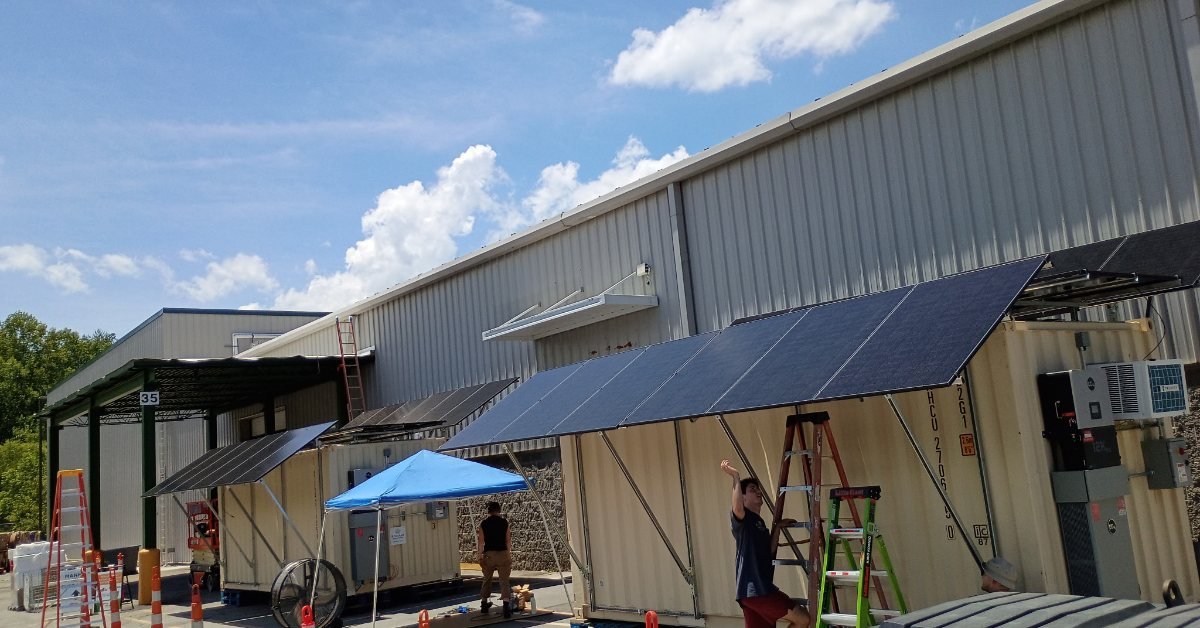
The small, portable, trailer-mounted systems, which the renewable energy advocates at the nonprofit Footprint Project call “beehives,” feature batteries and work in sunny and cloudy weather alike. “Cooler bees” include fridges and freezers for medications and food, “power bees” provide charging stations for phones and other devices, and “water bees” filter water. “Because they are mobile, these bees can be towed immediately to communities hardest hit in disasters,” said Footprint Project CEO Will Heegaard.
These “bees” provide up to 100 kilowatt-hours of energy, and could power a large building for up to 10 hours. The Footprint Project is prioritizing installing them outside food banks, fire stations, community centers, and libraries, all of which can store supplies and serve as a hub of community operations during a disaster.
Two mobile solar power trailers will be ready to deploy in 2027, and installations at five of the planned stationary sites will begin this summer. Sara Nichols of the economic development group Land of Sky Regional Council said she hopes this project can demonstrate that a combination of philanthropic and public funding can support small-scale renewables, even when federal changes have reduced the accessibility of solar for many.
“We are essentially setting the model and the precedent for what we hope will be a much bigger statewide and national project to duplicate,” Nichols said.
Reid Wilson, who leads the Department of Environmental Quality, is already talking with potential partners around the state about using small-scale solar to build out local climate resiliency throughout North Carolina, though nothing official has come of it yet. Federal funding could one day help, he hopes, but he isn’t going to hedge all his bets on it. Governor Josh Stein asked the General Assembly to include $1 million for microgrids in his $792 million request for Helene relief funding. It didn’t make the cut.
Featured Image: Courtesy of The Footprint Project
Written by Katie Myers for Grist
