


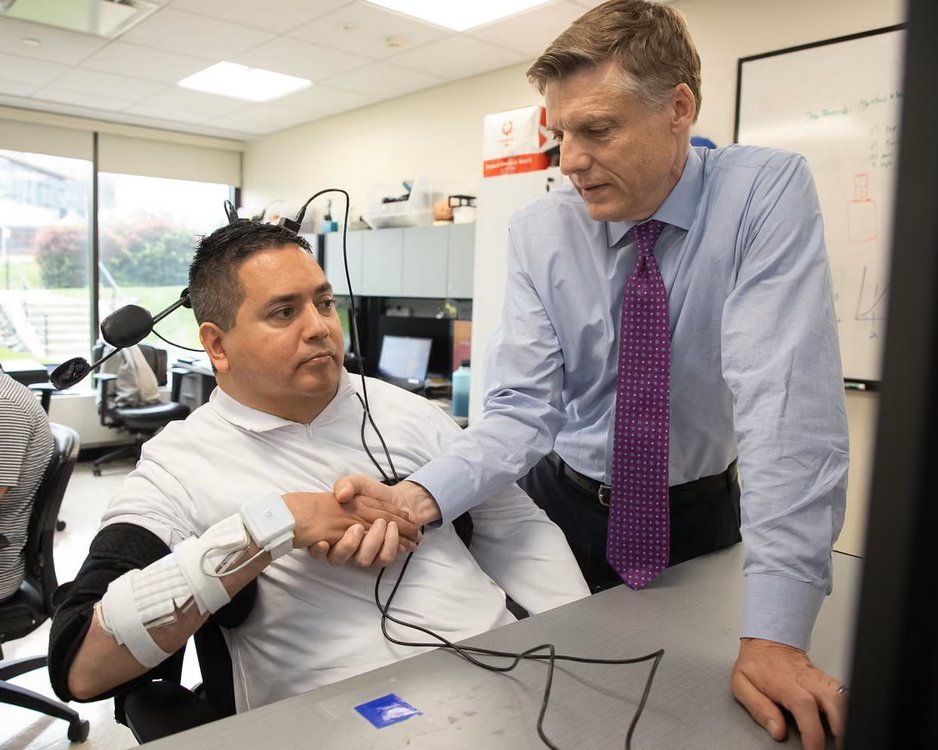
Keith Thomas (left) and Professor Chad Bouton (right) – credit, Feinstein Insitutes, released
A man who was paralyzed from the chest down is now regaining hand and arm control thanks to a double neural bypass surgery—by using a computer to connect his brain with the nerves in his hand and arms.
Hardly doomed to becoming a wheeled internet node for the rest of his life, the man has continued to regain feeling and function that persists even when the computer is turned off.
The result speaks volumes about the potential for this technology to improve the lives of those suffering from paralysis in the US and abroad.
Such hope and progress unfortunately begins with tragedy and loss, in a very familiar way.
Keith Thomas from Massapequa was just hanging out next to the pool during the summer of 2020, when he decided to dive in “aggressively as usual.” The next thing he knew, he was in a helicopter being transported to the hospital.
Just 3 months after breaking his neck at the bottom of the swimming pool, Thomas was contacted by the Feinstein Institutes for Medical Research asking if he were interested in enrolling in a 3-year medical trial for what they called double neural bypass surgery, with the paralyzed nervous system between the brain and the arms being that which is bypassed.
It uses electrodes implanted into Thomas’ brain to detect when he wants to move his arms. The signals are then routed to his arms and hands to move them. The “double” part refers to sensors embedded in his fingers which detect the presence and form of objects in his hands, performing another transfer of information to the brain via the electrodes.
Not only does it allow Thomas to move his arms and hands, feel the fur of his dog or the touch of his sister’s hands, but detect whether he’s holding a ball, a coffee cup, or an egg, and adjust pressure and control accordingly.
Training with the system for 35 weeks, the strength in his atrophied arms has increased: 86% in his right arm and 62% in his left, while also experiencing an increase in his range of motion. Having previously not been able to lift his hand above his neck, he can now scratch his nose and wipe his mouth. The progress was recently presented in a paper published in Nature.
ADVANCES IN REVERSING PARALYSIS:
“For me this is an incredible moment,” said Professor Chad Bouton, leader of the team at Feinstein that developed the technology.
“For years, we have been wanting to really tackle the restoration of movement and the sense of touch and bring those together and we’ve also wanted to create lasting effects,” Bouton said in a video release. “I think we’re going to continue to see progress and I think it’ll be applicable to the millions of folks around the world who really need this technology.”
An interesting thing about the technological ensemble restoring Thomas’ capabilities of touch and movement is that it’s unclear just how much more he’ll be able to recover. Where will he be after another 35 weeks?
WATCH the story below…
SHARE This Wonderful Turn Of Fortune For A Man Unable To Touch The World Around Him…
