


Introduction
The exit of US service members from Afghanistan in the summer of 2021 culminated in the drawdown of the Global War on Terrorism (GWOT), a military conflict that evolved into the longest war in American history.1 Operation Allies Refuge, a mission supported by several thousand rapidly deployed US troops and the US State Department, was charged with evacuating international personnel and Afghan nationals in response to the deteriorating humanitarian situation in the capital city of Kabul.2 3 The task force also included US and allied military surgical units located at two medical facilities at the Hamid Karzai International Airport (HKIA) in Kabul. Before the final departure of US service members and evacuees from Afghanistan, a suicide bombing at Abbey Gate triggered a mass casualty incident. This resulted in hundreds of casualties with complex blast, penetrating, and multisystem traumatic injuries.4
The surgical teams deployed at HKIA delivered care during the event under significant logistical and operational constraints, including equipment and supply limitations, deteriorating security conditions, and a rapidly evolving humanitarian crisis at the airport, which also complicated the aeromedical evacuation chain.5 The critically ill and injured patients sustained at HKIA were treated initially and then medically evacuated from Afghanistan via US Transportation Command and Critical Care Air Transport Teams (CCATT) to Landstuhl Regional Medical Center, Germany, and then ultimately back to the continental US, where they reached Walter Reed National Military Medical Center (WRNMMC) in Bethesda, Maryland, for definitive surgical care.
Walter Reed has re-verified as an ACS level 2 trauma center and serves as the principal combat casualty care reception military treatment facility (MTF) within the Military Health System (MHS). Throughout the GWOT, WRNMMC served as the primary destination for definitive surgical care, rehabilitation, and functional restoration for combat-injured service members. Colloquially designated as the ‘Flagship’ of the MHS by military medical leaders, WRNMMC is a 250-bed academic-tertiary care center with trauma, general, and complex subspecialty surgical support (ie, orthopedics, neurosurgery, plastic, otolaryngology) that has consistently maintained the capability to receive acutely injured casualties from overseas theaters of operation within 48 hours of wounding.6 During periods of high operational tempo, such as the mid-2000s surge, WRNMMC functioned as a vital link in the continuum of military trauma care, prepared to manage the full spectrum of combat injuries. Overall, during GWOT, WRNMMC and its legacy institutions, the National Naval Medical Center (NNMC) and Walter Reed Army Medical Center, treated over 10,000 combat casualties returning from overseas.
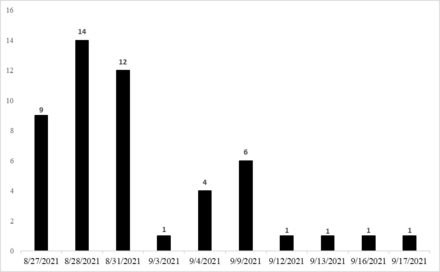
This same posture of readiness was evident during the evacuation from HKIA, when WRNMMC once again mobilized to receive and manage a sudden influx of severely injured casualties.7 Although the overall volume of combat casualties had steadily declined in the later years of GWOT, culminating in a prolonged period of reduced operational trauma, depicting the nadir in the ‘Walker Dip’, the HKIA incident represented the highest volume of combat casualties received at WRNMMC in over a decade.8
All casualties transferred to WRNMMC had undergone damage control resuscitation and initial operative management at HKIA or LRMC and had survived at least 48 hours before arrival. Accordingly, WRNMMC functioned primarily as the tertiary referral center, providing definitive and reconstructive surgical care, critical care, and coordinated multidisciplinary management following initial stabilization. The majority of injuries seen at WRNMMC from HKIA were the result of complex blast mechanisms and high-velocity weapons, rarely, if ever, encountered in civilian trauma centers.
For context, large-scale civilian mass-casualty incidents have demonstrated substantially higher immediate operative demand at receiving centers, including the 2017 mass shooting in Las Vegas, the 2013 Boston Marathon bombing, and the 2016 attack at the Pulse Nightclub.9–11 In contrast, the clinical workload at WRNMMC was dominated by definitive surgical management and longitudinal recovery following prior life-saving and limb-saving interventions.
Likewise, although the foreign national status of the evacuated Afghan patients did not substantially alter operative or clinical decision-making, it introduced additional disposition, repatriation, and interagency coordination requirements, increasing care-coordination complexity beyond that typically encountered in civilian trauma centers managing domestic mass-casualty events. Notably, however, it was the first time WRNMMC was required to simultaneously deliver multidisciplinary care to US service members and to evacuated foreign nationals flown to the US from another country, a demand no US military or civilian hospital had previously faced.
The medical response to the HKIA attack occurred within the context of a mature, globally integrated military trauma system that had been refined over two decades of sustained combat operations.12 Rather than representing a singular stress test of the MHS, the HKIA response demonstrated the continued adaptability and resilience of an established continuum of care operating during a period of force and infrastructure drawdown, when in-theater evacuation networks were reduced and fixed facilities were no longer operational.
Care of the wounded relied on coordinated performance across multiple echelons, including forward surgical teams, aeromedical evacuation, CCATT, and Landstuhl Regional Medical Center, before transfer to stateside definitive care at WRNMMC.13 This distributed, multinational response highlights the effectiveness of a global trauma system capable of sustaining coordinated care across several continents despite constrained theater resources.
Within this broader system, WRNMMC served as the principal stateside tertiary referral and definitive care center during the evacuation surge. Its role was essential in receiving stabilized casualties and providing complex surgical and multidisciplinary care; however, this capability depended on the successful performance and integration of the full trauma system before arrival. The HKIA experience, therefore, reinforces the importance of preserving WRNMMC’s advanced clinical and operational readiness and simultaneously underscores that military trauma readiness is inherently system-dependent and contingent on sustained interoperability, coordination, and capacity across the entire joint and coalition continuum of care.
Recognizing HKIA’s operational and clinical significance, a deliberate effort was made to systematically review and extract lessons from WRNMMC’s response. HKIA served as a real-time surge of military trauma protocols, multidisciplinary coordination, and system-level resilience. A structured quality assurance (QA) and process improvement (PI) initiative was undertaken to formally assess patient-level outcomes and system-wide functionality during this mass casualty event.
As part of this PI initiative, we descriptively analyzed the outcomes of casualties from HKIA who arrived at WRNMMC for definitive surgical care. The analysis sought to evaluate the effectiveness of surgical and critical care services provided to HKIA casualties and assessing the system’s overall readiness and adaptability to a large-scale casualty surge. This comprehensive approach ensured not only the evaluation of patient outcomes but also the enhancement of WRNMMC’s readiness for future surge events and the institutionalization of lessons learned. This manuscript aims to serve as a critical bridge between past experience and future readiness, ensuring that the hard-won lessons from GWOT and HKIA are preserved, applied, and used to strengthen the MHS’s preparedness for future combat casualty care demands.
