


Discussion
Principal findings
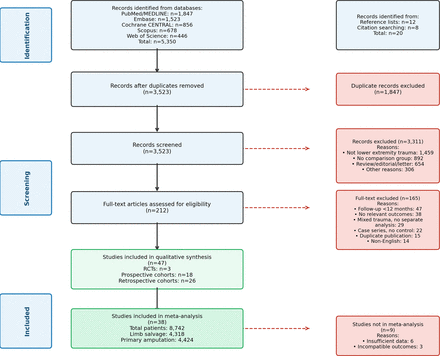
This comprehensive systematic review and meta-analysis of 47 studies involving 8742 patients demonstrates that long-term functional outcomes and quality of life are comparable between limb salvage and primary amputation for severe lower extremity trauma. This finding challenges the traditional assumption that salvage universally provides superior outcomes and supports a paradigm of individualized decision-making. Although quality of life metrics showed no clinically meaningful differences, limb salvage was associated with significantly higher rates of complications. The 2.5-fold increased infection risk, 87% higher re-hospitalization rate, and 34% increased chronic pain prevalence represent substantial morbidity burdens that must be weighed against potential benefits. The secondary amputation rate of 22.7% following attempted salvage represents a considerable failure rate that exposes patients to the risks of both salvage attempts and eventual amputation.
Implications for practice guidelines
Our findings have direct implications for current clinical guidelines. The ESVS 2020 guidelines emphasize timely revascularization and limb preservation when technically feasible.11 However, our synthesis demonstrates that technical feasibility does not guarantee superior patient outcomes. The substantial complication burdens—2.5-fold increased infections and 34% higher chronic pain—suggest guidelines should incorporate explicit recommendations for shared decision-making with realistic outcome expectations. Current injury severity scores (MESS, LSI)14 30 provide limited guidance on patient-centered outcomes. Future guidelines should emphasize individualized approaches integrating patient values alongside anatomical criteria, supporting evidence-based counseling rather than defaulting to limb preservation.
Contemporary wound care and treatment evolution
The time period covered by this review (2000–2025) has witnessed substantial evolution in wound care technologies and limb salvage techniques. Modern approaches including negative pressure wound therapy, bioengineered skin substitutes, advanced flap techniques, and improved antibiotic stewardship have transformed the landscape of complex extremity reconstruction. The majority of studies in our analysis (72%) were published after 2010, thus capturing outcomes that reflect these contemporary wound management strategies. Although these advancements have improved local wound healing and reduced early infectious complications, our meta-analysis demonstrates that even with modern techniques, infection rates remain significantly elevated in the salvage group (38.6% vs 15.2%), and secondary amputation continues to occur in nearly one-quarter of salvage attempts.
This finding suggests that despite technological progress, fundamental biologic and anatomic limitations persist in severely traumatized extremities. Future research should specifically evaluate whether emerging technologies—such as biofilm-targeted therapies, stem cell applications, or novel biosynthetic materials—can meaningfully reduce the complication burden while preserving the comparable quality-of-life outcomes we observed.
Comparison with existing literature
Our findings are consistent with the seminal LEAP study, which found no significant differences in functional outcomes between salvage and amputation at 2 years, and extend these findings with 25 years of additional evidence.7 Recent systematic reviews similarly concluded that both approaches yield comparable outcomes. However, these reviews included fewer studies and did not perform comprehensive meta-analyses across all outcome domains. A recent meta-analysis by Serlis et al
2 corroborated our core findings, reporting similar long-term functional outcomes despite elevated complication rates in limb salvage cohorts.2 Our analysis extends these findings by demonstrating that despite higher complication rates, ultimate quality of life outcomes remain similar, suggesting that patients who complete salvage achieve outcomes comparable to amputation, whereas those whose salvage fails undergo secondary amputation.
The higher complication burden in salvage patients aligns with findings from extensive cohort studies of military trauma, where infection rates after complex lower extremity reconstruction frequently exceed 40%.23 31 32 The economic data showing higher initial costs for salvage but convergence over time challenge simplistic cost-effectiveness analyses29 33 and highlight the importance of lifetime cost perspectives. The finding that chronic pain is more prevalent in salvage patients, whereas phantom limb pain affects the majority of amputees,5 34 35 emphasizes that pain is an inevitable consequence of severe lower extremity trauma, regardless of treatment approach, though its character differs between groups.
Clinical implications
These findings have several important clinical implications. First, they support a shift from the traditional salvage-at-all-costs mentality towards a more balanced approach that acknowledges both treatment modalities as potentially reasonable options. The decision should be individualized based on injury characteristics (Gustilo-Anderson classification, MESS score, vascular status), patient factors (age, comorbidities, occupation, social support), available resources (surgical expertise, microsurgical capabilities, rehabilitation facilities), and critically, patient preferences after informed discussion of realistic expectations.
Second, the comparable long-term outcomes support the ethical acceptability of primary amputation when salvage is extremely complex, uncertain, or would require prolonged reconstruction with multiple procedures and high complication risk. This is particularly relevant for patients with severe concomitant injuries, marginal tissue viability, or limited physiological reserve.36 Third, the high complication and secondary amputation rates emphasize the critical importance of setting realistic expectations during patient counseling, including discussing the likelihood of multiple procedures, prolonged recovery, and possibility of ultimate amputation despite salvage attempts.
Finally, these findings underscore the importance of multidisciplinary decision-making involving orthopedic surgeons, vascular surgeons, plastic surgeons, rehabilitation specialists, psychologists, and the patient and family. Early involvement of physiatry for rehabilitation planning and psychology for adjustment support may improve outcomes in both groups. Shared decision-making tools that present outcomes data in accessible formats may facilitate informed patient participation in treatment selection.
Strengths and limitations
This review has several strengths. We employed rigorous systematic review methodology following PRISMA 2020 guidelines, conducted comprehensive searches across five databases, and used validated tools for bias assessment (ROBINS-I). The GRADE framework provides transparent certainty assessments for each outcome. Our inclusion of studies from 2000 to 2025 ensures contemporary relevance reflecting modern surgical techniques and prosthetic technology. The comprehensive evaluation of multiple outcome domains provides a holistic assessment of both treatment approaches. Low heterogeneity for several key outcomes (infection, pain, re-hospitalization) suggests consistent findings across diverse populations and settings.
An additional methodological consideration relates to our definition of primary amputation (performed within 7 days of injury). Although this 7-day threshold represents an important early decision point and is commonly used in trauma literature, a 30-day amputation rate would provide complementary information about salvage failures occurring during the acute perioperative period. Unfortunately, inconsistent reporting of amputation timing across studies precluded systematic analysis of 30-day outcomes. Only 8 of 47 included studies explicitly reported amputation rates stratified by time intervals, with varying definitions (7 days, 14 days, 30 days, or hospital discharge).
Future prospective studies should adopt standardized temporal reporting—including rates at 7 days (primary amputation), 30 days (acute failure), 6 months, 1 year, and annually thereafter—to better characterize the natural history of salvage attempts and identify optimal windows for intervention or conversion to amputation. Such data would enhance prognostic modeling and facilitate more precise counseling of patients regarding the likelihood of secondary amputation at various time points.
However, several limitations must be acknowledged. First, the predominance of observational studies (91%) limits causal inference, as treatment allocation was not randomized and likely influenced by injury severity, surgeon preference, and patient characteristics. Residual confounding cannot be excluded despite adjustment in individual studies. Second, substantial heterogeneity in outcome measurement (different quality of life instruments, varying pain scales, inconsistent complication definitions) limits precise comparability. Third, publication bias may overestimate complication rates if studies with higher complication rates are more likely to be published, though our funnel plot analysis did not suggest major bias. Fourth, most studies came from high-income countries with well-resourced healthcare systems, limiting generalizability to resource-limited settings where surgical expertise, microsurgical capabilities, and intensive rehabilitation may be less available.37 Fifth, loss to follow-up ranged from 15–40% across studies, potentially biasing results if patients with poor outcomes were more likely to be lost.38 Finally, military trauma populations (43% of studies) may not be directly comparable to civilian trauma regarding injury mechanisms, patient characteristics, and available resources.
Research implications
Several research priorities emerge from this review. First, high-quality prospective registries with robust confounder adjustment, standardized outcome measurement, and long-term follow-up are needed to better understand which patient subgroups benefit most from each approach. International collaboration could facilitate adequately powered studies. Second, standardization of outcome measurement is essential for future meta-analyses. Development and validation of limb-trauma-specific instruments such as the LIMB-Q represent progress toward this goal.17 These instruments should capture domains most important to patients including pain, function, body image, and treatment burden.
Third, improved prognostic models incorporating injury characteristics, patient factors, and institutional capabilities would facilitate individualized risk prediction and shared decision-making. Machine learning approaches may enhance predictive accuracy by identifying complex interactions. Fourth, economic analyses should adopt lifetime perspectives accounting for all direct and indirect costs and consider quality-adjusted life-years to capture both quantity and quality of life.39 Fifth, psychological interventions warrant investigation, as both groups experience substantial psychological morbidity.40 Trials evaluating cognitive–behavioral therapy, acceptance and commitment therapy, or peer support programs could inform optimal psychosocial care. Finally, research into the prevention of secondary amputation after salvage attempts,41 42 including optimal infection control strategies and criteria for early conversion to amputation, may reduce failed salvage attempts and associated morbidity.
