


Chennai, July 9:
The Indian Institute of Technology Madras (IIT Madras) has announced plans to establish a Centre of Excellence (CoE) for Neurodiversity aimed at advancing research, developing assistive technologies and creating sustainable employment pathways for neurodivergent individuals.
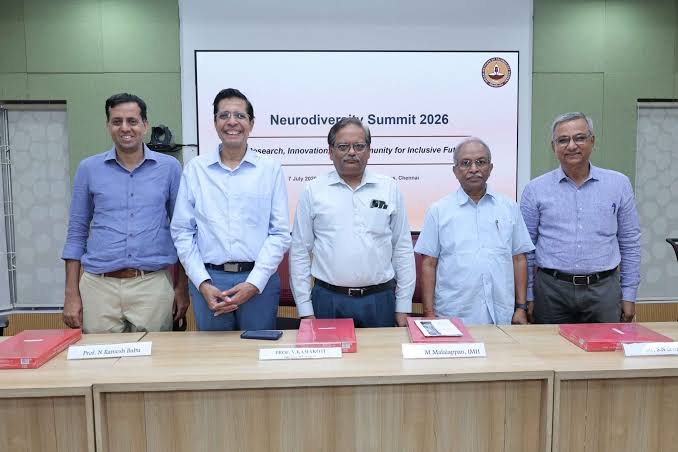
The proposal was unveiled during the Neurodiversity Summit 2026, which brought together researchers, policymakers, industry leaders, non-governmental organisations and community stakeholders to outline a long-term strategy for building an inclusive ecosystem.
The proposed centre will focus on developing digital assessment tools, personalised assistive technologies, adaptive vocational solutions and capacity building. It is also expected to serve as a hub for collaborative research and technology translation.
Addressing the summit, IIT Madras Director V Kamakoti emphasised the need for early identification of neurodivergent conditions and the development of evidence-based interventions. He said that skilled educators, caregivers and affordable assistive technologies would be key pillars of the initiative. “We need to move beyond tokenism and identify meaningful employment opportunities for people with disabilities. Partnerships with NGOs will play a critical role,” he noted.
Institute of Mental Health Director Dr M Malaiappan highlighted the need for deeper scientific understanding of neurodivergent behaviour, cognition and emotions. He stressed that collaboration between academia, service providers and technology institutions is essential to drive impactful outcomes.
Summit coordinators Arshinder Kaur and Viswanath Kumar Ganesan said participants agreed to jointly develop scalable, technology-enabled solutions and build a federated ecosystem supporting lifelong learning, independent living and sustainable employment.
As part of the immediate action plan, IIT Madras and its partners will pilot personalised recommendation engines, adaptive training systems and assistive technologies. Plans are also underway to establish prototype nodal centres, train personnel and create a digital platform connecting neurodivergent individuals with employers, mentors, researchers and funding opportunities. The initiative will also generate evidence to support future public policy on inclusion.
