


A quarter-century ago, the U.S. Supreme Court ruled that people who are elderly or live with disabilities and need long-term care have a right to get those services at home instead of in a hospital or nursing home.
Now advocates fear that protection could be pulled away, and with it, government support for the care of people with disabilities in their homes or in the community.
The Supreme Court’s Olmstead ruling in 1999, combined with a series of federal laws going back to 1973, “have changed what it means to be a person with a disability,” says Jenny Price, executive director of the Wisconsin Board for People with Developmental Disabilities.
“People just went away, out of their family homes,” Price says. “It is because of these protections that are in place that that doesn’t happen now.”
The Olmstead decision’s author, Justice Ruth Bader Ginsberg, wrote that “unjustified institutional isolation of persons with disabilities is a form of discrimination” under the 1990 Americans with Disabilities Act, and that the law gives them the right to live in a “less restrictive setting.”
Then-President Bill Clinton called on states to adopt more community-based services and enable people with disabilities to obtain care and services outside institutions as much as possible. Subsequent administrations continued in that direction, including taking legal action to require states to expand community care options.
A June 18 opinion from the U.S. DOJ’s Office of Legal Counsel reverses course. The opinion “concluded states may disregard decades of Supreme Court precedent and ensuing regulations mandating integration of individuals with disabilities into home or community settings,” Bloomberg Law reported.
Price says advocates are concerned that the opinion signals the Trump administration won’t enforce the right of people with disabilities to be integrated into the wider community that was underscored in Olmstead.
Along with that memo, the federal Center for Medicare & Medicaid Services has been focusing on Medicaid coverage for home- and community-based services, HCBS for short, and suggesting it is a source of fraud — a claim rejected by outside Medicaid experts.
“All of these things are happening at the same time,” Price says. With CMS warning states about fraud investigations, “a lot of states are figuring out how to limit home and community based services. It just kind of makes it more likely that there won’t be as much care at home.”
The DOJ memo, “says to states if you don’t have the home care people need to live in the community safely, the federal government isn’t going to care about that,” Price says — nor will it enforce the principle of community integration as it has in the past.
The two women who brought the 1999 Supreme Court case lived with intellectual disabilities as well as mental health diagnoses. Both of them “were in and out of a psychiatric institution but there was no dispute that their needs could appropriately be met in community-based programs,” American University law professor Robert Dinerstein wrote for the American Bar Association in 2025.
“Needing help or support to live the life that you choose shouldn’t be a reason for the government to take you out of the community, or away from living the life you want,” Price says.
Lives changed for people with disabilities
Stacy Ellingen has a form of cerebral palsy, a result of complications during her birth, that affects all of her muscles. The 41-year-old uses a power wheelchair and technological aids to help her communicate.
Stacy Ellingen lives at home where she gets home healthcare to assist her with her complex disabilities. (Photo courtesy of Stacy Ellingen)
Ellingen also has an active life in the community. She has a journalism degree, is a graphic designer and lives on her own in an apartment in Oshkosh. And she manages an online community for people with disabilities, the Self-Determination Network.
Wisconsin’s IRIS program, which enables her to hire caregivers and is covered through Medicaid, makes it possible for her to live in a home of her own where she receives daily care.
“Thanks to the services and supports I receive through Medicaid, I’m able to lead a successful life and be an active member of my community,” Ellingen told the Wisconsin Examiner in an email message.
With her IRIS caregivers, she doesn’t have to depend on her parents, now in their 70s, although they are able to provide backup help.
“I need assistance with all of my basic needs such as eating, toileting, showering, and dressing,” Ellingen wrote. “I literally rely on assistance from caregivers for everything from getting out of bed each morning, to getting dressed, to using the restroom multiple times a day, to eating each meal, to showering and getting back into bed every night.”
Carl Schulze was 27 when he broke his neck in a fall in 2007 after a night of partying. Surgery and two months in the hospital enabled him to survive, but the injury left him a quadriplegic.
Now 45, Schulze lives near Neenah in Winnebago County. In April he was elected to the Winnebago County Board.
“I can’t get in and out of my wheelchair on my own,” Schulze said in a phone interview. “I can feed myself, but I still need help having my food made.”
He’s been able to live independently thanks to home healthcare workers whom he hires through Medicaid.
The DOJ memo angered him. “The federal government wants to tell the states that they’re not going to enforce it if the states stop funding community-based services. That’s my home health aides,” Schulze said.
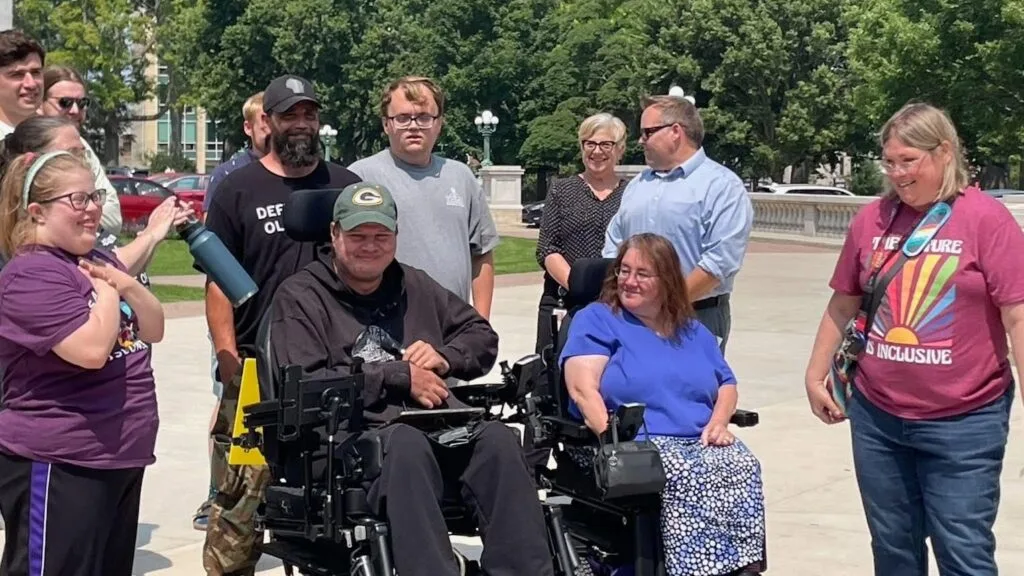
In August 2025 Schulze rode his wheelchair to Madison to call attention to home healthcare workers’ low pay and urge lawmakers to support increases in their wages. He said he worries now about having to go to an assisted living home because he’s had trouble finding enough home healthcare workers.
Better care at lower cost
Advocates and people with disabilities say care in the community helps the person thrive and have a more fulfilling life — its most important benefit
Ellingen has lived with disability from birth but has never had to live in an institution, and she can’t imagine having to do so now.
“I know that my needs are pretty high which is concerning when talk of putting people with disabilities back in institutions comes up,” she wrote, in response to a question about the DOJ memo. “Personally, after all the hard work my family and I have done to get me to where I am today, I can’t fathom being forced into an institution.”
In addition to being better overall for the person, Price says, “If we were providing that care the way we used to, it would cost a lot more.”
Advocates say there’s still another problem: There simply aren’t institutions available to house people who are now able to live in the community.
“It’s not as if tomorrow suddenly everyone could go someplace,” Price says. “Our concern always with all of these things going on is, does it mean some people have nowhere to go?”
Without services provided by the state, care would fall on the shoulders of family members.
“There’s so much unpaid caregiving that’s already going on,” Price says. “That burden might increase.”
SUBSCRIBE: GET THE MORNING HEADLINES DELIVERED TO YOUR INBOX.
