


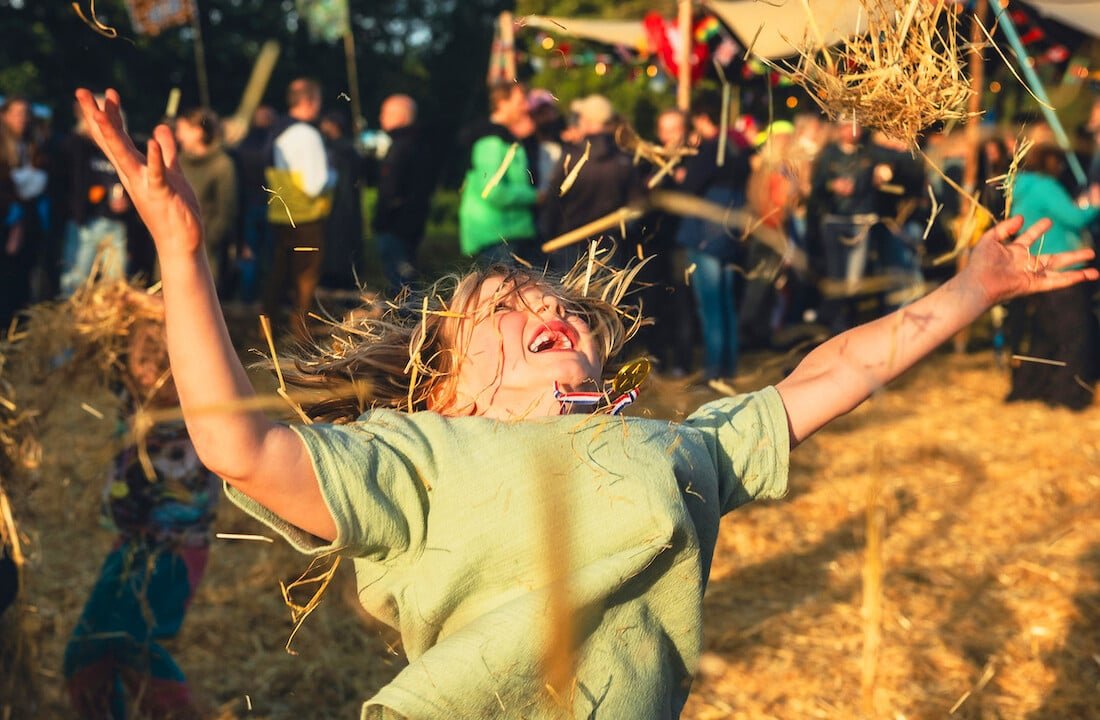
Dutch children are consistently ranked the happiest kids in the developed world. What is the Netherlands getting right? And does the humble bike have something to do with it?
A mother cycles determinedly through the drizzle while her togged-up toddler sits on the crossbar squinting in the rain. The sky is black and the cycle lanes are busy. An onlooking American tourist asks no one in particular what it would take for Amsterdammers to leave their bikes at home.
Riding through the rain is a rite of passage in the Netherlands, which has the highest bicycle-to-person ratio in the world, and is one of Europe’s wettest nations.
Yet, despite the often gloomy weather, the Dutch are surprisingly chipper. The latest World Happiness Report ranked the Netherlands the fifth happiest country, behind Finland, Denmark, Iceland and Sweden. Dutch kids, meanwhile, fare even better. In Unicef’s latest child wellbeing index, published this week, they retained their place as the happiest children in the West (the research only covers the developed world).
For Dr Margreet de Looze, assistant professor of interdisciplinary social science at Utrecht University, it’s no surprise. She has spent much of her career studying global child wellbeing, and reached the same conclusion. Which begs an obvious question: what are the Dutch doing right?
“Where Dutch children really standout is that they have very good social relations,” says de Looze. “The amount of support they receive from family and friends, from teachers and classmates – in all of these areas, Dutch children score high.”
It’s no coincidence, she says, that the Netherlands is the “part-time capital of Europe” (Dutch people work fewer hours than anywhere else on the continent). “It’s common for Dutch parents – men and women – to work part-time,”she says. “For children, that’s valuable, it brings you closer as a family. But it’s not possible for everyone.”
Human-scale and largely traffic free, Dutch cities are generally safer for children. Image: Dee
Low rates of bullying in Dutch schools, which have a blanket ban on smartphones, is another factor, adds De Looze. The Netherlands’ status as a leader in gender equality also boosts childhood wellbeing, her research shows – and not just for girls.
“We found that in more gender-equal countries, boys and girls were happier than in gender-unequal countries,” she says. “That’s interesting, because often people believe that it’s specifically girls who benefit from gender equality.”
More gender-equal nations, adds de Looze, also tend to be more economically equal. “Where there’s more equality, social support is typically stronger,” she says. “In countries with high economic inequality, people are unhappier, even the richest. More equality is better for everyone.”
Parenting, Dutch style
While there’s something jarring, perhaps, for non-Dutch folk, about watching worshippers gather outside a church in Amsterdam’s red light district, or seeing children walk past a cannabis coffeeshop, the Netherlands’ permissive culture is in fact linked to better wellbeing among young people.
“It forces Dutch parents and schools to talk about it,” says de Looze. “That’s a key thing: open communication. This is the world that is out there – and they have to learn to deal with it. In other countries, drugs are also available, just not legally. You want to raise them in a way that they learn to make good decisions.”
It’s a philosophy that appears to work better than other approaches. According to Our World In Data, 0.9% of the Dutch population have drug disorders, compared to 3.8% in the US, 1.7% in the UK, and 1.2% in Spain.
In the Netherlands, children bike to school from a young age. Image: Anna Feiner
The Netherlands’ socially liberal attitude, adds de Looze, sees Dutch parents “promote autonomy while still being involved”. “There’s a belief that shared decision-making has more impact. For example, as a parent, you need to set rules, but if you involve children in making them, they might be more willing to comply.”
Liesbeth Levy, director of the Knowledge Center for Cultural Education Rotterdam (KCR), agrees. “Agency is very important,” she says. “Children must learn to develop their judgement and tastes.
The KCR helps them do that. It puts on cultural education programmes for children in schools across Rotterdam – the poorest big city in the Netherlands – and has sister organisations doing similar work across the country.
It’s common for Dutch parents to work part-time. For children that’s valuable, it brings you closer as a family
“Cultural education is more than just playing the flute or doing a play, it’s about stimulating the imagination of children, giving them space to see who they are,” she says. “It’s important that children are agents of their own education, but they need teachers to show them. We help children to make their world bigger.”
Anna Feiner, a mother of two from Rotterdam, agrees. “In the Netherlands, it’s very important that children have their own opinions and freedom to be their own person.”
The way that Dutch towns and cities are organised helps. Often, they are human-scale, tight-knit places where bikes rule the road and cars have a limited presence. They are safer spaces to be a child.
Anna Feiner, a mother of two, says it’s important children have the freedom to be their own person. Image: Anna Feiner
“My son, Tije, is 10, and he’s been biking to school on his own since he was nine,” says Feiner, programme manager at Rotterdam Zoo. “It was terrifying letting him go at first. But it’s frowned upon if you don’t let your children bike to school.
For kids, bicycles represent freedom. “I’ve been riding a bike ever since I remember,” says Bea Nicholls-Lee, 15, who was born in Amsterdam but now lives in the UK. “Having a bike definitely improved my childhood due to reduced dependence on my parents and more freedom to explore the city with my friends.”
Bea’s mother, Deborah Nicholls-Lee, a British journalist who relocated to Amsterdam, was struck by the Netherlands’ more relaxed parenting style.
Cultural education is more than just playing the flute, it’s about giving children space to see who they are
“Children have more freedom in the Netherlands, where a philosophy of ‘alles mag, niets moet’ (everything is allowed, nothing is forced) reigns,” she says. “Sometimes I liked this, sometimes I struggled with the lack of imagination that it implied.” The lack of safety helmets worn by Dutch children being an example of the latter.
Having raised two children in the Netherlands, Nicholls-Lee believes that the country’s healthcare system lays the foundations for a healthy family life.
“One thing that’s often overlooked but which makes the Netherlands a great place for children is the excellent healthcare they receive from day one,” she says. “For the first week or so after my children were born, a kraamzorg (maternity nurse) came to our home to help us care for the baby, provide guidance on breastfeeding, and do light chores such as cooking and cleaning.”
Though healthcare is not free in the Netherlands, all new mothers have the right to a kraamzorg through their health insurance.
Growing pains
While the Netherlands leads the way in childhood wellbeing, it’s not immune to global trends. In 2025, Unicef noted that children in the developed world have seen “marked declines in their academic performance, mental wellbeing, and physical health in the period since the start of the Covid-19 pandemic”.
The Netherlands also recorded a slight dip, which De Looze attributes to increasing academic pressures.
“When we started our studies, the Netherlands scored lowest of all countries for school work stress – that’s no longer the case,” she says. “Kids are more stressed about doing well at school, getting good grades, doing their homework – that’s a negative development.” It’s worse for girls, she adds.
Dutch children are typically encouraged to develop their judgement and tastes. Image: Ben Wicks
Other experts are quick to point out that there’s still much work to be done in the Netherlands. “There are still a lot of people growing up in poverty here,” cautions Levy.
It’s why places like Dynamo Youth Center Club are so vital. Located in Amsterdam-Oost, the free, government-funded facility is a space where young people can come to make and record music.
“A lot of the kids who come here are quite lonely,” says Maarten de Jong, a youth worker and DJ. “Places like this mean there’s always somewhere for them to go. Everybody is welcome.”
Similar facilities have opened across Amsterdam. “When we started out, we were the only ones doing this,” says de Jong. “Now many neighbourhoods have a centre like this.”
De Jong wishes these spaces had been around when he was young. “I was born in the ’60s and we didn’t have so much,” he says. “This is like a utopia for me.”
Main image: Peyman Shojaei
Be part of the solution
At Positive News, we’re not chasing clicks or profits for media moguls – we’re here to serve you and have a positive social impact. We can’t do this unless enough people like you choose to support our journalism.
Give once from just £1, or join 1,800+ others who contribute an average of £3 or more per month. Together, we can build a healthier form of media – one that focuses on solutions, progress and possibilities, and empowers people to create positive change.
Support Positive News
