


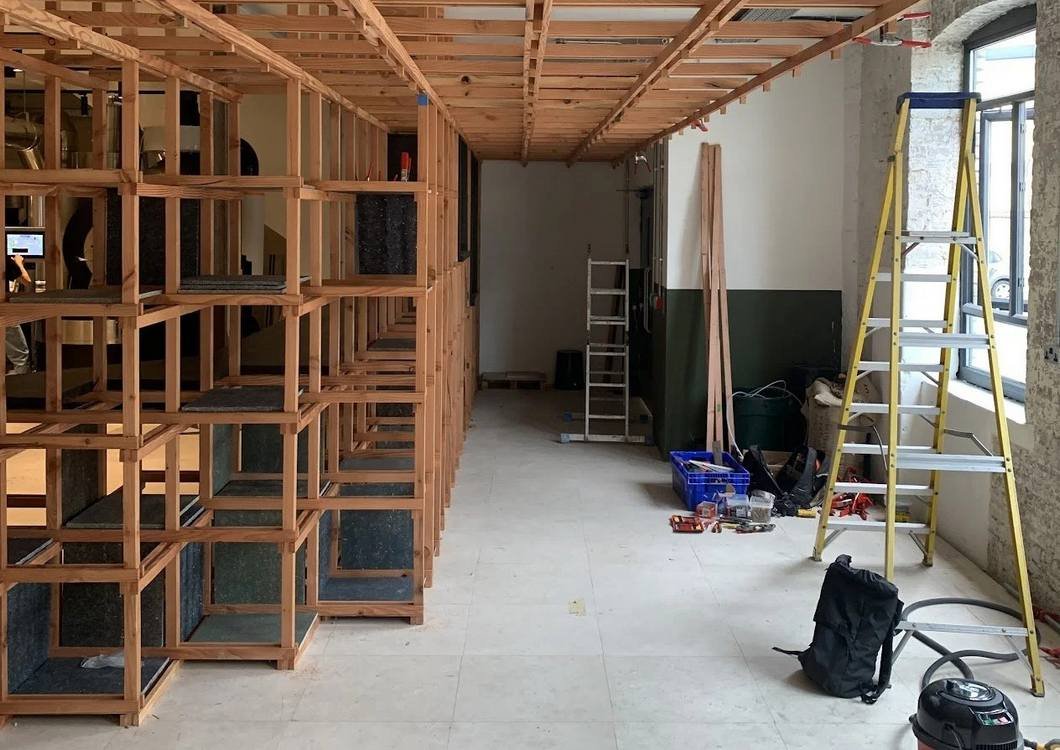
– credit, retrieved from Yes Make
A salvage and reuse operation in London is ensuring that every charming bit of wood, brick, glass, porcelain, and steel that has made the city beautiful can continue to do so with a second life in the circular economy.
Started through an epiphany of “street logic” by a man frustrated by red tape, Yes Make is making things all over London out of what the city might otherwise throw out.
“We’re creating a regenerative supply chain for the city we love,” says Joel De Mowbray, founder of Yes Make, to the Guardian. “Turning things that would otherwise go to waste into objects that have cultural potential.”
Yes Make operates in tandem with Material Cultures, which played an equal part in the endeavor of finding somewhere in the expensive London real estate market to run a salvage yard.
That place is a 5-acre industrial site in the city’s Newham borough called Tipping Point East which promotes circular construction. As well as being the largest site of its kind in London, it’s also the biggest in the whole of the United Kingdom.
The Guardian reports that more than half of the UK’s waste is generated by the construction industry. It recycles some of it, but not nearly enough for De Mowbray’s liking—especially when he looked at what was going to waste: like a 105-year-old sequoia tree from the Linford Arboretum.
Instead, it was brought to Tipping Point East where Yes Make organized an educational workshop run by the National Saw Mills organization on how to use a portable saw mill to turn an old-growth tree into lumber.
There are huge quantities of high-quality, imported, or exotic lumber that have gone into making London, and as the city constantly balances modernization and preservation, some of that wood gets squeezed through the cracks. De Mowbray has ensured he and his outfit are there to pick up all the mahogany, teak, and afromasia that does.
Yes Make’s most recent project was the new HEJ Coffee Roastery on Old Kent Road. De Mowbray’s team arrived with a custom structure made from reclaimed Douglas fir and oak salvaged from the London Docklands.
“Designed to frame the roasting space and invite the public in, this piece holds stories of the tides and the city alike,” they wrote on Instagram.
Beyond lumber, Tipping Point East also refurbishes and certifies construction materials for bulk sale to contractors at sometimes one-tenth the price of new stock.
GNN has previously reported on similar operations: in Savannah, Georgia.
Re:purpose Savannah is a 501(c)3 that takes old, condemned buildings apart for their bricks, timber, door frames, metalwork, and other components and sells them to construction firms building new homes for discerning clients. They’ve taken apart beach houses, dairies, bungalows, cottages, and traditional homes in town.
The non-profit sells all of the salvaged material at its own lumber yard, where old boards, beams, joints, and flooring undergo a light touch of restoration to remove decay or split ends.
SHARE This Admirable Operation In East London Working To Reuse The City’s Heritage…
