


Introduction
You finally got the job.
The offer letter felt like a dream. The congratulatory messages poured in. Your family felt proud. You promised yourself—this is my moment.
But then… something shifted.
On your first day, you looked around and thought,
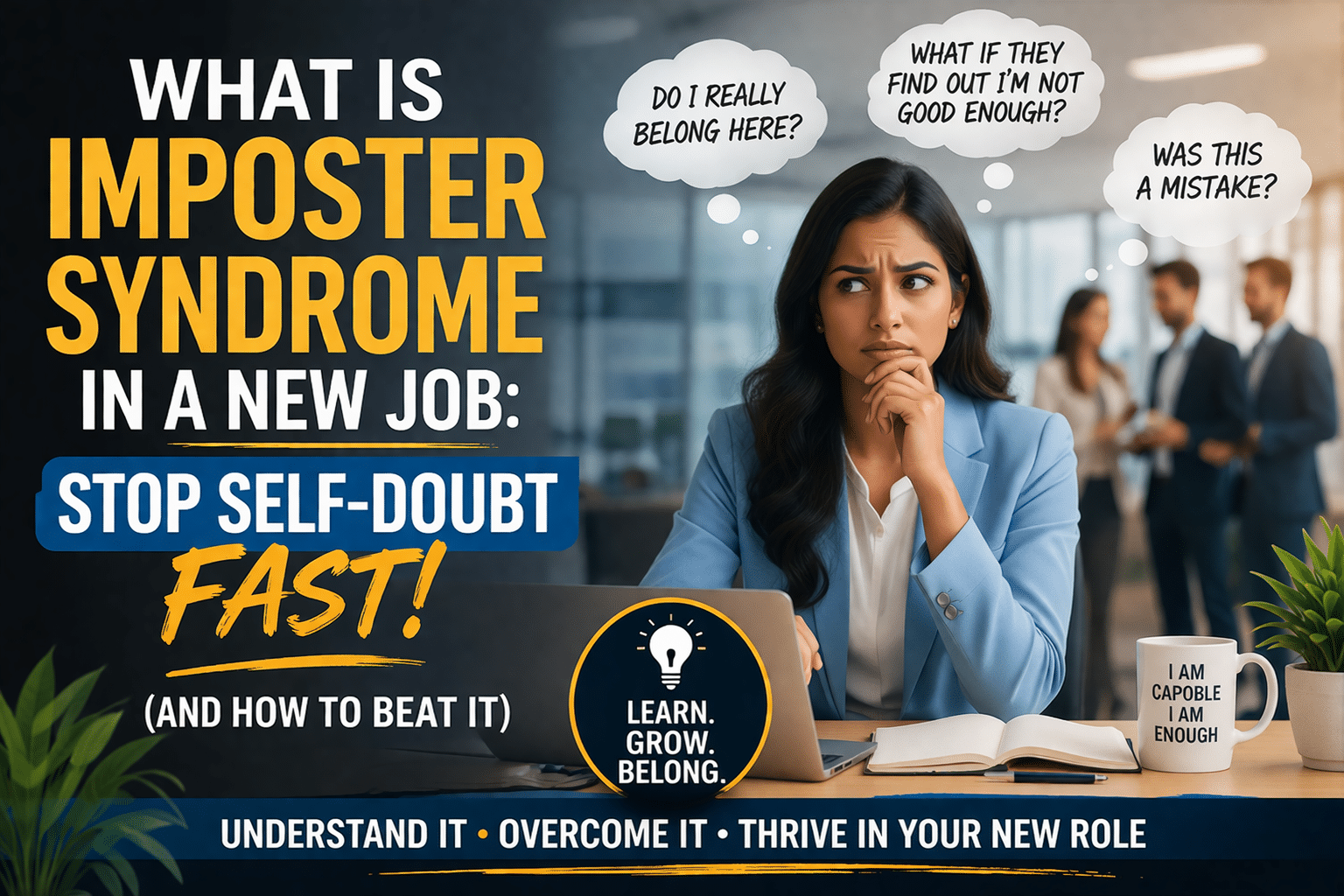
“Do I really belong here?”
“What if they find out I’m not as good as they think?”
“Was this a mistake?”
If this sounds familiar, you’re not alone.
This silent, nagging voice inside your head has a name. It’s called imposter syndrome.
And today, we’re going to deeply explore what is imposter syndrome in a new job, why it happens, and how you can overcome it—not just temporarily, but permanently.
Let’s be real. Starting a new job is exciting, but it’s also overwhelming. New systems, new expectations, new people—and suddenly, your confidence shakes. You compare yourself with experienced colleagues. You hesitate to ask questions. You overthink every email you send.
This is exactly where what is imposter syndrome in a new job becomes more than just a concept—it becomes a lived experience.
As a trainer working with professionals across industries, I’ve seen this pattern repeatedly. High performers, talented individuals, even leaders—feeling like frauds in the beginning.
But here’s the truth:
“Imposter syndrome is not a sign of incompetence. It’s a sign that you are growing.”
In this article, we won’t just define what is imposter syndrome in a new job.
We will break it down psychologically, emotionally, and practically—so you walk away with clarity, confidence, and control.
What is imposter syndrome in a new job?
Imposter syndrome is a psychological pattern where you doubt your abilities, feel like a fraud, and fear being exposed—despite having real achievements and qualifications.
When applied to a workplace context, what is imposter syndrome in a new job becomes:
A state where you feel undeserving of your new role, constantly question your competence, and fear that others will discover you are not capable enough.
Psychological Roots of Imposter Syndrome
From a psychological perspective, what is imposter syndrome in a new job connects to:
- Cognitive distortions (negative thinking patterns)
- Low self-efficacy (belief in your abilities)
- Perfectionism
- Fear of failure and rejection
According to research published in the International Journal of Behavioral Science, nearly 70% of people experience imposter syndrome at some point in their lives.
Yes—70%.
That means even the person you think is “confident” may be silently struggling.
Types of Imposter Syndrome (Workplace Context)
Understanding types helps you identify your pattern:
1. The Perfectionist
- Sets unrealistically high standards
- Feels like a failure even with small mistakes
2. The Expert
- Feels inadequate unless they know everything
- Avoids tasks due to fear of not knowing enough
3. The Natural Genius
- Believes success should come easily
- Feels like a fraud when effort is required
4. The Soloist
- Avoids asking for help
- Thinks needing support = weakness
5. The Superhuman
- Works excessively to prove worth
- Burnout is common
Real-Life Example (From Training Experience)
During a corporate training session, a young manager told me:
“Sir, I got promoted, but I feel like they made a mistake. I’m scared every day.”
When I asked about his performance history—he had consistently exceeded targets.
So what was happening?
Not incompetence.
Not lack of skill.
Just a classic case of what is imposter syndrome in a new job.
Within 3 weeks of coaching:
- His confidence improved
- He started contributing ideas
- His team performance increased
Awareness was the turning point.
Now that you understand what is imposter syndrome in a new job, let’s explore why it happens.
1. Transition Shock
A new job = new environment.
Your brain moves from:
- Known → Unknown
- Comfort → Uncertainty
This triggers anxiety and self-doubt.
2. Comparison Trap
You start comparing:
- Your Day 1 with others’ Year 5
- Your learning phase with others’ mastery
This creates a false belief:
“I am not good enough.”
3. Fear of Judgment
You worry:
- “What will my boss think?”
- “Will my team respect me?”
- “What if I make mistakes?”
This fear fuels what is imposter syndrome in a new job deeply.
4. High Expectations
Sometimes:
- You expect too much from yourself
- Or others expect too much from you
Either way → Pressure increases → Confidence drops.
5. Lack of Feedback
Silence is dangerous.
No feedback =
Your brain fills gaps with negative assumptions.
Signs You Have Imposter Syndrome in a New Job
Let’s check if you relate.
Common Symptoms:
- Constant self-doubt
- Over-preparing for simple tasks
- Fear of asking questions
- Attributing success to luck
- Feeling like you “fooled” the interviewer
- Avoiding challenges
- Anxiety before meetings
Quick Self-Check Table
Thought PatternReality“I don’t belong here”You were selected for a reason“Others are smarter”Others have more experience“I’ll be exposed”Learning is expected“I got lucky”You earned this opportunity
How to Overcome Imposter Syndrome in a New Job (Step-by-Step Guide)
Now comes the most important part.
Understanding what is imposter syndrome in a new job is powerful—but transformation comes from action.
1. Normalize the Feeling
First rule:
“It’s not just you.”
Say it again.
Even top CEOs and leaders experience this.
2. Reframe Your Thoughts
Instead of:
- “I don’t know this”
Say:
This small shift changes your mindset.
3. Track Your Wins
Create a “Confidence Journal”
Write:
- Daily achievements
- Positive feedback
- Small wins
This builds evidence against self-doubt
4. Ask Questions Without Fear
Remember:
“Asking questions is a sign of growth, not weakness.”
5. Stop Comparing Yourself
Comparison kills confidence.
Focus on:
6. Seek Feedback Regularly
Ask:
- “Am I on the right track?”
- “What can I improve?”
Clarity reduces anxiety.
7. Accept Mistakes as Learning
Mistakes are not failures.
They are:
“Feedback in disguise.”
8. Build Support Systems
Connect with:
You don’t have to do it alone.
9. Practice Self-Compassion
Be kind to yourself.
You are:
10. Focus on Contribution, Not Perfection
Instead of asking:
Ask:
Case Study: From Self-Doubt to Confidence
A fresher joined a finance firm.
Week 1:
- Silent in meetings
- Avoided speaking
- Felt overwhelmed
Week 4 (after coaching):
- Started asking questions
- Took initiative
- Delivered a presentation
What changed?
Understanding what is imposter syndrome in a new job and applying small actions daily.
Is Imposter Syndrome Normal in a New Job?
Yes. Completely normal.
In fact:
- It shows you care
- It shows you want to perform well
But unmanaged, it can lead to:
- Anxiety
- Burnout
- Low performance
How Long Does Imposter Syndrome Last?
It depends on:
- Your mindset
- Your environment
- Your actions
For some:
For others:
With awareness and practice → It reduces faster.
Can Imposter Syndrome Be Positive?
Surprisingly—yes.
It can:
- Push you to learn
- Increase preparation
- Build humility
But balance is key.
Too much → Paralysis
Healthy level → Growth
Powerful Mindset Shift
“You are not an imposter. You are in transition.”
Practical Daily Routine to Beat Imposter Syndrome
Morning:
- Affirmation: “I deserve this role.”
During Work:
- Ask 1 question daily
- Note 1 learning
Evening:
Consistency creates confidence.
Expert Insight
From a behavioral science lens:
- Imposter syndrome is linked to schema-based thinking
- Early experiences shape self-belief
- Workplace triggers activate these patterns
Using Cognitive Behavioral Techniques (CBT):
- Identify negative thoughts
- Challenge them
- Replace them
This is evidence-based and effective.
References
Conclusion
Starting a new job is never easy.
And if you’ve been wondering what is imposter syndrome in a new job, now you know:
It’s not weakness.
It’s not failure.
It’s not incompetence.
It’s simply a phase of growth.
You are stepping into something bigger.
And your mind is trying to catch up.
So the next time that voice says:
“You don’t belong here”
Smile and reply:
“I am learning. I am growing. I belong here.”
Thank you for exploring this insightful article.
If you’re hungry for more knowledge, don’t miss out on our other engaging articles waiting for you. Dive into our treasure trove of wisdom and discover new perspectives on related topics.
Click ‘Our Blog’ and ‘How to Guide’ to embark on your next adventure.
Happy reading!
FAQs on What is imposter syndrome in a new job
1. What is imposter syndrome in a new job in simple terms?
It is a feeling where you doubt your abilities and fear being exposed as a fraud, even though you are qualified for your job. It often happens when you start a new role and are still learning.
2. Why do I feel like I don’t deserve my new job?
This feeling comes from self-doubt, comparison, and fear of judgment. Your brain is adjusting to a new environment and interpreting uncertainty as incompetence.
3. Is imposter syndrome a mental illness?
No, it is not a mental illness. It is a psychological pattern or mindset issue that many people experience, especially during transitions like a new job.
4. How can I quickly overcome imposter syndrome?
Start by acknowledging the feeling, tracking your achievements, asking questions, and seeking feedback. Consistent small actions help build confidence.
5. Does everyone experience imposter syndrome?
Yes, studies suggest around 70% of people experience it at some point in their lives, especially during new challenges or roles.
6. Can imposter syndrome affect job performance?
Yes, if unmanaged, it can lead to anxiety, hesitation, and reduced productivity. But with awareness, it can be controlled effectively.
7. How long does imposter syndrome last in a new job?
It varies from person to person. With the right mindset and strategies, it can reduce within weeks.
8. Should I talk to my manager about imposter syndrome?
Yes, if you feel comfortable. A supportive manager can provide guidance, feedback, and reassurance.
9. Can imposter syndrome happen even after years of experience?
Yes, it can reappear whenever you face new challenges, promotions, or unfamiliar responsibilities.
10. What is the best mindset to overcome imposter syndrome?
Focus on growth, not perfection. Replace “I don’t know” with “I am learning.”
