


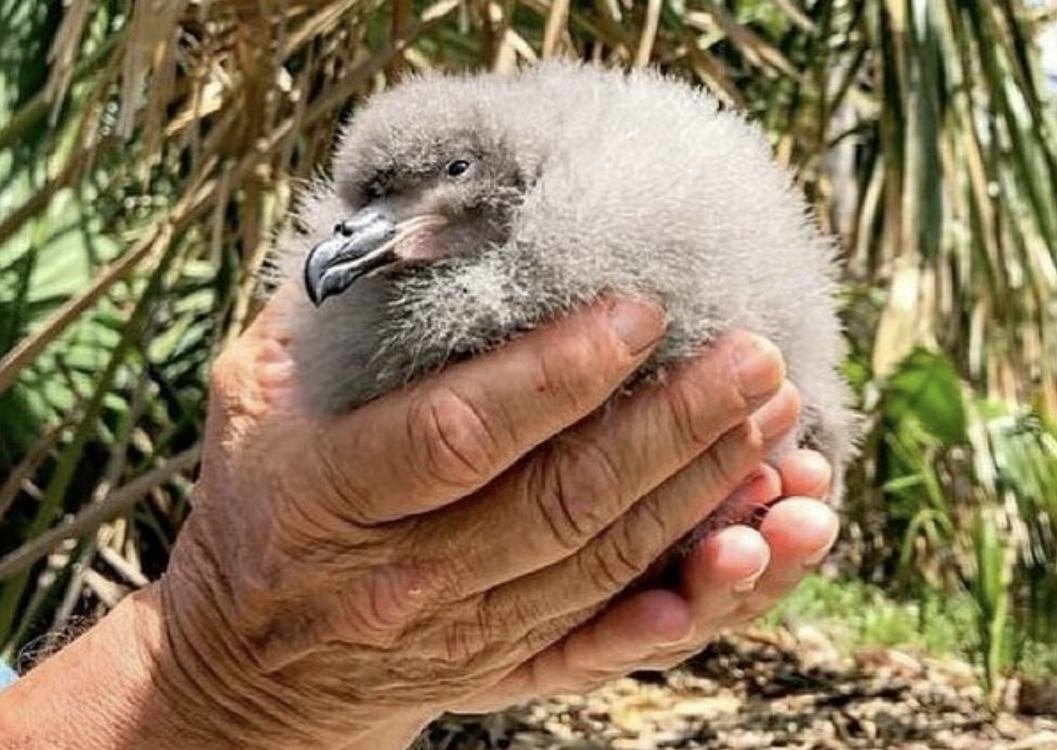
A Bermuda petrel, or Cahow, on Nonsuch Island – credit, Cahow Recovery Project
Though an event neither singular nor inaugural, the hatching of an endangered seabird and national icon of Bermuda is still being celebrated wildly by a special group of conservationists who’ve created a “living museum” on Nonsuch Island.
Measuring just 14 acres and found in the northeast corner of the Bermuda island chain, Nonsuch Island is the only place the world’s 3rd-rarest seabird, known locally as the cahow, comes to breed.
The fact that it is breeding at all is nearly a miracle, as the cahow was believed to be extinct for a period of 300 years that started in the early days of British colonial governance and extended all the way to the second-half of the 20th century.
The animal, also known as a Bermuda, or gadfly petrel, bears all the quirks of an animal doomed to follow the dodo into history. It takes 3-6 years for adults to return to Nonsuch Island to breed, and if they do, the female may produce one egg.
That one egg may hatch, although it might not; some 50% of the eggs don’t hatch. Adults abandon that single chick one-week before it fledges, when instinct drives it to seek food out at sea while still learning how to fly. Between 28 and 35% of fledglings don’t survive their first year.
Nesting on the ground, they’re extremely vulnerable to predation from invasive animals, and in 1960, British ornithologist and Bermuda’s first conservation officer, David Wingate, identified just 18 breeding pairs on Nonsuch Island.
Wingate would go on to pioneer the Cahow Recovery Program, which today is recognized as one of the most successful restoration projects anywhere in the world for a Critically-Endangered species.
By the time Wingate’s successor as chief of the program, Jeremy Madeiros, took over, their numbers had grown to 55. Today, there are 450 birds of all ages on the island, a remarkable turnaround.
RESTORING PRISTINE ISLANDS: Marshall Islands Experience Explosion of Wildlife One Year After Invasive Rats Were Removed
Part of that turnaround was making sure these birds had good nesting habitat. Cahows nest in underground burrows or deep rock crevices; only nests deep enough to be completely dark are chosen.
Today, 85% of all cahows nest in artificial concrete nest burrows constructed for them as part of the Recovery Program.
The recovery program gestated a transformation of Nonsuch Island into a complete wildlife sanctuary, wooded, and with a small freshwater marsh where access to the public is strictly limited to prevent invasive species introduction. The restoration of the once barren island into a ‘Living Museum of pre-colonial Bermuda’ was Wingate’s life’s work.
LOST ISLAND BIRDS: Missing for 200 Years, the Galapagos Rail Reappears Following Floreana Island Restoration
65 years into this rewilding experiment, key endemics have repopulated the island, including the yellow-crowned night heron, West Indian top shell, land hermit crabs, and the beautiful Bermuda skink.
Expeditions there are organized by the environment ministry for educational and research purposes, while several live camera feeds allow those interested to observe the cahow in its natural habitat.
SHARE The Story Of This Feathered Fuzzball Coming Back To Bermuda…
