


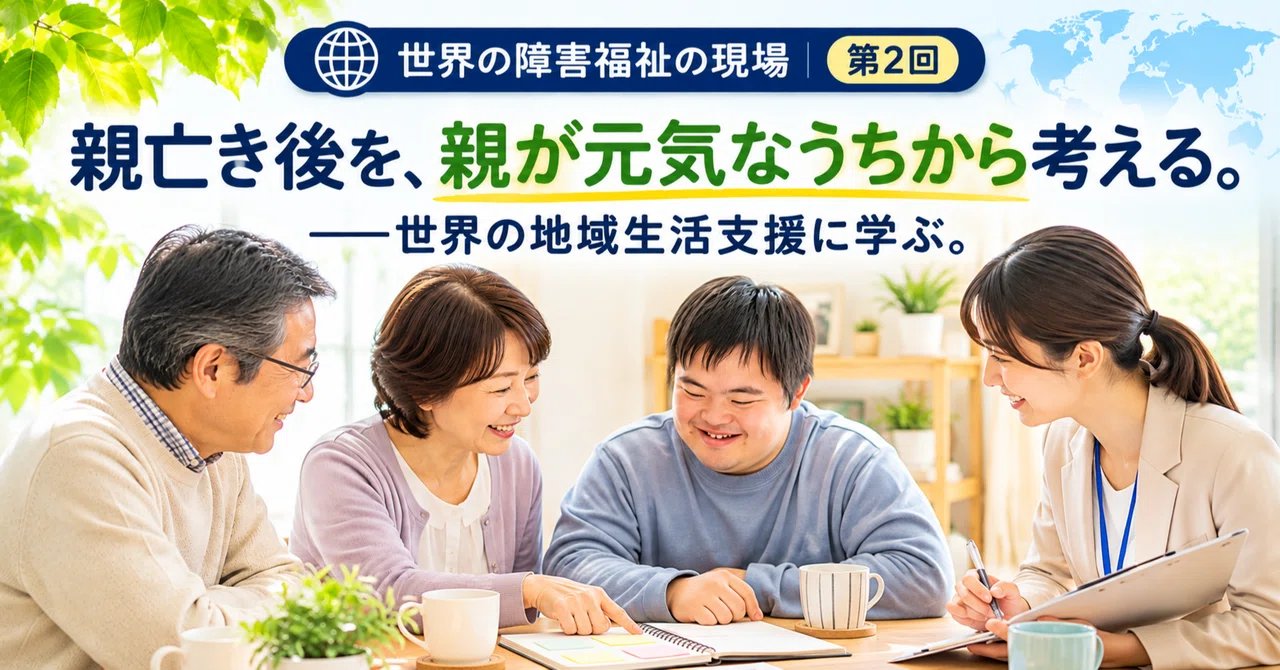
“Planning for life after parents are gone while they are still healthy.”
— Learning from community living support around the world.
On the front lines of disability welfare around the world
“How will my child live once I’m gone?”
For parents raising individuals with developmental or intellectual disabilities, “life after parents are gone” is a question without easy answers.
Will they be able to eat proper meals?
Will they be able to visit a doctor?
Will they be able to ask someone for help when they are in trouble?
And above all, will they be able to live with a smile, true to themselves?
Even when children become adults, these worries do not necessarily fade away.
However, there is an important perspective we can learn from disability welfare systems around the world.
Rather than trying to find a single person to replace the parents, it is about gradually expanding the network of people and systems that support the individual’s daily life.
Preparing for life after parents are gone is not just for the day a parent passes away.
It is also preparation so that both parents and their child can live with peace of mind starting right now.
In this article, using community living support in England and Australia as a guide, we consider what we can do in Japan.
1 | “Where to live” alone cannot protect daily life
When thinking about life after parents are gone, housing is often the first thing that comes to mind.
Will they be able to get into a group home?
Will they be admitted to a care facility?
Will they be able to live on their own?
Of course, securing a place to live is important.
However, even once a place to live is decided, daily life still goes on.
Meals, hospital visits, managing money, interacting with people, work, and enjoying days off.
And someone to talk to when feeling lonely or anxious is also necessary.
We must consider not only where they will live, but what kind of life they can lead there.
Furthermore, there is something we must not forget.
Is that the kind of life the person actually wants?
Article 19 of the Convention on the Rights of Persons with Disabilities emphasizes that persons with disabilities have the opportunity to choose where and with whom they live, and have access to the support services necessary to live in the community.
Peace of mind for the parents, and the wishes of the individual.
Valuing both serves as the starting point for planning future life.
2 | Learning from England: Family Members as Recipients of Support as Well
In England, under the Care Act enacted in 2014, there is a framework to assess the care and support needs of adults.
One of its characteristics is the establishment of a system that assesses current and future support needs for family members and others who provide care.
How much support are the parents providing?
Can they continue doing so moving forward?
Are the parents’ own health and daily lives being protected?
It is a framework that also turns its attention to the circumstances of the family.
Of course, even in England, the mere existence of a system does not guarantee that one can always access the desired support.
Even so, this approach holds significant meaning.
It means that while family members are those who support a person with a disability, they are also individuals who receive support when needed.
“My parents are still healthy, so we’re fine.”
Rather than thinking that way, it is important to think about the future together while parents are still in good health.
It means building connections with society before the burden on the family reaches its breaking point.
This is a perspective that Japan should value as well.
3 | Learning from Australia: Thinking About Housing and Support Separately
In Australia, there is a framework called the NDIS (National Disability Insurance Scheme) that supports people with disabilities.
Within this scheme, there are multiple support systems related to how an individual lives.
SIL (Supported Independent Living)
This is a framework that covers costs such as assistance from support workers for individuals who need continuous help or supervision in their daily lives.
It is not a system that covers everyday living expenses such as rent or groceries.
ILO (Individualised Living Options)
This is a framework that considers how the individual wishes to live, who they want to live with, and what kind of support they need, building an individualized living support arrangement.
Both have eligibility requirements, and they are not freely available choices for everyone.
However, there is something we can learn from this.
Namely, that where one lives and the support one receives there can be considered separately.
For example, if an individual wishes to continue living in a familiar community, rather than immediately considering moving elsewhere, we can consider what kind of support would enable them to keep living in their current community.
Of course, systems and funding sources differ between Japan and Australia.
While we cannot directly adopt the exact same system, there is much to learn from the approach of designing support around the person’s own wishes.
4 | Japan Also Has Systems to Support Life After Parents Are Gone
Japan also has systems in place to support community living for people with disabilities.
Here are some of the main services.
Planned Consultation Support
Based on the individual’s wishes and daily life challenges, this service creates service utilization plans for disability welfare services and coordinates with relevant organizations.
Group Homes (Communal Living Care)
This is a system where individuals live in a shared residence and receive necessary counseling, daily life support, and other assistance.
Independent Living Support
This service supports community life through home visits, counseling, and other means for individuals who meet the eligibility requirements.
Short Stays (Short-Term Respite Care)
This is a system where individuals receive short-term daily living support according to need, such as when family caregivers become ill.
Community Life Support Bases and Related Facilities
These are community-based systems designed to provide emergency response and support the transition to community living, anticipating the increasing severity of disabilities, aging, and life after parents pass away.
As of April 1, 2024, municipalities are required to make efforts to develop community life support bases and establish core consultation support centers.
However, development status and available services vary by region.
They are not necessarily available whenever you need them.
That is precisely why it is crucial to connect with local consultation desks and verify the actual support systems while you are still in good health.
5 | Five Steps of Preparation Parents Can Take While Still in Good Health
You do not need to decide everything about the future today.
Start with what you can do right now.
Five steps of preparation for life after parents pass away. Centering on the individual’s wishes, gradually set up daily life support, consultation contacts, living experiences, and emergency response. This schematic diagram organizes the practical suggestions presented in this article.
1. Write down the support currently provided by parents
Waking them up in the morning.
Managing meals and medications.
Accompanying them on hospital visits.
Liaising with welfare service facilities.
Listening to them when they feel anxious.
Things that seem obvious to parents may not always be understood by others.
Start by identifying what they can do on their own and what they need support with.
2. Understanding their wishes and what brings them comfort
Favorite foods.
Places where they feel calm.
Sounds they dislike.
Things they enjoy doing on days off.
The kinds of people they want to spend time with.
If communicating verbally is difficult, consider using picture cards or communication devices.
Facial expressions and behavior can also provide clues, but it is important not to assume what they want based solely on the interpretations of those around them.
3. Expanding advisors beyond the family
Consultation support specialists, welfare service staff, medical professionals, and local community members.
Rather than relying on one person for everything, gradually foster connections with people in diverse roles.
4. Building up the life experiences they desire
Going out with people other than family members.
Experiencing shopping.
Using short-stay respite care.
Touring potential future residences.
While prioritizing the individual’s wishes and sense of security, build up experiences gradually without overextending.
Independence does not mean being able to do everything entirely on one’s own.
Living the life you desire while receiving necessary support is also a form of independence.
5 | Confirm emergency response plans
If a parent is suddenly hospitalized, who should be contacted?
Where will the person stay?
Who will assist with medications and meals?
Consult with your local municipality’s disability welfare division or consultation support service office to confirm emergency contact methods, intake conditions, and backup alternatives in advance.
6 | Leaving Money Behind and Protecting Daily Living
Financial life planning is also essential when preparing for the time after parents pass away.
It helps to organize details such as disability pensions, the individual’s income, savings, inheritance, rent, food expenses, and user fees for welfare services.
If assistance is needed with property management or entering into contracts, the adult guardianship system may be considered as an option.
However, having a disability does not automatically mean one must use the adult guardianship system.
Furthermore, even if mechanisms are in place to support property management, that does not automatically guarantee daily meals, hospital visits, or leisure support.
Mechanisms that support finances and contracts, and mechanisms that support daily life—it is vital that both are arranged as needed.
Regarding inheritance and the use of specific systems, consult with local government offices and legal or welfare professionals while respecting the individual’s wishes.
7 | A Lack of Progress in Preparation Is Not Solely a Family’s Problem
A 2020 systematic review on future planning for adults with intellectual disabilities and their families pointed out that there is insufficient research on systematic methods for supporting future planning and on evaluating their outcomes.
The difficulties of future planning should not be treated as a problem that can be resolved solely through the efforts of families.
Not knowing where to seek advice.
Having few available services.
Being unable to find housing that suits the individual.
Lacking financial leeway.
These are issues that sometimes cannot be solved by families alone.
Public administration, welfare services, healthcare, and local communities must work together to address them.
Furthermore, siblings have their own lives to live.
Rather than taking it for granted that future support should be left to siblings, it is important to respect everyone’s wishes, including those of the individual.
8 | Taking the First Step Today
If you are not sure where to start, try writing down the following three things on a sheet of paper first:
What kind of everyday life does the individual value?
What support is currently being handled solely by the family?
Who can you consult when the family is no longer able to provide support?
Then, try telling your consultation support specialist or local government office the following:
“I am worried about what will happen after the parents pass away, so could you please work with us starting now to think about our future life?”
You may not find all the answers right away.
However, reaching out for that consultation will be the first step in planning for the individual’s future.
Conclusion | Creating the Future Now, While Parents Are Still in Good Health
Letting another supporter know what you thought only a parent could understand.
Adding one more place where the person can feel at ease.
Adding one more person they can turn to for advice when in trouble.
Each of these may seem like a small thing.
Yet, accumulating them can become the foundation supporting their future life.
Planning for the life after parents does not mean only thinking about the day parents are gone.
It means nurturing connections with society starting now, so the person can continue living a life true to themselves.
Furthermore, parents themselves are also allowed to cherish their own lives.
The happiness of the individual, and the happiness of the family.
Rather than giving up on either, we want to strive toward a society that can support both.
Connecting parental love to community support, rather than keeping it held solely within the family.
Perhaps that is one form of community living support to consider while parents are still healthy.
Preview of the Next Issue
In Part 3, we plan to examine diverse ways of living and community support worldwide, not limited solely to group homes.
List of Sources
1. Ministry of Foreign Affairs, “Convention on the Rights of Persons with Disabilities” Article 19
Regarding choice of residence and support necessary for community living.
https://www.mofa.go.jp/mofaj/fp/hr_ha/page22_000899.html
2. Ministry of Health, Labour and Welfare, “Project for Developing the Support System for Community Living of Persons with Disabilities”
Regarding the best-effort obligation placed on municipalities starting April 1, 2024.
https://www.mhlw.go.jp/stf/seisakunitsuite/bunya/hukushi_kaigo/shougaishahukushi/service/chiikiseikatsu_shientaisei_seibi.html
3. Ministry of Health, Labour and Welfare, “Community Life Support Bases, etc.”
Regarding community support systems with a view toward emergency response and life after parents pass away.
https://www.mhlw.go.jp/stf/seisakunitsuite/bunya/0000128378.html
4. Ministry of Health, Labour and Welfare, “Details of Disability Welfare Services”
An overview of domestic welfare services for persons with disabilities.
https://www.mhlw.go.jp/stf/seisakunitsuite/bunya/hukushi_kaigo/shougaishahukushi/service/naiyou.html
5. Ministry of Health, Labour and Welfare, “Regarding Consultation Support for Persons with Disabilities”
An overview of planned consultation support and other services.
https://www.mhlw.go.jp/stf/seisakunitsuite/bunya/hukushi_kaigo/shougaishahukushi/service/soudan_shien.html
6. UK Government. Care Act 2014, Section 10.
Regarding the assessment of carers’ present and future support needs.
https://www.legislation.gov.uk/ukpga/2014/23/section/10
7. UK Government. Care and support statutory guidance.
Statutory guidance on care and support in England.
https://www.gov.uk/government/publications/care-act-2014-supporting-implementation/care-and-support-statutory-guidance
8. National Disability Insurance Scheme. What is supported independent living (SIL).
Regarding Australia’s daily living support systems.
https://www.ndis.gov.au/participants/home-and-living/types-home-and-living-supports/what-supported-independent-living-sil
9. National Disability Insurance Scheme. What are individualised living options (ILO).
About individual living support systems.
https://www.ndis.gov.au/participants/home-and-living/types-home-and-living-supports/what-are-individualised-living-options-ilo
10. Approaches to and outcomes of future planning for family carers of adults with an intellectual disability: A systematic review. (2020)
A systematic review on future planning for adults with intellectual disabilities and their families. Please refer to the public abstract.
https://pubmed.ncbi.nlm.nih.gov/32431067/
DOI: 10.1111/jar.12742
Thinking about the future of people and society based on global insights.
Futaba Care Design
#DevelopmentalDisabilities #AutismSpectrumDisorder #IntellectualDisabilities #DisabilityWelfare #AfterParentsPassAway #LifeAfterParents #CommunityLivingSupport #GroupHomes #DecisionMakingSupport #FamilySupport #ConsultationSupport #CRPD #FutabaCareDesign
