


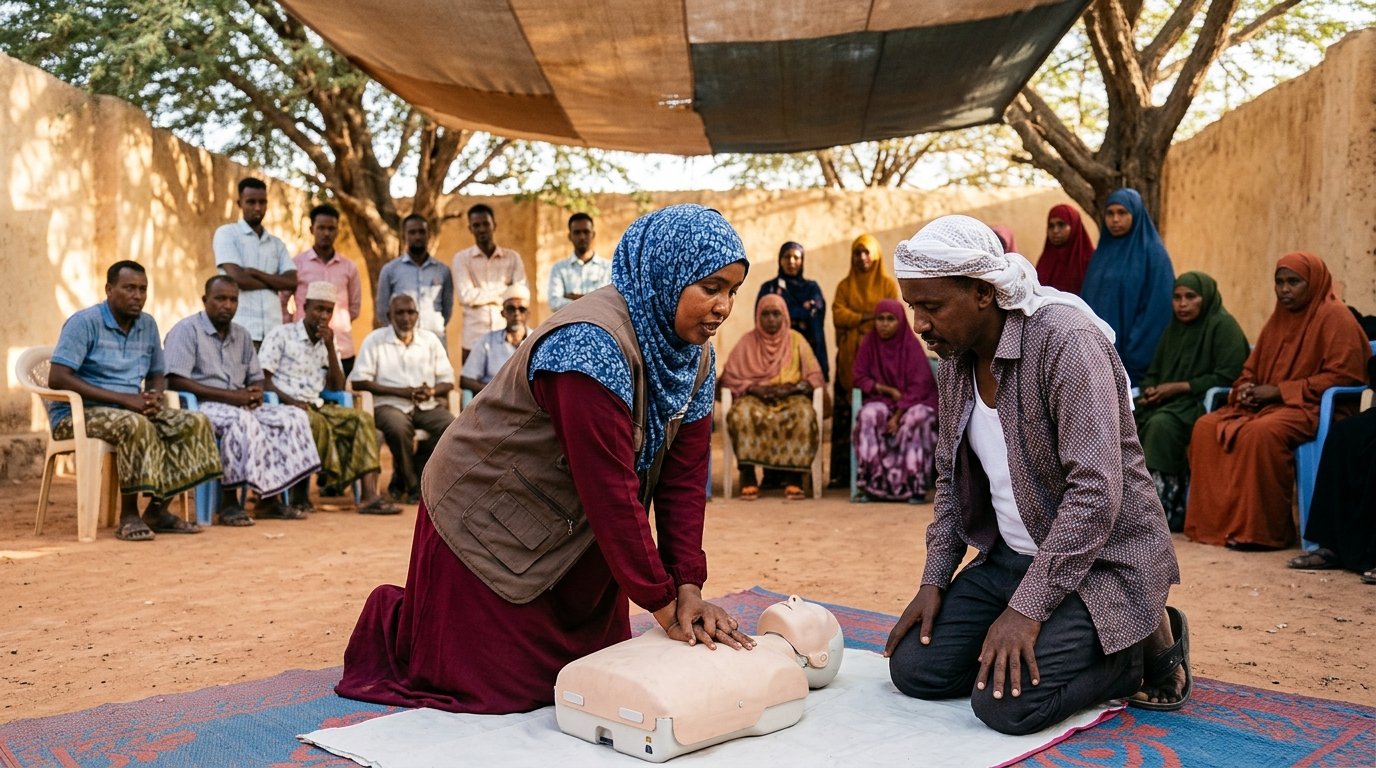
A fully recovered sudden cardiac arrest survivor in Somaliland has released a public testimony to dismantle long-standing local taboos and promote community awareness of cardiopulmonary resuscitation, according to a clinical correspondence published in Resuscitation Plus. The intervention highlights how clinical resuscitation milestones can translate into broader public health initiatives in regions where formal emergency medical infrastructure has historically been scarce. Prior to recent bilateral health initiatives, bystander cardiopulmonary resuscitation rates across Africa were documented at 8 percent or less, and were practically non-existent in Somaliland, where emergency dispatch systems and public familiarity with life-saving resuscitation techniques were not previously established or socially accepted.
The clinical case presented in the report began on July 18, 2026, when a 47-year-old man arrived at Gabiley General Hospital experiencing sudden severe chest pain that radiated to his left shoulder, accompanied by profuse diaphoresis. During an initial electrocardiographic evaluation, the patient suddenly lost both his pulse and spontaneous respiration. A clinical resuscitation team that had recently returned from specialized medical training in Taiwan intervened immediately, initiating both basic and advanced cardiac life support protocols without delay at the bedside.
The medical team delivered prompt chest compressions, applied an automated external defibrillator, administered electrical shocks, and delivered intravenous adrenaline to counter the sudden cardiovascular collapse. As a result of these rapid measures, return of spontaneous circulation was successfully achieved within two minutes. Following resuscitation, the patient demonstrated stable vital signs, presenting with an oxygen saturation of 99 percent, a heart rate of 86 beats per minute, a blood pressure reading of 110/70 mmHg, and a respiratory rate of 19 breaths per minute.
Subsequent diagnostic testing with a 12-lead electrocardiogram confirmed that the underlying cause of the arrest was an acute anterior wall ST-segment elevation myocardial infarction. To receive specialized post-resuscitation and advanced cardiac management, the patient was promptly transferred to Gargaar Hospital. Following advanced cardiac care, the patient ultimately achieved complete neurological recovery.
With full written informed consent, the patient recorded a public testimony to raise public awareness of CPR and resuscitation for sudden cardiac arrest. In the published video recording, both the patient and his resuscitator appear on camera to recount the sudden nature of the collapse. Their account directly challenges the entrenched cultural perspective that sudden cardiac arrest is an entirely inescapable divine decree, emphasizing instead that sudden collapse is a treatable medical emergency and urging the public to embrace life support education.
The authors emphasize that a living survivor provides unique credibility in settings where successful cardiopulmonary resuscitation has no prior precedent. Rather than relying solely on formal administrative guidelines, hearing directly from a healthy, neurologically recovered community member provides social permission for others to act during emergencies. While CPR prevalence tracks national income, a documented shift in a setting with no CPR tradition is of practical public health relevance.
This case also demonstrates how hospital capabilities can serve as an operational anchor for broader community engagement, aligning with the objectives of the World Health Assembly resolution on emergency care for universal health coverage. Pursued through bilateral healthcare partnerships between Taiwan and Somaliland outside of formal World Health Organization membership, the collaboration has already enabled the introduction of first-responder and school-based training programs in Somaliland. Healthcare providers will implement other low-cost, scalable initiatives in the future.
Subject of Research: Community cardiopulmonary resuscitation awareness and emergency cardiac care in Somaliland
Article Title: The first survivor’s voice: breaking the silence of the public on cardiopulmonary resuscitation in Somaliland, East Africa
Article References: Mohamed Bile, E. M., Muuse, M. M., Sheekh Muhumed, I. S., Pan, C.-T., & Chiang, W.-C. (2026). The first survivor’s voice: breaking the silence of the public on cardiopulmonary resuscitation in Somaliland, East Africa. Resuscitation Plus, 32, Article 101540. https://doi.org/10.1016/j.resplu.2026.101540
Image Credits: AI Generated
DOI: 10.1016/j.resplu.2026.101540
Keywords: cardiopulmonary resuscitation, sudden cardiac arrest, Somaliland, Gabiley General Hospital, Gargaar Hospital, defibrillation, advanced cardiac life support, basic life support, ST-segment elevation myocardial infarction, emergency medical services, Taiwan-Somaliland cooperation, World Health Assembly, resuscitation training, return of spontaneous circulation, public health awareness, bystander CPR
