


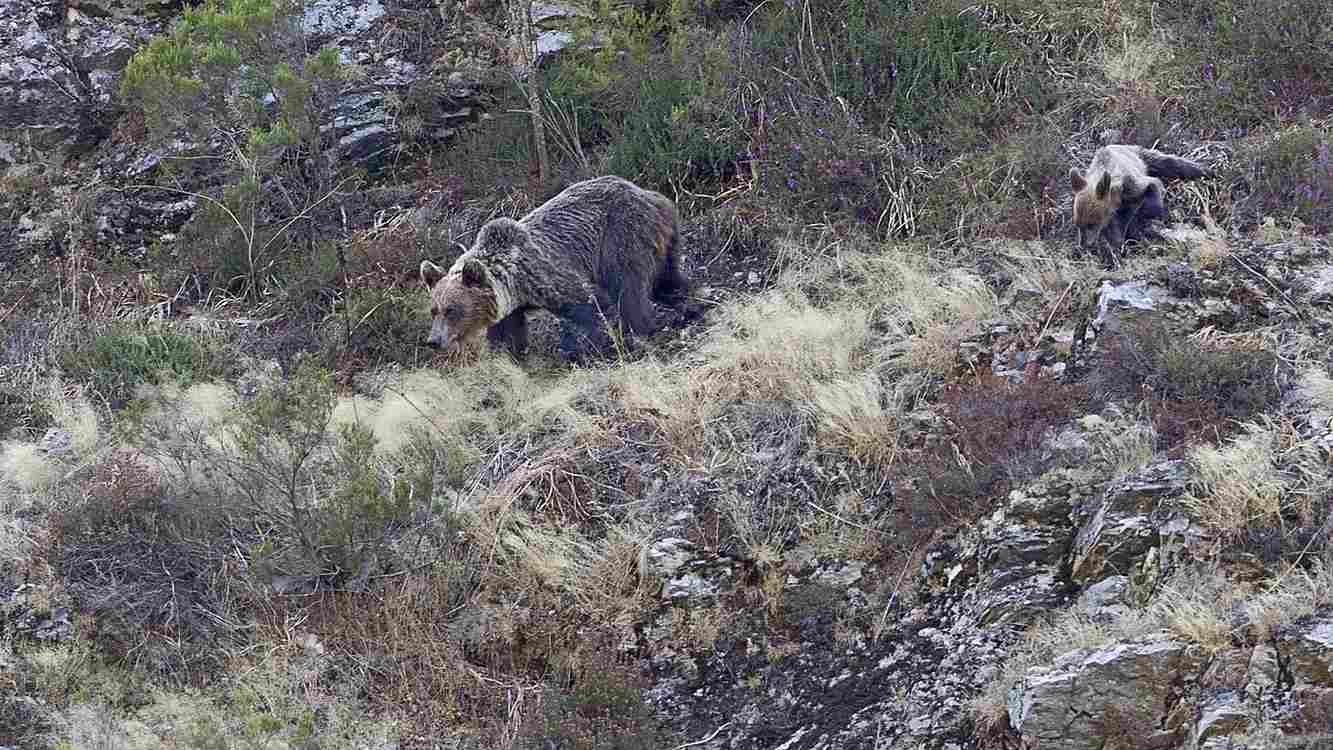
A Cantabrian brown bear – credit, Juan Iacruz CC BY-SA 4.0.
From the brink of extinction to roaming across 6,500 square miles, populations of Cantabrian brown bears have doubled in Spain over the last 20 years to 370.
Numbering as few as 140 by estimates in the early 21st century, they’re another example of Spain’s ongoing success in protecting several of the country’s endemic species.
Taking its name from the far northern Spanish region whose mountains stand as the bear’s last redoubt, Cantabrian brown bears can actually be found across the regions of Asturians, Leon, Galicia, and Palencia, in addition to Cantabria.
By restricting the movement of animals, the Iberian Peninsula’s northern mountain ranges have led to high rates of endemism in Spain and Portugal among animals such as the wolf, lynx, and bear.
Direct human persecution and the conversion of wilderness to agricultural land gradually impacted the brown bear’s numbers until they could only be found in Cantabria. Yet they clung to existence in the mountains until sufficient protections were put in place for them to gain a second wind.
A study published in 2023 bears witness to the successful survival and spread by Spain’s bears. Published in the journal Conservation Science and Practice, it found that the government’s continual protection measures and establishment of new protected areas, coupled with rural depopulation, allowed the bears to substantially recover.
Using all data available to them, the authors measured the changes in population numbers across 3 periods: from 1982 to 1992, from 1993 to 2002, and from 2003 to 2012.
While a 25% reduction in the numbers of bears was observed between the first 2 periods, this was followed by a 70% increase by the end of the 3rd period. That final period also saw their breeding ranges expand by 30%, such that Cantabria’s 2 breeding populations now overlap, having been separated for decades by an 18-24 mile series of gorges with a highway running through them.
The first 2 periods coincided with the creation of Somiedo Natural Park and Redes National Park respectively, which increased the amount of protected areas centered on the last remaining populations of brown bears 688 square kilometers. Fines for unauthorized killing of bears reached some $350,000.
Additional growth in the geographical range of 77% was observed by the authors between 2013 and 2022 in exactly the proportion and areas they predicted.
Representation of the range and breeding range of the Cantabrian brown bear population in the three selected periods – credit, Diaz-Fernandez et al. Conservation Science and Practice, doi10.1111/csp2.12894
The total area now occupied by brown bears extends beyond 17,000 square kilometers, or 6,500 square miles. The bear went locally extinct in neighboring Asturias, where another 5,000 square kilometers of viable habitat is likely one of the next places the growing bear population will expand into.
The authors warned that existing management plans by the surrounding territories are outdated and underestimate the ability of the bear to spread and colonize the region, and that these plans should be updated pre-emptively to prevent human-wildlife conflict.
MORE CONSERVATION SUCCESSES: From One Surviving Male Bison, Azerbaijan Now Has 25 Calves Born Wild in 7-Year Success Story
The brown bear is the largest carnivore in Europe, and as such is instrumental in anchoring the terra firma food web from the top down. It performs vital ecosystem services by scavenging carrion and thereby preventing disease, as well as aiding in plant biodiversity by dispersing seeds that stick to its shaggy coat.
In an interesting coincidence, it took another of Spain’s largest carnivores: the Iberian lynx, about the same 2 decades to recover from population collapse in Andalusia. Since 2010, more than 400 Iberian lynx have been reintroduced to parts of Portugal and Spain, where over 600 adult lynx are now raising cubs and roaming across over 1,200 square miles.
They were once considered “Critically-Endangered” by the IUCN, but now merely “Vulnerable,” the same status as the cheetah in Africa.
SHARE This Brilliant Bear News From Sunny Spain With Your Friends…
