


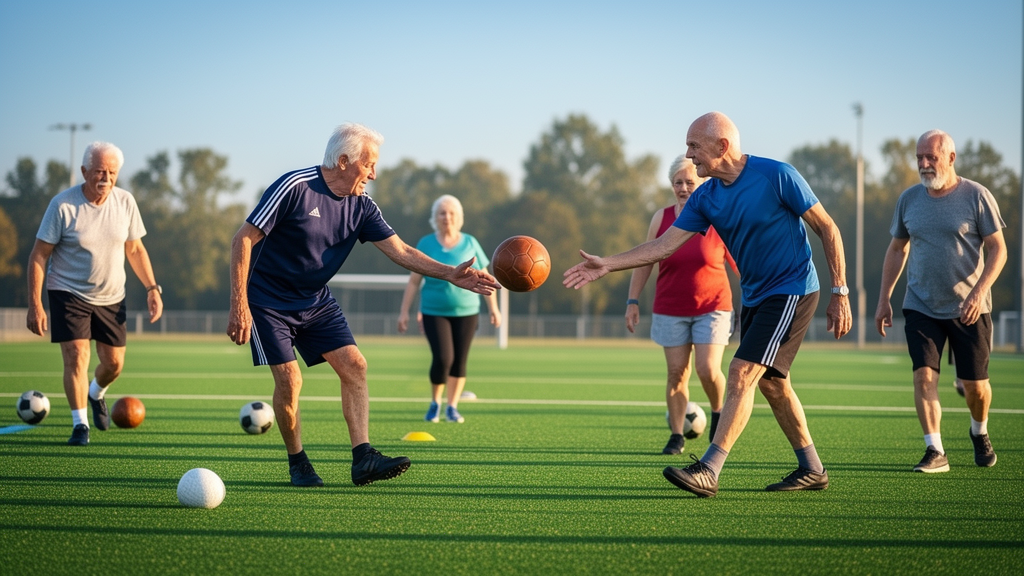
A preliminary study published in BMC Sports Science, Medicine and Rehabilitation provides initial descriptive estimates regarding the safety and health impacts of walking football for older adults with low physical activity levels. A secondary aim of the investigation was to descriptively characterize the participants’ self-rated physical and mental health over a 12-week period. The study addresses a gap in current knowledge, as reports from health care providers have indicated a lack of understanding regarding the safety aspects of team sports for this demographic, and existing research on injuries and well-being within walking football remains limited.
The study enrolled a total of 39 participants, comprising 13 men and 26 women, with a mean age of 74.0 years and a standard deviation of 5.7 years. All participants were identified as having low physical activity levels prior to beginning the intervention. Of the initial cohort, 33 participants, consisting of 11 men and 22 women, completed the full 12-week study period. The trial was retrospectively registered with the ISRCTN registry under the identifier ISRCTN41037595 on August 14, 2024. The intervention involved participating in walking football, a recreational sport specifically aimed at older adults, which has been previously noted for its fun and social aspects. The study design included weekly monitoring of injuries and assessments of self-rated health at both the baseline and the conclusion of the 12-week period.
Methodologically, the researchers utilized a weekly injury questionnaire that participants completed throughout the 12 weeks of walking football. Additionally, at both the start and the end of the intervention, participants answered four specific questions designed to assess their self-rated physical health, mental health, anxiety, and loneliness. This dual assessment approach enabled the researchers to compare the participants’ perceptions of their health status before and after the 12-week period of regular walking football participation. The data collected provided a foundation for calculating injury incidence rates and proportions, as well as for describing the trends in self-rated health metrics.
The results indicated that the participants’ ability to fully participate in playing walking football during the 12-week study period was 95% on average. Three out of the 33 participants who completed the study suffered from an injury that led to reduced or missing training sessions. This outcome resulted in an injury incidence proportion of 9%. The estimated injury incidence rate was calculated to be 7.25 injuries per 1,000 player-hours, with a 95% confidence interval ranging from 1.49 to 21.18. The wide confidence interval reflects the small number of injury events observed in the study, highlighting the uncertainty associated with the precise rate estimate.
Beyond injuries, the study examined reports of pain and self-rated health. Mild or moderate pain was reported by 11 participants during the 12-week period. Regarding general physical health, 87.9% of the participants rated their health as ‘good’ to ‘excellent’ at baseline. After completing the 12 weeks of walking football, this percentage decreased slightly to 81.8%. In contrast, the self-rated general mental health showed a slight improvement. At baseline, 90.9% of the participants rated their mental health as ‘good’ to ‘excellent’, whereas this figure increased to 93.9% post-intervention. These descriptive findings provide a snapshot of how participants perceived their physical and mental well-being over the course of the study, although the changes were modest and the sample size was limited.
The authors conclude that the study presents preliminary descriptive estimates of injury incidence and self-rated physical and mental health during the 12-week walking football intervention. They emphasize that the findings should be interpreted with caution due to the small sample size and the low number of injury events observed. The study serves as an initial step in understanding the safety profile of walking football for older adults with low physical activity levels, but the results require confirmation in larger cohorts with longer follow-up periods to establish more robust evidence.
Subject of Research: Injury incidence and self-rated health in older adults during walking football
Article Title: Estimating injury incidence and describing self-rated physical and mental health during 12 weeks of walking football for older (60+) men and women with low physical activity levels
Article References: Caspers, A., Andersson, H., Godhe, M., Fransson, D., Börjesson, M., & Ekblom-Bak, E. (2026). Estimating injury incidence and describing self-rated physical and mental health during 12 weeks of walking football for older (60+) men and women with low physical activity levels. BMC Sports Science, Medicine and Rehabilitation, 18(1), Article 543. https://doi.org/10.1186/s13102-026-02224-4
Image Credits: AI Generated
DOI: 10.1186/s13102-026-02224-4
Keywords: walking football, older adults, injury incidence, physical health, mental health, low physical activity, safety, recreational sport, BMC Sports Science, Estimating, injury, incidence
