


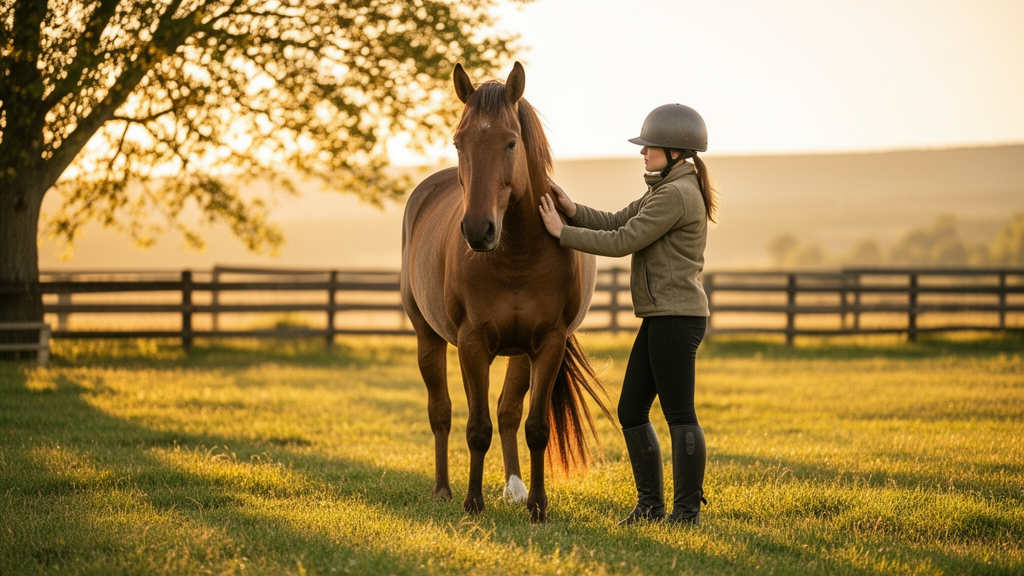
The quality of the relationship between a horse and its rider is positively associated with mental well-being among female equestrians, while horse ownership itself shows no relationship to bond quality, according to a cross-sectional validation study published in Frontiers in Sports and Active Living. Led by Hajnalka Eszter Selmeci, Tamás Berki, and Noémi Gyömbér at the Hungarian University of Sports Science in Budapest, the investigation examined the psychometric properties of the Horse-Rider Relationship Scale and explored its direct associations with psychological outcomes in riders.
The authors noted that the horse-rider relationship is increasingly recognized as a determinant of psychological well-being in equestrian riders, but validated measurement instruments have remained scarce outside English-speaking contexts. To address this methodological gap, the researchers administered a survey to a cross-sectional sample of 160 female equestrian riders across Hungary. Participants completed a Hungarian version of the Horse-Rider Relationship Scale alongside the Sport Mental Health Continuum Short Form.
The Horse-Rider Relationship Scale assesses five distinct relational dimensions: compatibility, communication, respect, trust, and self-confidence. To evaluate the construct validity of the instrument in this population, the researchers conducted a confirmatory factor analysis. The analysis confirmed the hypothesized five-factor structure with acceptable model fit, reporting a comparative fit index of 0.974, a Tucker-Lewis index of 0.962, a root mean square error of approximation of 0.059, and a standardized root mean square residual of 0.037.
Bivariate Pearson correlation analyses revealed that all five relationship dimensions yielded statistically significant positive associations with emotional, psychological, and social well-being. Across the measured dimensions, the strongest correlations were observed between psychological well-being and rider self-confidence (r = 0.495), followed closely by communication (r = 0.485). These positive correlations indicate that riders reporting higher relationship quality with their horses also reported higher levels of well-being across emotional, social, and psychological domains.
In addition to evaluating relationship dimensions, the researchers examined group differences based on horse ownership. The analysis revealed that owning a horse was not significantly associated with any of the five Horse-Rider Relationship Scale dimensions, indicating that the quality of the bond does not depend on legal ownership. The authors concluded that the scale demonstrates sound psychometric properties in Hungarian female riders, noting that relationship quality rather than ownership is associated with greater mental well-being, which underscores the value of fostering horse-rider partnerships in sporting and therapeutic equestrian contexts.
The research paper, situated in the sport psychology section of Frontiers in Sports and Active Living, contextualizes the human-animal interaction between equestrians and horses as a meaningful contributor to psychological well-being.
Subject of Research: Horse-rider relationship quality and mental well-being in female equestrian riders
Article Title: The quality of the horse-rider relationship and mental well-being in female equestrian riders: a cross-sectional validation study in Hungary
Article References: Selmeci, H. E., Berki, T., & Gyömbér, N. (2026). The quality of the horse-rider relationship and mental well-being in female equestrian riders: a cross-sectional validation study in Hungary. Frontiers in Sports and Active Living, 8, Article 1944561. https://doi.org/10.3389/fspor.2026.1944561
Image Credits: AI Generated
DOI: 10.3389/fspor.2026.1944561
Keywords: equestrian sport, horse-rider relationship, mental well-being, sport psychology, human-animal interaction, Horse-Rider Relationship Scale, psychological well-being, cross-sectional study, quality, horse-rider, relationship, mental
