


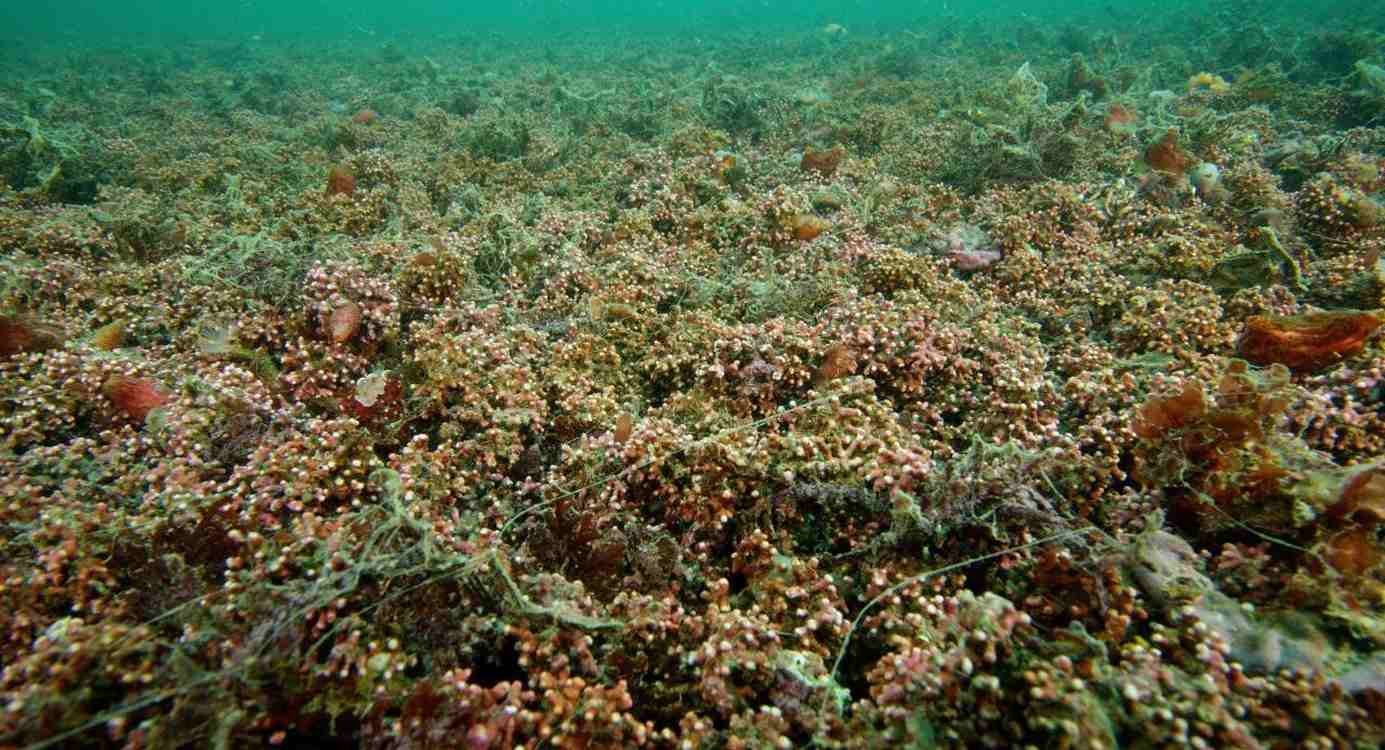
Maerl beds in French waters – credit, Olivier Dugornay, CC 4.0. BY
Seabed Thriving 10 Years After Scottish Dredging Ban
Islanders Celebrate Protections of Their Magical Maerl Beds
Fish Stocks Thrive Thanks to This Strange Seaweed and Locals Who Protected It
A ban on industrial scallop dredging has been “the most amazing thing to happen” to the residents, both man and marine, of the Summer Isles.
In place for 10 years, the ban has protected this extraordinary kind of magenta-colored seaweed called maerl, which forms hard, chalky nodules like coral on the seabed, and has allowed for whales, dolphins, porpoises, and key fish stocks to thrive.
Scallop dredging around the Summer Isles had damaged this incredible marine seascape for decades until a coalition of citizen scientists and activists got the activity banned inside a 150,000-acre protected area off the northwest coast of Scotland that contains all the area’s maerl beds, including 2 that are over a mile long which have been growing in the same place for 9,000 years.
Maerl builds up overtime into beds and carpets that interlock, creating magnificent marine habitat for fish species to breed.
Looking somewhat like the pieces from a game of knucklebones, the free movement of water between each nodule provides for excellent circulation which the foundational species of the marine food web need. They in turn provide for the species above and beyond them, all the way up to dolphins and humans.
The protections have been the “most amazing thing to happen to the Summer Isles,” one local activist and artist named Diyanna Ross told the Guardian. “It is an archipelago that is made in heaven for breeding fish.”
The Blue Hope Alliance, of which Ross is a part, also includes an association of Scottish “creel” fishermen, a smaller, more sustainable method of harvesting seafood that doesn’t deplete underlying stocks.
Decades of dredging had severely depleted scallop numbers, requiring industrial fishing operations to damage more and more seabed in search of the bivalves.
The 10-year-old campaign to ban scallop dredging, the Guardian reports, was as much about allowing these creel fishermen to continue to harvest scallops as it was about allowing the scallop to recover.
YOU’LL ALSO LIKE: Another Trawling Ban, Another Big Recovery for Sea Life
And recover they have—like “night to day,” says Alasdair Hughson, a scallop diver from the Scottish Creel Fishermen’s Federation.
Scientists have demonstrated that despite constraining available fishing areas, the creation of marine protected areas actually benefits fish stocks in the long term, as they offer a haven for uninterrupted proliferation of game species which then spill out beyond the protected area’s boundaries.
Though the object of the Blue Hope Alliance and SCFF’s activism was ending the practice of exploiting a single species without limit, that benefit felt by the scallops is now spilling over to herring, cod, and haddock, which are able to breed amidst the maerl beds without fear of disturbance.
GOOD FISHING NEWS: Over 90 California Fish Stocks Almost Totally Rebuilt Thanks to Trawling Ban, Other Measures
Should the dredging ban have been dismissed, by now a significant portion—if not all—of the Summer Isles maerl beds would have been destroyed.
Scottish wildlife authorities estimate that the country contains roughly 30% of all the maerl beds in northwest Europe, and most in the UK. A single pass of the heavy metal dredging gear used in industrial harvesting can crush or bury 70% of all the maerl it touches.
SHARE This Fantastic Story Of Activists Protecting Their Seas….
