


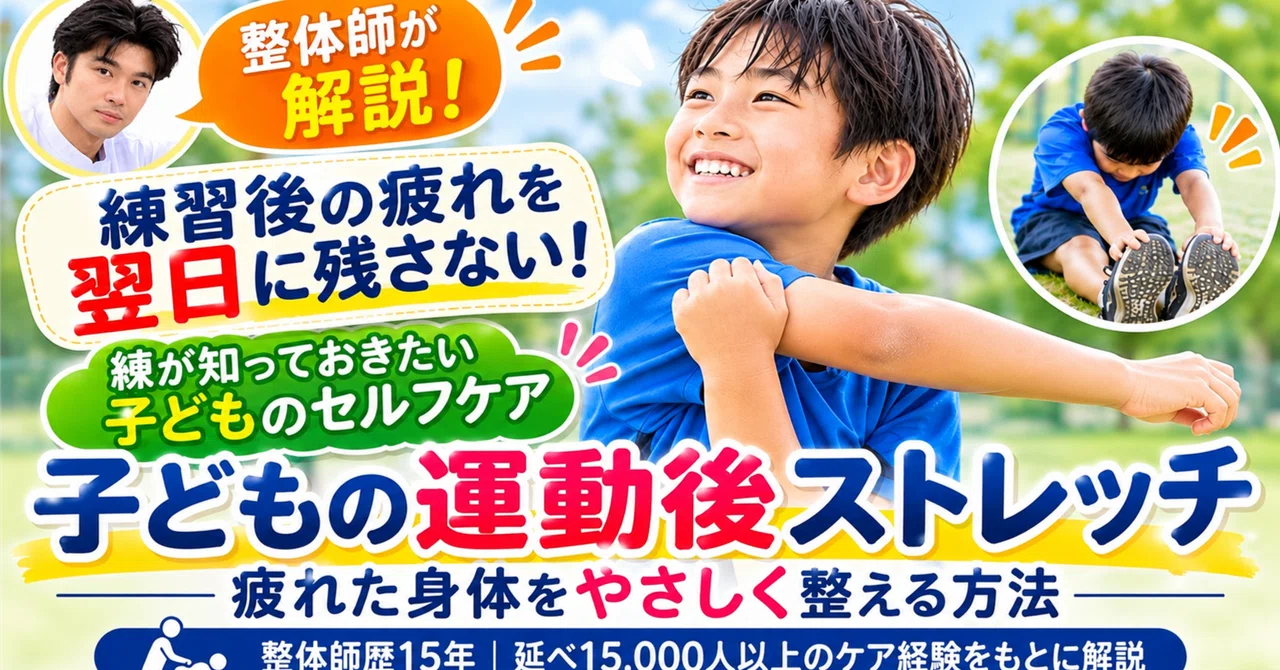
Don’t Let Post-Practice Fatigue Carry Over to the Next Day! Self-Care for Kids That Parents Should Know
Post-Exercise Stretching for Kids | How to Gently Restore a Tired Body
Soccer, baseball, basketball, track and field, volleyball, tennis…
Children who work hard at sports every day.
And the parents who support that hard work.
When your child comes home from practice,
“I’m so tired today…”
“My legs are so stiff!”
“I have practice tomorrow too, will I be okay?”
Have you ever felt worried seeing them like that?
For children who work hard at sports, post-practice body care is just as important as the practice itself.
After moving their bodies with all their might, muscles can accumulate fatigue, and they may feel tightness or heaviness in their bodies.
Children in their growth phase, in particular, are still in the process of developing.
It is important to build daily habits of taking care of their bodies, including not just exercise volume, but also rest, sleep, and nutrition.
That said, there is no need for parents to acquire specialized knowledge or learn difficult stretches.
What is important is to notice changes in your child’s body, avoid pushing them too hard, and support them with what you can do.
So, this time, we will introduce post-practice stretches and self-care for fatigue recovery for children who work hard at sports and the parents who support their bodies.
No special equipment is required.
There are also simple care routines that parents and children can do together.
“You worked hard again today!”
Why not take some time to care for your child’s body along with those words of encouragement?
*Stretching and post-exercise care should be performed once practice is over and the child is in a safe, calm state. If there is any pain, do not force the stretch and stop immediately.
Chapter 1 | What is happening to the bodies of children who work hard at sports?
Sports practice involves repeating various movements such as running, jumping, kicking, throwing, and bracing.
These actions place a gradual load on muscles, joints, and the body as a whole.
That is why children may feel fatigue or tightness after practice.
So, what kind of changes occur in a child’s body?
1. Muscle fatigue accumulates
Actions like running, jumping, and kicking a ball use various muscles, including those in the legs, buttocks, and back.
On days with high activity levels or more intense practice than usual, children may feel muscle fatigue or tightness.
In particular, the thighs, calves, and buttocks are areas that are prone to strain depending on the type of sport.
After practice, it is important to check the child’s physical condition and let them rest within a reasonable range.
2. Repetitive movements place strain on specific areas
How the body is used varies depending on the sport.
For example,
Soccer: Running, kicking, cutting
Baseball: Throwing, hitting, running
Basketball: Jumping, landing, changing direction
Track and field: Running, jumping, stepping
Tennis: Running, stopping, swinging a racket
As you can see, the repetitive movements differ for each sport.
Since stress can concentrate on the same areas, be sure to check your child’s overall physical condition after practice.
3. During growth spurts, attention to physical changes is also necessary
A child’s body develops bones, muscles, and joints as they grow.
During periods of rapid height growth, their body balance and movement patterns may also change.
Therefore, even movements that were previously performed without issue may cause discomfort due to these physical changes.
What is important here is not to assume that pain is just simple muscle soreness.
If there is pain, do not force them to stretch, and consult a medical professional if necessary.
For children to enjoy sports for a long time, rest tailored to their physical condition is just as important as the amount of practice.
Chapter 2 | Physical Signs Parents Should Check After Practice
Children may not always be able to explain their physical condition well.
Therefore, it is important for parents to notice differences from their usual state.
Take a moment to observe them after practice or when they return home.
Legs and Thigh Area
Thighs look tight
Complaining that their calves feel heavy
Reluctant to go up and down stairs
Walking differently than usual
Lower Back and Hip Area
Seeming bothered by their lower back or hip area
Feels uncomfortable when leaning forward
Seems to have trouble sitting down or standing up
Shoulders and arms
Bothered when rotating shoulders
Seems to have difficulty raising arms
Complains of pain when throwing a ball
General condition
Looks more tired than usual
Appetite has decreased
Having trouble falling asleep
Does not want to go to practice
Just because these changes occur does not necessarily mean there is an injury or illness.
However, caution is required if unusual behavior persists.
In particular, do not stretch and consult a medical institution in the following cases.
When an injury is suspected, it is also important not to force them to continue practicing.
The first care parents can provide is to notice the small changes in their child.
Chapter 3 | Gentle Stretches You Can Do After Your Child Exercises
From here on, we will introduce simple stretches that are easy to incorporate after practice.
This is intended for children who have no pain or injuries and are feeling normal post-exercise fatigue.
You do not need to do all of them.
Perform them within a comfortable range, adjusting for the child’s age and physical flexibility.
The important thing is not to stretch strongly, but to move the body comfortably.
1. Gently stretch the front of the thighs
The front of the thighs is a part used in various sports, such as running, kicking, and jumping.
[Method]
Hold onto a wall or handrail to stabilize your body
Slowly bend one knee
Hold your ankle within a comfortable range
Stop at a position where you feel a light stretch in the front of the thigh
Hold for about 10 to 20 seconds while continuing to breathe
Do the same for the other side
*If you cannot reach your ankle, there is no need to force it. Stop if you feel like you might lose your balance.
Point: Do not arch your back or pull your knee too hard.
2. Gently stretch the back of the thighs
The back of the thighs are used for movements such as running and bending the body forward.
[Method]
Sit on the floor or a mat
Extend one leg forward and bend the opposite knee comfortably
Try not to round your back too much
Slowly lean your body toward the extended leg
Stop at a position where you feel a light stretch in the back of your thigh
Hold for about 10 to 20 seconds while continuing to breathe
Do the same for the other side.
Tip: There is no need to force your hands to reach your toes. Stop if you feel pain or numbness.
3. Gently stretch the calves
In sports that involve running or jumping, the calves are also frequently used.
[Method]
Place both hands on a wall
Step one leg back
Place the heel of the back foot on the floor
Slowly bend the front knee
Stop at a position where you feel a light stretch in the back calf
Hold for about 10 to 20 seconds
Do the same for the other side.
Point: Do not force your heels into the floor. Do not perform this if you have pain in your ankles or Achilles tendons.
4. Gently stretch the hip area
The gluteal muscles are used for movements such as running, stopping, and changing direction.
[Method]
Sit on the floor or a mat
Bend both knees slightly
Place one leg near the other and find a comfortable position
Keep your back straight naturally
Breathe while in a position where you feel a light stretch around your hips
If it is difficult to maintain the posture, it is okay not to force it.
Point: Stop if you feel pain in your knees or hip joints.
Important points when stretching
Stretching should be incorporated according to the body’s condition.
It does not mean that the more you stretch, the better it is.
Try to make it a time for parent and child to move their bodies comfortably together.
Chapter 4 | It’s Not Just About Stretching! Important Things for Fatigue Recovery
When it comes to post-exercise body care, many people might think of stretching.
However, to support a child’s body, there are other important things besides stretching.
Things to be especially conscious of are meals, hydration, and sleep.
1. Replenish nutrients with post-practice meals
When playing sports, the body uses energy.
After exercise, base your meals on your regular diet, incorporating staples, main dishes, and side dishes in a balanced way.
For example,
Rice or bread: Energy to move the body
Meat, fish, eggs, soy products: Protein to build the body
Vegetables and fruits: Vitamins, minerals, etc.
There is no need to prepare special supplements or expensive foods.
First, it is important to create an environment where they can eat their daily meals properly.
If they have no appetite or if their food intake remains extremely low, do not force them to eat; instead, check their physical condition and consult a professional if necessary.
2. Don’t forget hydration
During exercise, you sweat, so water is lost.
After practice, make sure to provide hydration according to the child’s condition.
Be especially careful on hot days or days with high levels of physical activity.
Drink water before practice
Stay hydrated frequently during practice
Replenish fluids after practice
Be careful of heatstroke on hot days
If your child has sweated a lot, consider replenishing salt and electrolytes depending on the situation.
It is important to develop a habit of drinking fluids frequently, rather than waiting until they are thirsty.
3. Ensure sufficient sleep time
Sleep is very important for a child’s physical development.
Sleep is a time for the body and brain to rest.
Lack of sleep can affect concentration and athletic performance the next day.
Some things you can do at home include:
Going to bed at a consistent time as much as possible
Staying away from smartphones and games before bed
Creating a calm environment in the bedroom for sleep
Ensuring there is time to rest after practice
and so on.
The amount of sleep required varies depending on the child’s age.
As a general guideline, 9 to 12 hours of sleep is recommended for children aged 6 to 12, and 8 to 10 hours for those aged 13 to 18.
Try to plan a daily rhythm that includes sleep time so that the day doesn’t end with just practice.
4. Resting is also part of practice
It is wonderful to practice hard every day.
However, if there is not enough time to let the body rest, fatigue may not recover sufficiently.
Adjust the amount of practice on days when fatigue is high
Do not force them when they are in pain
Ensure rest days are secured
Check their sleep and nutritional status as well
To continue playing sports for a long time, not only are days of hard work important, but so are days of rest.
Chapter 5 | What parents can do to protect the bodies of growing children
When your child is working hard at sports,
“Wouldn’t they get better if they practiced more?”
“Won’t they fall behind the others if I let them rest?”
You might feel that way sometimes.
Of course, putting in effort is important.
However, protecting your child’s body is just as important.
1. Listen carefully to your child
After practice,
“Where do you feel tired today?”
“Is anything hurting?”
“Do you think you’ll be okay for practice tomorrow?”
Please try asking them things like this.
What is important is that the child feels safe talking about their physical condition.
When they complain of pain, instead of immediately saying “You’re fine” or “Keep at it,” listen to what they have to say first.
2. Consider the balance between practice volume and rest
Children who love sports may sometimes push themselves too hard during practice.
Between school life, extracurricular activities, and sports practice, a child’s day is surprisingly busy.
Pay attention not only to physical fatigue but also to mental fatigue.
3. Do not make them endure pain
As children continue to play sports, they may experience physical discomfort.
However, continuing to practice while enduring pain does not necessarily lead to good results.
If there is pain, stop or adjust the exercise, and have it checked by a medical institution if necessary.
Especially during growth periods, problems related to bone and joint development can occur.
It is important not to assume that it is just the usual fatigue.
4. Acknowledge not just the results, but the process of their hard work
On days they win a match, and on days they lose.
On days they do well in practice, and on days things don’t go as planned.
For a child, words from their parents are a great source of support.
“You worked hard again today.”
“You were able to practice until the end.”
“You’re tired, so let’s rest well today.”
Such words can lead to a sense of security for the child.
Just like physical care, let’s also cherish mental care.
Let’s choose just one thing you can start doing today
You don’t need to start everything at once.
First, try choosing just one thing you can do at home.
□ Check your child’s physical condition after practice
□ Try gently stretching their thighs and calves
□ Don’t forget to hydrate after practice
□ Ensure they eat a proper meal
□ Ensure they get enough sleep
□ Let them rest without pushing them on days when they are very tired
□ Consult a professional if there is any pain
It’s okay if you can’t do everything perfectly every day.
Moving the body a little after practice.
Going to bed earlier than usual.
Taking the time to listen to your child.
Such small, consistent efforts lead to habits that value the body.
*If there is pain, swelling, difficulty walking, etc., do not try to handle it with stretching; please consult a medical institution.
For children to enjoy sports for a long time
For children who work hard at sports, practice is a valuable time.
However, practice is not the only part of building a body.
Post-exercise care.
A balanced diet.
Getting enough sleep.
And, time to rest the body.
All of this supports a child’s growth.
What parents can do is not just teaching difficult training.
Noticing changes in your child’s body.
Letting them rest when they are tired.
Acknowledging the hard work they put in during the day.
Why not start with such accessible support first?
So that children can continue to enjoy the sports they love with a smile.
Let’s cultivate the habit of taking care of the body together as parent and child, little by little.
✨ Author Profile
Hiro Seitai’s [New Book of Anatomy]
Self-Care Consultation Room for Building a Pain-Free Body
15 years of clinical experience | A chiropractor who has been involved in the care of over 15,000 people in total.
Served as a store manager at chiropractic salons in Omotesando, Ikebukuro, and Takadanobaba, and also experienced store management.
Leveraging experience cultivated in a wide range of treatment settings such as sports chiropractic, beauty chiropractic, and myofascial release, I am currently active as a total advisor.
“Making physical discomfort easier to manage through more accessible methods”
Valuing this sentiment, I share self-care practices that can be incorporated into daily life and during breaks at work.
I would like to convey the importance of caring for the body to children who work hard at sports and the parents who support their growth.
Don’t push yourself too hard, and don’t endure too much.
Let’s build habits together for taking care of your own body.
