


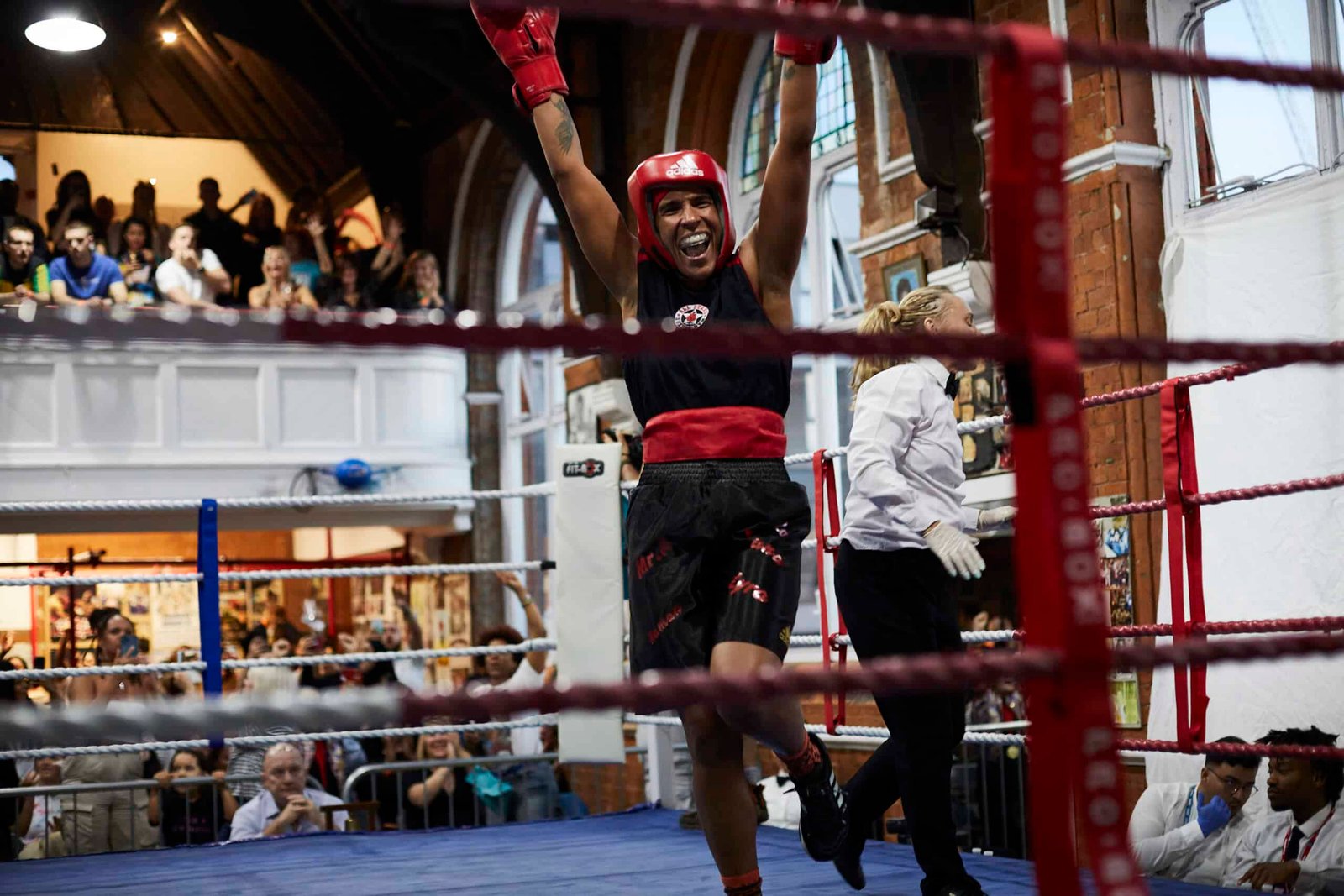
A new series of all-female fight nights aims to fund free boxing classes that help women rebuild their confidence after abusive relationships
“The Fight Forward programme literally saved my life,” explains Saria, 40, raising her voice above the sound of gloves hitting punchbags and fellow boxers chatting at the 12×3 boxing gym in Aldgate, east London.
Two years ago, after leaving one abusive relationship and then finding herself in another, Saria was struggling. She signed up for her first boxing camp, run by former Team GB boxer and European gold medallist Lesley Sackey, who had begun offering free classes to survivors of domestic abuse.
“Doing that camp gave me the strength to fight for myself in that relationship, to get myself out of it, and to have confidence,” she recalls. “It gave me a sense of self-worth that I’d never had in my life.”
As she speaks, others from her cohort sidle up beside her, flushed and energised after rounds of sparring, to compare notes on everything from gum shields to home-made glove deodorising sprays.
Saria’s involvement in boxing now goes well beyond a weekly fitness class: on 28 November she will join several women from the programme to step into the ring at London’s Ladbroke Hall for The Fight Back. It will be the inaugural event staged by a new venture called Fight Back Promotions.
Founded by Sackey alongside three-time national boxing champion Shelly Sweeney and impact media entrepreneur Poppy Mason-Watts, Fight Back Promotions aims to turn ticketed events into a sustainable source of funding for Fight Forward CIC, the not-for-profit organisation behind Saria’s training programme.
One quarter of the profits from each event will support Fight Forward’s classes and programmes for women affected by domestic abuse. The founders also want to give women in white-collar boxing more opportunities to compete against evenly matched opponents, in a space where men have traditionally dominated fight cards.
Women were barred from professional boxing in the UK until 1998, while women’s boxing made its Olympic debut at London 2012. In white-collar boxing, the organisers say, women can still find themselves matched with opponents in different weight classes or with different levels of experience.
Good news, now on video
Enjoying this story? Get three more every Saturday on What Went Right, our new weekly video podcast bringing you the good news that matters.
Watch the trailer
Serving women better “means taking into account fair matching,” Sackey explains. “It also means allowances around period weight. That’s a massive thing. Boxing is a weight-class sport, and we know that when it’s our cycle, we can put on up to 2kg in water weight. That’s never been considered in the white-collar space before.”
For Mason-Watts, securing big-name sponsors was an important part of establishing the project. Brands including lululemon, NEOM and Proper Snacks have signed up to support the events, but ticket sales remain central to the model. She hopes the first fight night will fund free places for another 40 to 60 women, with the team aiming to stage two events a year.
The WHO estimates that nearly one in three women worldwide have experienced physical or sexual violence by an intimate partner, or sexual violence by someone else, during their lifetime. Meanwhile, the latest figures from the ONS suggest that around one in eight women aged 16 and over in England and Wales experienced domestic abuse, sexual victimisation or stalking in the past year.
Fight Back co-founders, from left to right, Poppy Mason-Watts, Lesley Sackey and Shelly Sweeney. Image: Fight Back
Just under 40 women have now completed the structured boxing programme, with organisers gathering feedback before and after sessions to assess changes in participants’ mental health and self-esteem. Sackey says the team is also working with refuges and domestic abuse charities to establish a referral pathway, while some women continue training long after their initial camp has ended.
Sweeney, who coaches many of the classes, says she sees the change from the side of the ring. “A few women have come in quite shy, with curved shoulders, and over time, as they box more, their chest lifts slightly, their chin comes up, and you suddenly notice they’re the ones starting conversations rather than having conversations being started for them.”
For women who have experienced domestic abuse, boxing might seem an unlikely way to rebuild confidence, particularly when the sport is so closely associated with physical violence. Fight Forward’s free introductory classes, however, do not require participants to spar or compete, and women can train at a pace that suits them.
There’s a misconception that they’re putting women back into the space of violence that they’ve experienced before. But this is different. This is a a consensual environment
Fight Forward participant Amja has heard that objection before. “There’s a misconception that they’re putting women back into the space of violence that they’ve experienced before,” she says. “But this is different. This is a consensual environment. It’s controlled, you have choice, and it’s a way of releasing tension. In a violent situation, you have no choice, and your autonomy is taken away from you.”
“My children were at my fight night,” she adds, “and I think them witnessing their mother in a different light was a game-changer, considering the dynamic of the separation.”
For Saria, 28 November will be her fourth fight in the ring. She has been told who her opponent will be, although they have never met, which she says is beside the point. “It’s not about getting into the ring and fighting somebody else. It’s about fighting for me, because I am worth fighting for.”
To learn more about Fight Forward’s regular boxing classes and the Fight Back Programme, visit fightforward.org.uk.
The Fight Back takes place on 28 November at Ladbroke Hall. Tickets are available via SHWDWN.
Main image: Fight Forward
Because the world needs it
Positive News reports on the people and ideas driving progress. We believe that giving attention to solutions helps them spread.
Our journalism is independent and powered by our readers. There are no media moguls or shareholders extracting profits: your contribution funds our work to investigate what’s working, understand why, and bring those stories to a wider audience.
If you value a fuller picture of what’s happening in the world, please become a Positive News supporter today.
Support Positive News
