


Case presentation
An 18-year-old female presented status post motor vehicle crash at 50 mph as an unrestrained driver when she crashed into a metal fence. The report from emergency medical services (EMS) was that the fence post impaled the patient through the lower chest. EMS encoded a prolonged extrication, during which the fence post had to be cut and left in situ through the left chest with “stable” vital signs. On arrival to the emergency department (ED), her vitals were blood pressure 119/85 mm Hg, heart rate 103, respiration rate 23, and she was in acute distress but had an intact airway with bilateral breath sounds and no signs of external hemorrhage. The patient arrived alert with a Glasgow Coma Scale score of 14. On initial exposure, there was a through-and-through impalement injury with a 2-inch diameter fence post through the left chest wall. Chest radiographs were obtained without evidence of hemothorax or pneumothorax. The pole was situated along the inframammary fold, raising concern for possible abdominal injury. A Focused Assessment with Sonography for Trauma (FAST) examination was performed with a positive result specifically in the splenorenal fossa.
What we did and why?
B. Proceed with exploratory laparotomy first.
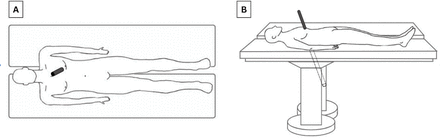
The patient was brought directly to the operating room. Extensive attention to positioning was required to appropriately position the patient that would allow for foreign body removal with access to both the chest and abdomen for exploration. Two operating tables were positioned next to one another with a small space in between to accommodate the traversing fence post. She was placed on the two tables, ensuring that the post sat between the tables allowing for removal from the patient’s posterior side (figure 1). During positioning, the patient became hypoxic. A 28-French chest tube was inserted through the left midaxillary incision above the fifth rib and directed toward the lung apex. Exploratory laparotomy was performed given concern for splenic, hepatic, and diaphragmatic injury. This revealed no intra-abdominal, hepatic, splenic, or diaphragmatic injury. After thorough exploration of all four quadrants, attention turned to the impaled foreign body for removal (figure 2). All markings and materials needed for a left-sided anterolateral thoracotomy were drawn and ready in the event of hemorrhage.
Schematic demonstrating dual-table operative positioning to accommodate anterior and posterior access in thoracoabdominal impalement. (A) Overhead view. (B) Lateral view.
Intraoperative view of the foreign body lodged in the patient’s left chest prior to extraction.
The fence post was slowly removed posteriorly from the patient and direct anterior visualization was maintained. On complete removal of the post, we did not appreciate violation of the mediastinum. Specifically, there were no appreciated injuries to the pericardium, great vessels, or heart. The anterior and posterior traumatic defects in the chest wall each measured 5–6 cm in diameter. These traumatic thoracotomies served as adequate windows for thorough mediastinal evaluation; however, we remained fully prepared to open the chest if deemed necessary. We noted moderate damage to the lung with no active hemorrhage from the parenchyma. There was an obliterated costochondral cartilage with severely comminuted fifth and sixth ribs. Given the absence of active hemorrhage and presence of complex chest wall trauma without preoperative CT scan, we opted to proceed with exploration of the chest wall wounds as well as closure with plans to obtain a postoperative CT scan to guide further management. The anterior chest wound was irrigated with normal saline and betadine and noted as hemostatic without bleeding. Devitalized lung tissue was debrided, and the anterior chest wound was closed in layers. The deep tissue fascia was reapproximated with 0 PDS followed by the deep dermis using 2–0 Vicryl suture in an interrupted fashion. The skin was loosely closed with interrupted Monocryl to account for possible infection due to the foreign body. The patient was then placed in the right lateral decubitus position to access the posterior chest wall wound. An associated posterior eleventh rib fracture was observed without evidence of active hemorrhage. The posterior wound was closed in a similar manner, and both anterior and posterior chest wounds were dressed with topical antibiotics and sterile dressings (figure 3).
Postoperative incisions after removal of the impaled foreign body. (A) Anterior view showing surgical incisions. (B) Posterior view showing corresponding incisions.
The patient was transferred to the surgical trauma intensive care unit for monitoring and CT scans, which revealed no evidence of post-traumatic injury (figure 4). The patient was taken to the operating room the next day for chest wall reconstruction including debridement, open reduction and internal fixation of the 5th, 6th, and 11th ribs, and traumatic thoracic hernia repair. At 9 months postoperatively, the patient was participating in occupational therapy with improvement and minimal pain.
Postoperative CT of the abdomen and pelvis demonstrating no evidence of post-traumatic injury. (A) Axial view. (B) Sagittal view.
Discussion and conclusions
Whereas trauma due to motor vehicle collision is common, impalement injuries remain rare and under-reported in the literature.1 They are categorized into type 1 and type 2 injuries: Type 1 injuries occur when a moving body strikes a stationary object, and Type 2 injuries occur due to a moving object penetrating a stationary object.2 Our case represents a Type 1 injury caused by the driver hitting a stationary metal fence. Impalement, especially thoracic impalement, poses significant challenges that require rapid surgical care from an interdisciplinary team.3
All patients presenting to the ED after thoracoabdominal trauma should be screened and treated according to Advanced Trauma Life Support protocol.4 In cases of impalement injuries, it is critical that the foreign object is not removed prematurely, but rather in the operating room, as it can cause severe bleeding.5 After the primary survey, imaging such as FAST and CT should be applied early, as they are useful adjunct tools that can identify the presence of intraperitoneal and intrathoracic injuries.6 In cases such as this, it may not be possible to obtain CT imaging, as the impaled object prohibited the patient from laying and fitting in the CT scanner. In addition, scatter artifact from metallic objects may limit radiologic evaluation of injuries.7
Thoracotomy or sternotomy has long been considered the gold standard for the emergency management of major chest trauma involving a large foreign body for a hemodynamically unstable patient with active hemorrhage, cardiac tamponade, or injury to major thoracic structures.8 Video-assisted thoracic surgery is an option for hemodynamically stable patients with small impalements to the chest wall.9 Likewise, diagnostic laparoscopy is a minimally invasive technique used for penetrating trauma offering several advantages such as smaller incision sites, fewer postoperative complications, and faster recovery, but also carrying a higher risk of conversion to open laparotomy in more complex injuries.10
Whereas several techniques may have been indicated, our patient sustained a penetrating thoracoabdominal injury, was hemodynamically stable, alert at admission, and had a positive lower upper quadrant (LUQ) FAST. Given the extensive thoracic injury and concern for rapid decompensation, the operative team prioritized definitive exclusion of intra-abdominal injury prior to chest exploration via exploratory laparotomy.11 The certainty and speed of this approach were felt to outweigh the benefits of a minimally invasive approach, particularly given the high likelihood of conversion to an open procedure in the setting of our patient’s complex surgical positioning. Ultimately, there was no demonstration of intraperitoneal injury intraoperatively. A FAST scan can quickly identify fluid in the intraperitoneal and abdominal region but has its limitations including non-blood fluid detection, imaging artifacts, as in our case, and technical limitations of providers and patients.6 Moreover, the nature of the injury deflected the diaphragm, left lobe of the liver, and the spleen downward, obscuring the examination and making it more difficult to interpret. CT remains the gold standard for hemodynamically stable patients with concern for intra-abdominal bleeding but was unable to be performed due to the foreign body in the patient.7 Impalement injuries are uncommon and do not conform to strict protocol for injury management. Many factors such as impalement mechanism, body areas affected, size and location of the impaled object, patient stability, injured viscera and major blood vessels play a role in the complexity of management.12 13
Successful outcomes depend on maintaining retained foreign bodies in situ until operative control is established and thoughtful operative planning that allows for safe positioning and operative access during removal of the object. Our novel case underscores the importance of operative coordination and adaptability in managing rare and technically challenging trauma. This approach may be applicable to similar complex thoracoabdominal impalement injuries where standard operative positioning is not feasible.
