


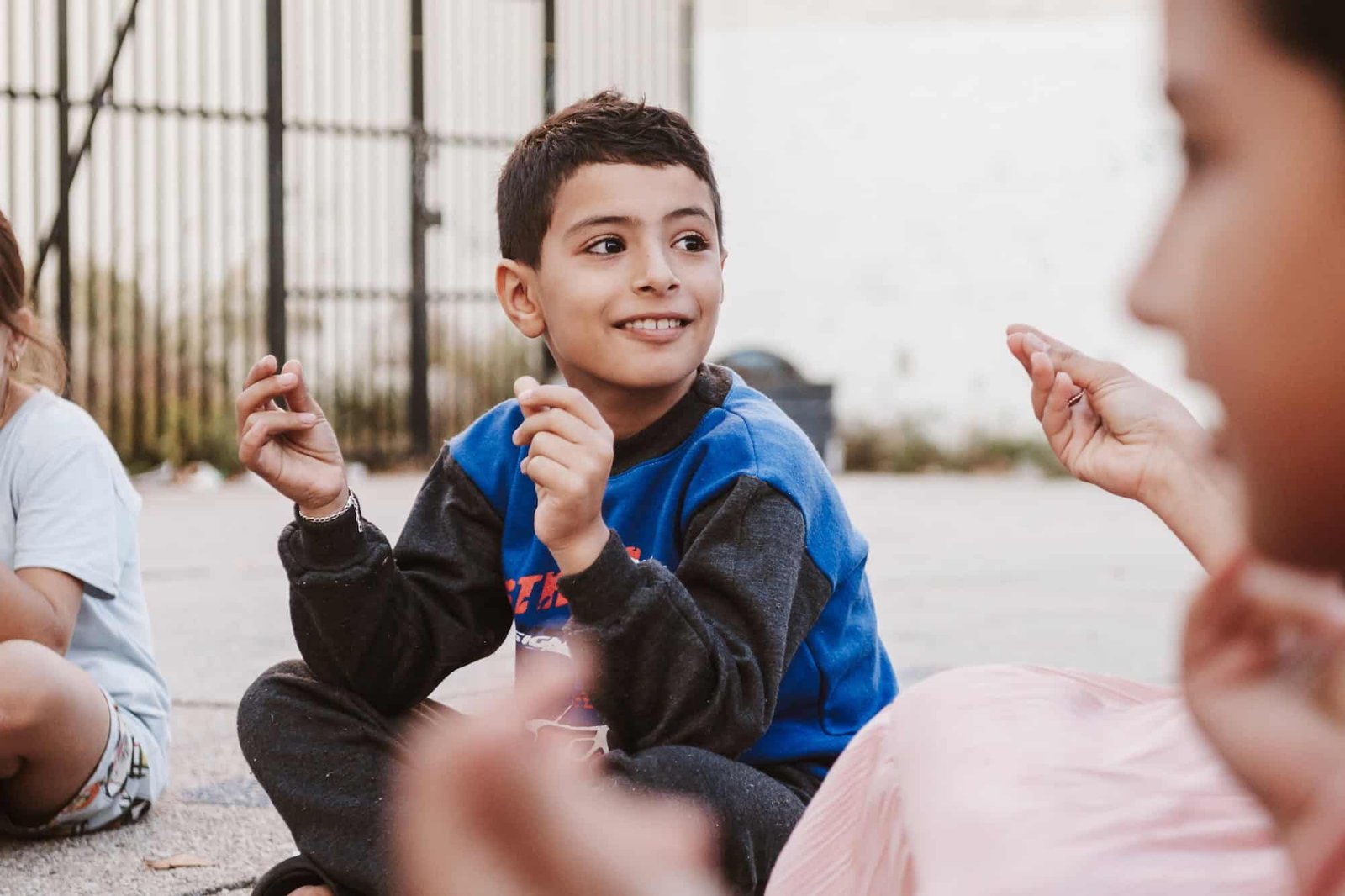
With nearly 50 million children displaced by conflict and violence, charities are finding ways to give young people something often lost in war: the chance to play
Hamza, a 10-year-old Palestinian boy who had spent his whole life in the overcrowded Nahr el-Bared refugee camp in northern Lebanon, used to be withdrawn and shy. He rarely spoke and avoided interacting with other children. When he started school aged six, he had never held a pencil or opened a book.
But then he began taking part in the Enhancing Quality and Inclusive Education (EQIE) programme, run by the global NGO Right To Play. Alongside receiving speech therapy, he took part in group activities, which helped him start expressing his emotions through drawing, storytelling and roleplay. His favourite game was “guess the emotion”, where one child would act out a feeling and the others had to guess it.
His confidence grew. One year later, he could write his own name, recognise letters and had made friends. After four years, he was a thriving, joyful child who proactively took part in class. He told his teacher his dream was to become a dentist.
Solutions every Saturday
Uplift your inbox with our weekly newsletter. Positive News editors select the week’s top stories of progress, bringing you the essential briefing about what’s going right.
Sign up
Hamza’s story is just one example of how play-based interventions can positively impact children who have experienced displacement or war-related trauma. Play, which comes in multiple forms, is integral to teaching children core skills and boosting self-esteem, explains Racha Nasreddine, country director for Lebanon at the charity.
“It’s not always moving and playing and causing chaos,” she says. “It’s more about how you transfer specific knowledge in a very interactive way, and how you make that child an active actor in their learning process. For a child, what is always important is creating a routine. In war, children lose a sense of control over their lives, so play can bring some of that back.”
Interventions like these are urgently needed. Conflicts across the Middle East, Ukraine and Sudan have caused immense suffering, with children heavily impacted. According to Unicef, nearly 50 million children had been displaced due to conflict and violence by the end of 2024, almost triple the figure in 2010.
Children in Lebanon take part in Right to Play’s programme, learning to express themselves through drawing, storytelling and group activities. Image: Right to Play / Ralph Azar
As well as experiencing physical trauma, many of these children experience psychological distress, including post-traumatic stress disorder, anxiety, depression, selective mutism, sleep problems and behaviours such as aggression or withdrawal. Play can form a crucial part of psychosocial therapy, but opportunities are limited due to the closure of schools, a lack of access to playgrounds and green spaces, and cramped conditions in camps.
Children have a fundamental right to play enshrined in Article 31 of the UN Convention on the Rights of the Child, yet many are denied this right.
In response, global play organisations are stepping up to this challenge. Catalytic Action is another international charity that uses design and architecture to create empowering play spaces for children in conflict and disaster zones.
Organised play can be critical in helping children recover from trauma by enabling them to reprocess their memories in a healthier way
An integral part of trauma recovery is the co-design process, explains co-founder Joana Dabaj. Local children imagine their dream playgrounds through drawings and workshops, giving them a sense of agency. “The process is as important as the final result, because we’re enabling sharing of feelings, of experiences, of visions,” she says. “It acknowledges their needs, their rights, and translates their ideas into reality.”
One such playground was created in collaboration with non-profit Habibi International, in a courtyard in the Bersive refugee camp in the Kurdistan region of Iraq, home to many internally displaced people. The playground’s unique features have multiple uses: staggered benches around the perimeter serve as both seats and jumping-off platforms, while holes in the outer wall enable younger children to peek through and play hide-and-seek. Others can play ball sports in a central open space, while the perimeter features swings, monkey bars, hopscotch markings and sensory toys, such as speaking pipes, a xylophone and a steering wheel.
Spaces like this are built to last, so the benefit can stretch over years rather than weeks. Other organisations focus on makeshift structures, which can respond to the volatility of war by being easy to transport and install. That is the thinking behind the modular playgrounds recently launched by UK-based charity Playrise.
These play structures can be easily dismantled and modified with different attachments, from hammocks and swings to monkey bars and musical instruments like drums, generating a flexible design that can meet the preferences of different communities. The designs were created in collaboration with children in Ethiopia and Egypt, and the first prototype will go to a camp in Aysaita, Ethiopia.
Children often get sidelined in war, explains co-founder Ariana Mouyiaris Meininger, and projects like Playrise aim to centre them again.
“In environments where there is conflict, [children] get adultified early,” she says. “They have to take on a lot of roles that shouldn’t fall on their shoulders. So it’s trying to communicate both to a global audience and to communities themselves how important play is for children.”
Organised play can be critical in helping children recover from psychological trauma by enabling them to “reprocess” their memories in a healthier way, explains Kieran King, head of humanitarian at charity War Child UK. But it cannot rely solely on well-designed structures, he says. Play should be integrated within child protection programmes, which take into account safeguarding issues and ideally involve trained facilitators.
In war, children lose a sense of control over their lives, so play can bring some of that back
Play may not involve a physical structure at all, but simply children’s imagination. Helen Christie, a clinical psychologist and trainer for the charity Children & War Foundation, explains that integrating “fantasy” into psychosocial therapy is crucial for trauma recovery. Activities based around re-enacting traumatic events, such as bombings, shootings or displacement, should move to a new, reparative narrative, she says, rather than simply repeating the trauma. For example, when children have recurrent nightmares about past events,“rehearsing” a new ending to their dream through role play can help them heal.
Palestine Play Projects is a UK-based volunteer-led charity that relies heavily on imaginative play. While it used to set up physical playgrounds, since the start of the Israel-Gaza war in October 2023, it has pivoted to hosting play sessions in refugee camps in Khan Yunis, working with a youth theatre group called Child Smile.
“It’s about the temporary spaces, the liminal spaces, the leftover spaces – being able to go to where children are, and then creating the conditions where play is possible,” says Theresa Casey, a volunteer and consultant on play and children’s human rights.
Workers with Child Smile arrive at camps with just a “backpack of resources”. Using methods such as Magic Mitten, a psychosocial support app and storytelling toolkit for children with war-related trauma, originally created for children in Ukraine, facilitators do group activities such as storytelling using make-believe animal characters, talking about emotions, and journalling. The most crucial part is building trust with the children.
Yara*, an 11-year-old girl displaced from northern Gaza, experienced severe trauma after her entire immediate family was killed. She became withdrawn, emotionally shut down and sometimes aggressive. After taking part in the Child Smile sessions for two weeks, she showed a “remarkable transformation”, the charity says, becoming more confident, actively taking part and supporting other children. She was finally able to write about her loss, and how she missed her family, marking a significant emotional turning point.
With the world in such a volatile state, more and more children are being deprived of a childhood. Only 3% of humanitarian aid goes towards education, according to the World Bank, with just a fraction of that reaching play-based support.
While food, shelter, medical care and water will always be the essentials, play is also vital for children’s physical and mental wellbeing, learning and development, and for bringing them small moments of normality in unfathomably difficult circumstances.
Play cannot protect children from displacement or airstrikes, but as the eminent child psychotherapist Garry Landreth says, play is “the child’s language” – and without it, they have no voice.
* Names have been changed to protect identities
Main image: Right to Play / Ralph Azar
Be part of the solution
At Positive News, we’re not chasing clicks or profits for media moguls – we’re here to serve you and have a positive social impact. We can’t do this unless enough people like you choose to support our journalism.
Give once from just £1, or join 1,800+ others who contribute an average of £3 or more per month. Together, we can build a healthier form of media – one that focuses on solutions, progress and possibilities, and empowers people to create positive change.
Support Positive News
