


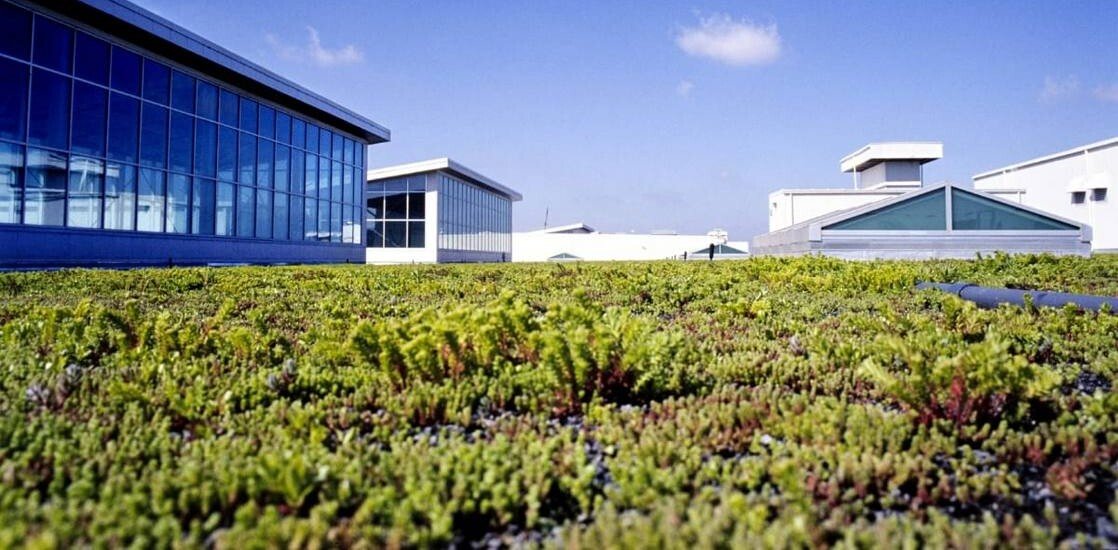
Photographed by Michelle Andonian, from The Henry Ford Collections
The year was 1915, and before Henry Ford decided to turn a 2,000 acre stretch of land along the Rogue River into one of America’s largest manufacturing centers, he thought of turning it into a bird sanctuary.
In a strange, roundabout way, that vision was recently achieved at the gargantuan Rogue Factory in Dearborn, Michigan, when the company decided to install a 454,000-square-foot “living roof” on the factory’s final assembly building.
The mixture of drought-resistant sedum and freely-growing wild plants provides amazing benefits to biodiversity and energy bills, with local kildeer waiting just 5 days before building their nests atop the roof where Ford Raptors and F-150s roll off the assembly line beneath.
Installed in 2002, the living roof consists of a layer of porous concrete, earth, and sedum. In addition to keeping the building 10° warmer in winter and 10° cooler in summer, it is designed to act as a sponge that absorbs rainwater into underground chambers, while slowing runoff into the surrounding stormwater system which has suffered from flooding in the past.
It was the largest turf roof in the world at the time of its completion, and completely solved the flooding problem.
AUTO FIRMS DOING THEIR PART: Hyundai Partners with Healthy Seas to Turn Scourge ‘GhostNets’ into Floor Mats for Cars
Today, the Ford Rogue Center, which has been producing for American consumers for over 100 years, is still the largest plant in the Ford inventory. The 600 heavily-industrialized acres were cleaned up at the end of the century to the tune of $2 billion—a necessity to remove almost a century’s worth of industrial contaminants from the surrounding environment.
Along with the turf roof, the whole site is a biodiversity hotspot for birds, insects, and butterflies, with some 20,000 honeybees having moved in among the thousands of flowers, shrubs, and trees.
SHARE This Awfully Green Legacy To One Of America’s Biggest Auto Plants…
