


SALT LAKE CITY — Ray Lancaster last heard from her son on Jan. 1, 2017, when he posted a message on social media reading: “The end is just the beginning.”
Her son had struggled with depression and alcoholism for years, and her husband called him to make sure he was OK. He insisted he was just dealing with typical wintertime blues and promised to call if things got worse.
“He didn’t call,” Lancaster said. “He didn’t reach out. He wrote a suicide note, and we buried him. We lost our buddy. He was a good guy, and he was a lot of fun, and he was happy, and he had two little kids. And it was, that was rough.”
Lancaster described her son — who she helped raise for the majority of his life and considered a son — as a happy, humorous, “very fun person” to be around, even when he was struggling.
Lancaster and her son had divided loyalties when it comes to professional baseball teams — she is a huge fan of the Minnesota Twins and he cheered for the New York Yankees — and the two often talked trash to one another throughout the season. When his son was born, Lancaster brought him a Twins onesie to the hospital.
“The next week he sent me a video of him washing his car with it,” she said with a laugh.
Her husband’s family had a history of depression, so Lancaster was familiar with mental health issues, but it wasn’t until after her son’s death that she learned he had previously been found unresponsive by his best friend who helped resuscitate him and called an ambulance, likely saving his life.
“It needs to be talked about,” she said. “It needs to be brought out of being thought as a sin or taboo or whatever. This is real, and it needs to be brought out into the open.”
Salt Lake County tax lien coordinator Ray Lancaster, who lost her son to suicide, shares her story at the Salt Lake County Government Center in Salt Lake City on Thursday. (Photo: Kristin Murphy, Deseret News)
Lancaster attended a walk that year for Suicide Awareness and Prevention Month and was overwhelmed by the amount of love and support she received when people saw the colored beads she wore signifying her loss.
“It became a huge passion for me because no one should have to feel that alone,” she said. “No one should have to get to that point of having a plan (or) self-harming. Suicide ideation is a real thing. No one should have to get there.”
Lancaster works as a tax lien coordinator for Salt Lake County — where she has worked for nearly 35 years — and began to push for the county to officially recognize September as Suicide Prevention and Awareness Month.
“I’ve been on a mission for eight years,” she said, but kept “hitting dead ends.”
Until last year, when she connected with Treasurer Sheila Srivastava while passing out bracelets to spread awareness.
‘It never occurred to me’
Srivastava’s son was 15 years old and practicing driving with his father when his dad suffered a fatal heart attack.
“His dad started having a heart attack and he witnessed the whole thing,” Srivastava said. “The ambulance was called, and they came and picked him up and left my son sitting there alone at McDonald’s.”
The experience was traumatic enough, but Srivastava said she didn’t realize how much her son blamed himself for his father’s death until three years later, when he told his therapist he had a plan to take his own life.
“I didn’t know … that he blamed himself, as a 15-year-old boy,” she recalled through tears. “He felt like he was helpless and worthless and that he didn’t do anything to save his dad, and this is something that he held on to alone for three years.”
She checked him into an institution for 16 days — she notes how privileged and lucky she was to be able to get him quick treatment — and when he got out he started college.
Ten years later, her son is in his final year of graduate school, where he is working on a Ph.D. in philosophy with dreams of working in academia.
“I think it’s really important to share his story, too, because he survived, and it’s still traumatic for me, knowing that my son was having all of those difficult feelings,” Srivastava said. “It never occurred to me that my son was having those feelings because we were there. We loved him. He knew I loved him, we say ‘I love you’ every time we go to bed. It was beyond me how he felt that way.”
Salt Lake County treasurer Sheila Srivastava takes a selfie with her son, who was suicidal years ago but survived, on Jan. 6. (Photo: Sheila Srivastava)
Srivastava was elected treasurer in 2024 and was in her first year in office last year when Lancaster approached her and asked for help getting the county to do something to promote suicide awareness. By then, it was too late to recognize September as Suicide Prevention and Awareness Month, but as August rolled around this year, Srivastava told Lancaster her office would promote awareness and prevention.
That wasn’t enough for Lancaster, who thought the county government as a whole should take action. So Srivastava invited the county mayor and county council to join.
Mayor Jenny Wilson, the County Council and other county elected officials issued a proclamation Tuesday, declaring September as Suicide Prevention and Awareness Month, encouraging residents to “learn the warning signs, check on those who may be struggling, and share the 988 Suicide and Crisis Lifeline with anyone who needs it.” The proclamation also invites residents to attend this year’s Out of the Darkness Community Walk on Saturday at 9 a.m. at Veterans Memorial Park in West Jordan.
Wilson grew emotional during Tuesday’s county council meeting while reading the obituary of Colin Hilton, longtime CEO and president of the Utah Olympic Legacy Foundation, who died last month at 58. Hilton died by suicide, according to his obituary, while “fighting, trying to find a way back to his loving family and life.”
The mayor credits Srivastava as “driving the (proclamation) effort from the start,” according to a news release, and Srivastava in turn points to Lancaster’s years of persistence.
“I am thrilled,” Lancaster said, but she isn’t done. “I want to keep it going. The proclamation is just the first step, and it is the right step.”
Salt Lake County tax lien coordinator Ray Lancaster, who lost her son to suicide, shows her semicolon tattoo, a symbol of suicide prevention and mental health awareness, in Salt Lake City on Thursday. (Photo: Kristin Murphy, Deseret News)
‘It’s not your failure’
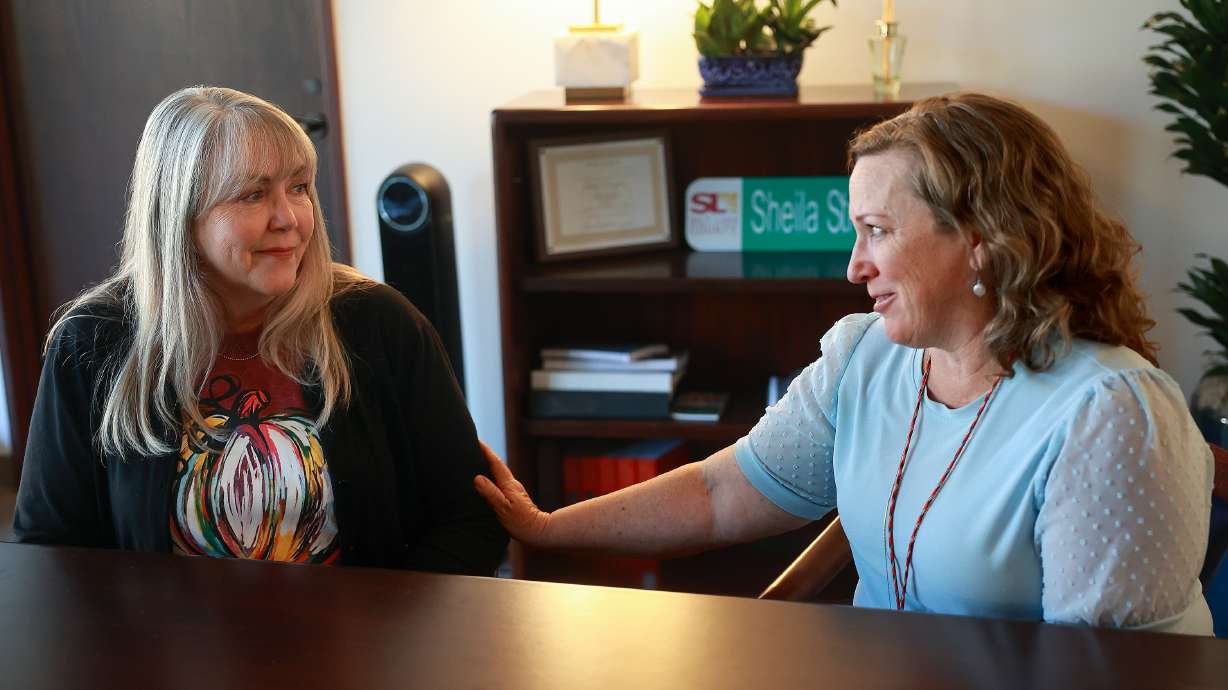
The more Lancaster and Srivastava have shared their stories, the more people they realize have been affected by suicide, and the more community they feel. Sitting next to each other in Srivastava’s office, the pair take turns sharing and comforting each other.
Although he is doing well, Srivastava still worries about her son and has had to learn to give him space when he needs it.
Lancaster still can’t shake the thought of what might have been if things had gone differently.
“I have to live with that guilt every single day,” she said. “Yes, we called him. I should have driven to his house and stayed there for as long as necessary, and I didn’t. That’s my failure.”
Srivastava cuts her off.
“No,” she said. “It’s not your failure.”
Both women encouraged everyone to be willing to ask direct, non-judgmental questions to family members or friends who might be struggling.
“I come right out and say, ‘I’m so sorry. It looks like you’re having a difficult time. Are you feeling suicidal?'” Srivastava said.
Lancaster shows a tattoo on her wrist with a lotus flower and a semicolon, the national symbol for suicide awareness. It also has a quill — a reminder to “write our story” — and her son’s initial.
“The more we talk, the more support we have for each other,” she said. “The more we talk, the more visible, the more they’re heard, the more they’re supported.”
Suicide prevention resources
If you or someone you know is struggling with thoughts of suicide, call 988 to connect with the 988 Suicide and Crisis Lifeline.
Crisis hotlines
- Huntsman Mental Health Institute Crisis Line: 801-587-3000
- SafeUT Crisis Line: 833-372-3388
- 988 Suicide and Crisis LifeLine at 988
- Trevor Project Hotline for LGBTQ teens: 1-866-488-7386
Online resources
Warning signs of suicide
- Talking about wanting to die
- Looking for a way to kill oneself
- Talking about feeling hopeless or having no purpose
- Talking about feeling trapped or in unbearable pain
- Talking about being a burden to others
- Increasing the use of alcohol or drugs
- Acting anxious, agitated or recklessly
- Sleeping too little or too much
- Withdrawing or feeling isolated
- Showing rage or talking about seeking revenge
- Displaying extreme mood swings
The more of these signs a person shows, the greater the risk. Warning signs are associated with suicide but may not be what causes a suicide.
Information from the American Foundation for Suicide Prevention.
What to do if you see warning signs of suicide
- Do not leave the person alone
- Remove any firearms, alcohol, drugs or sharp objects that could be used in a suicide attempt
- Call the U.S. National Suicide Prevention Lifeline at 800-273-TALK (8255)
- Take the person to an emergency room or seek help from a medical or mental health professional
Information from the American Foundation for Suicide Prevention.
The Key Takeaways for this article were generated with the assistance of large language models and reviewed by our editorial team. The article, itself, is solely human-written.
