


Anika Puri, now a graduate of the Massachusetts Institute of Technology, got her start in STEM from an early age.
In fact, when she was 17, she was awarded the Peggy Scripps Award for Science Communication at the Regeneron International Science and Engineering Fair in 2022 for an invention that was inspired by her childhood trips to India.
Growing up, Puri traveled with her family to India, where she saw the ongoing illegal trade of ivory, markets flush with products that came from the trafficking and killing of elephants.
Although the ivory trade has been illegal for decades and elephant hunting has been prohibited in India since the 1970s, the problem has persisted.
“I was quite taken aback,” Puri told Smithsonian Magazine when she was 17. “Because I always thought, ‘well, poaching is illegal, how come it really is still such a big issue?’”
Wolfgang Hasselmann/Unsplash
She discovered that drones were used to detect and capture footage of poachers, but that they lacked accuracy and timeliness. But that footage did provide a eureka moment.
After watching videos of elephants and humans, Puri noticed that the two species moved in vastly different ways, with delineations in speed, turning patterns, and other motions.
“I realized that we could use this disparity between these two movement patterns in order to actually increase the detection accuracy of potential poachers,” she told the magazine.
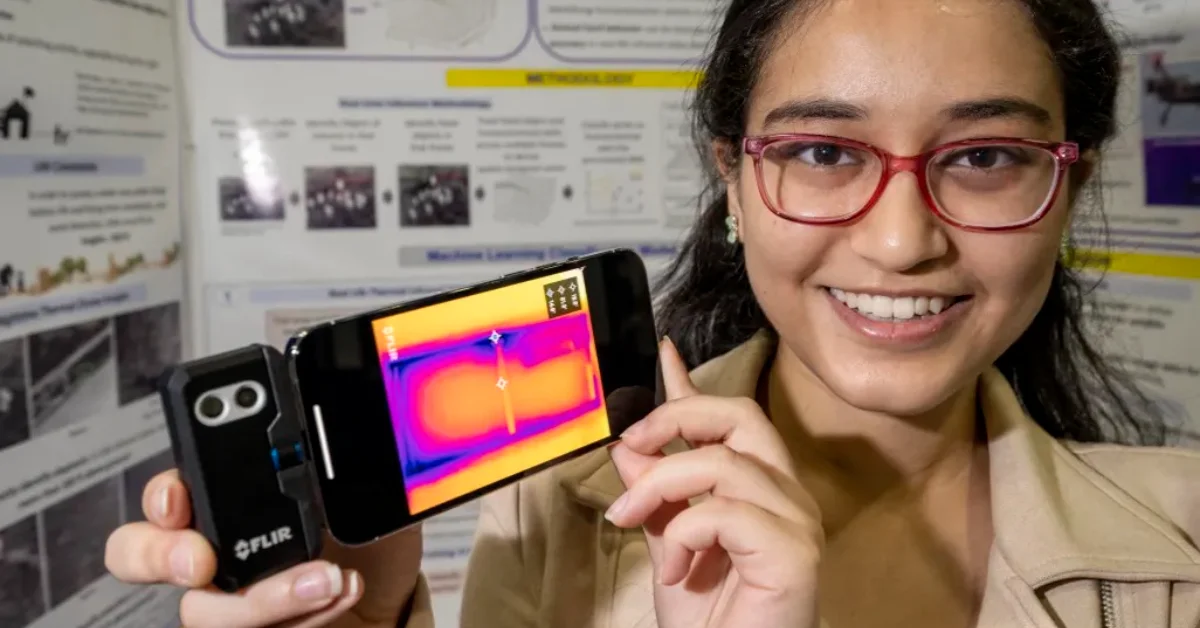
So, she invented EISa (short for elephant savior), a low-cost, artificial intelligence-driven tool that uses thermal and infrared videos to detect movement patterns as a drone captures real-time footage to distinguish more accurately between elephants and potential poachers.
The device uses a $250 low-resolution thermal camera that can plug into an iPhone. Once attached to a drone, the system gives real-time insights as it flies over a park. Field testing showed that Puri’s invention was able to detect humans with over 90% accuracy.
Puri with her award. Courtesy of Society for Science
Puri submitted her project to ISEF 2022, the world’s largest international pre-college STEM competition. She won the aforementioned $10,000 prize, as well as a top title in the competition’s earth and environmental sciences category.
“It’s really amazing just to see all these kids coming together. And for the same purpose — enjoying science and doing research,” Puri told Smithsonian Magazine. “I was honored just to be on that stage.”
The poacher-tracking invention was not Puri’s first foray into AI and other technological pursuits. She was part of a summer program at Stanford’s AI Lab, and after graduating high school, went on to work as a research assistant at Harvard’s Computational Health Informatics Center.
She just graduated with dual Bachelor’s degrees from MIT in June 2026, one in business management and another in AI and computer science. It’s unclear what the end result of her poacher-detection project was — aside from the ISEF prize — but according to LinkedIn, Puri is still thriving in STEM.
Courtesy of Society for Science
She has held AI research and engineering internships with Goldman Sachs and Nvidia and is currently part of the Bernard M. Gordon MIT Engineering Leadership Program.
“Initially, my enthusiasm for artificial intelligence was based off of this limitless possibility for social good,” Puri told Smithsonian Magazine in 2022.
Once she discovered that AI could contain biases informed by human inventors, she saw another side to her work.
“It really has the capability to reinforce some of the worst aspects of our society,” she said. “What I really realized from this is how important it is that women, people of color, all sorts of minorities in the field of technology are at the forefront of this kind of groundbreaking technology.”
You may also like: Teen scientists invent brain-controlled bionic prosthetic leg for their friend — and win prestigious $50K prize
Featured Image: Courtesy of Society for Science
