


This story was originally published by The 19th and was republished with permission.
Gloria Steinem, one of the leaders of second-wave feminism and a feminist thought leader for generations, has died at the age of 92.
In a career that saw attitudes on women change (and change again — and again), Steinem — often with her signature aviators — served as the literal face of second-wave, intersectional feminism for decades. From her coming of age during the Mad Men era and Civil Rights Movement to her founding Ms. magazine at the start of a new push for gender equality to #MeToo and the ensuing backlash, Steinem was a tireless champion for furthering the work of the feminist movement and promoting gender, racial, and class equity, even when it has meant reevaluating some of her own past positions.
Jay Godwin/Public Domain“We are the women our parents warned us against, and we are proud.” — Gloria Steinem
Born in Toledo, Ohio, in 1934, Steinem’s childhood was largely shaped by her parents’ divorce when she was 10. She watched her mother struggle to find and hold a job, which, later in life, Steinem said had a significant impact on her understanding of patriarchal systems and the impact they can have on women, especially working women.
Likewise, Steinem bore witness to the way doctors routinely wrote off her mother’s health concerns, often with a gendered bias, because she had once experienced what was then described as a nervous breakdown. Seeing firsthand the way society treats women — especially single women, working mothers, and those with marginalized identities — led Steinem to develop a core belief that women were inherently unequal in modern American society. She was also born less than 15 years after the 19th Amendment was ratified, with a mother who remembered life before it.
After attending the all-women’s Smith College in Massachusetts, Steinem entered the public sphere as a young journalist; one of her first major bylines was a 1962 story for Esquire magazine that came from what was ostensibly an assignment about contemporary contraception use. That article, “The Moral Disarmament of Betty Coed,” became a feature-length treatise on the way American women are unjustly faced with the binary choice of career or family.
This was followed the next year by a story for Show magazine entitled: “A Bunny’s Tale,” for which Steinem spent a year working as a Playboy Bunny at New York City’s Playboy Club. In the piece, Steinem focused on the exploitative labor conditions of the Playboy Club and the impact these working conditions had on the women there, including, but not limited to, sexual demands frequently made of them as part of their employment.
“The truth will set you free, but first it will piss you off.”
In interviews, Steinem spoke about how attending an abortion access rally in 1969 for a story for New York Magazine was a life-changing event for her, one that put her on a path of being a public, activist feminist for the rest of her life. (Steinem had received an abortion herself in 1957 in London, when the procedure was still illegal. She dedicated her 2015 memoir, “My Life on the Road,” to Dr. John Sharpe, the English doctor who had provided her care.)
Steinem’s work combining journalism and feminist action converged in 1972, when she co-founded Ms. magazine and quickly emerged as a key symbol of second-wave feminism and its focus on the way reproductive rights, labor rights, and sexuality converged in women’s lived experiences.
Steinem was among the first generation of White women who were allowed to vote, and the magazine debuted at a time when women were not legally allowed to own a credit card or apply for a mortgage without their husband’s permission.
It was the same year women were allowed for the first time to register to run the Boston Marathon. The Supreme Court’s landmark Roe v. Wade decision making abortion legal in America was still a year away. Women could not equally participate in sports or attend universities or U.S. service academies. Rape within marriage was not illegal, and working women who became pregnant could be fired from their jobs. Family leave was still more than two decades away.
For these reasons and beyond, Steinem was a longtime critic of marriage.
Jewish Women’s Archive/Wikimedia Commons (CC BY-SA 2.0)
She did eventually marry David Bale, an environmentalist and animal welfare activist, in 2000. He died in 2003. Steinem had no biological children, but is survived by her four adult stepchildren, including the actor Christian Bale.
Steinem’s decision to marry appeared on the surface to contradict her earlier arguments against the institution. Years later, in a 2019 interview with National Geographic, she offered an explanation that also underscored the changes she had helped bring.
“I didn’t change. Marriage changed,” she said. “We spent 30 years in the United States changing the marriage laws. If I had married when I was supposed to get married, I would have lost my name, my legal residence, my credit rating, many of my civil rights. That’s not true anymore. It’s possible to make an equal marriage.”
“The abolition and suffrage movements progressed when united and were damaged by division; we should remember that.” — “Women Are Never the Front Runners,” 2008
A key proponent of the Equal Rights Amendment, Steinem was politically outspoken throughout her life — criticizing the Vietnam War during the 1968 presidential election, supporting Shirley Chisholm’s candidacy in 1972, being arrested outside of the South African embassy for protesting against apartheid in South Africa in 1984, becoming a vocal defender of Anita Hill during Supreme Court Justice Clarence Thomas’ 1991 confirmation hearings, and endorsing Secretary of State Hillary Clinton as the Democratic nominee for president in 2008 and 2016.
She also found herself at the center of a cross-generational debate on what feminism is and who it is there to serve after she wrote an op-ed in 1998 defending President Bill Clinton in the midst of the scandal involving his sexual relationship with a former White House intern, Monica Lewinsky.
In her op-ed, which ran in The New York Times under the headline “Feminists and the Clinton Question,” Steinem sharply criticized those calling for the president’s resignation or impeachment in light of his behavior with Lewinsky and other women who had come forward with allegations of sexual misconduct, arguing that much of the right-wing vitriol aimed at Clinton was in fact because of his support for reproductive rights.
Perhaps even more notably, she said to condemn Clinton’s behavior was to also work against one of the key wins of the feminist movement: asserting women’s sexual independence and agency. Steinem wrote that by the letter of the law, Clinton had not engaged in any form of sexual harassment because his sexual relationship with Lewinsky was consensual. This relationship, she said, was clearly explained, and without fault, by “the common-sense guideline to sexual behavior that came out of the women’s movement 30 years ago: no means no; yes means yes.”
“Women may be the one group that grows more radical with age.” — “Outrageous Acts and Everyday Rebellions,” 1983
Decades later, in the throes of 2017’s #MeToo movement and the public reckoning with and reevaluation of the Lewinsky situation through a lens of power differentials, Steinem told reporters that in the present day, she might have written about Clinton differently.
The Clinton op-ed in many ways perfectly encapsulates the life and legacy of Gloria Steinem: A woman who changed the landscape in terms of what it meant to think about women’s power and agency, most notably through the written word — and a woman whose hand in the creation of second wave feminism, and its failures to often operate in an intersectional manner, gave Americans reason to pause and reconsider just who is being served up power by what iterations of feminism.
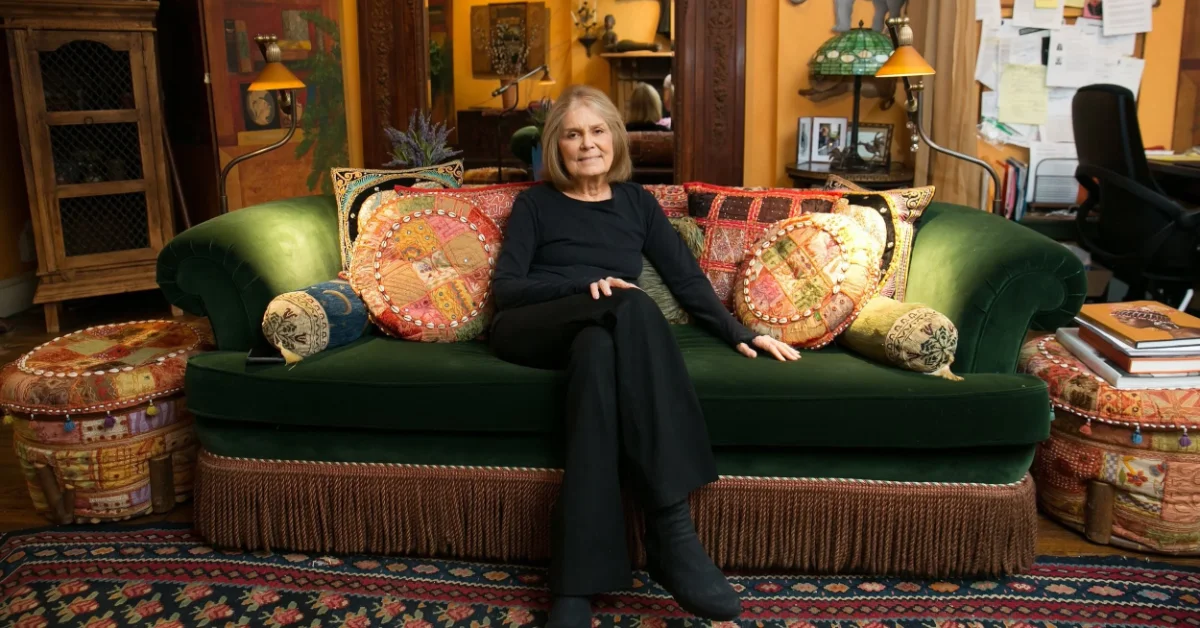
Until the end of her life, Steinem’s Upper East Side brownstone was a headquarters for her allyship, and she hosted diverse, intergenerational talking circles around the issues she championed. The salons were a space for strategizing, mentoring, community, and collective building.
In the end, when Gloria Steinem spoke, the world listened — and kept talking and evolving through it.
Dying seems less sad than having lived too little.” — “Outrageous Acts and Everyday Rebellions,” 1983
Featured Image: Courtesy of Gloria’s Foundation
