


Taxes can eat into potential retirement income and savings at a time when many are trying to save as much as possible. That’s why minimizing the bills to Uncle Sam can be a significant value advisors can add for their clients.
Processing Content
With that in mind, a recent paper by James Mahaney, founder and principal at Georgetown, South Carolina-based Mavericus Retirement Services, detailed an approach meant to maximize retirement income before a penny has to go to the U.S. Treasury. His blueprint emphasizes the ways in which retirees can maximize tax-free Social Security checks and offers ideas for when to collect the benefits.
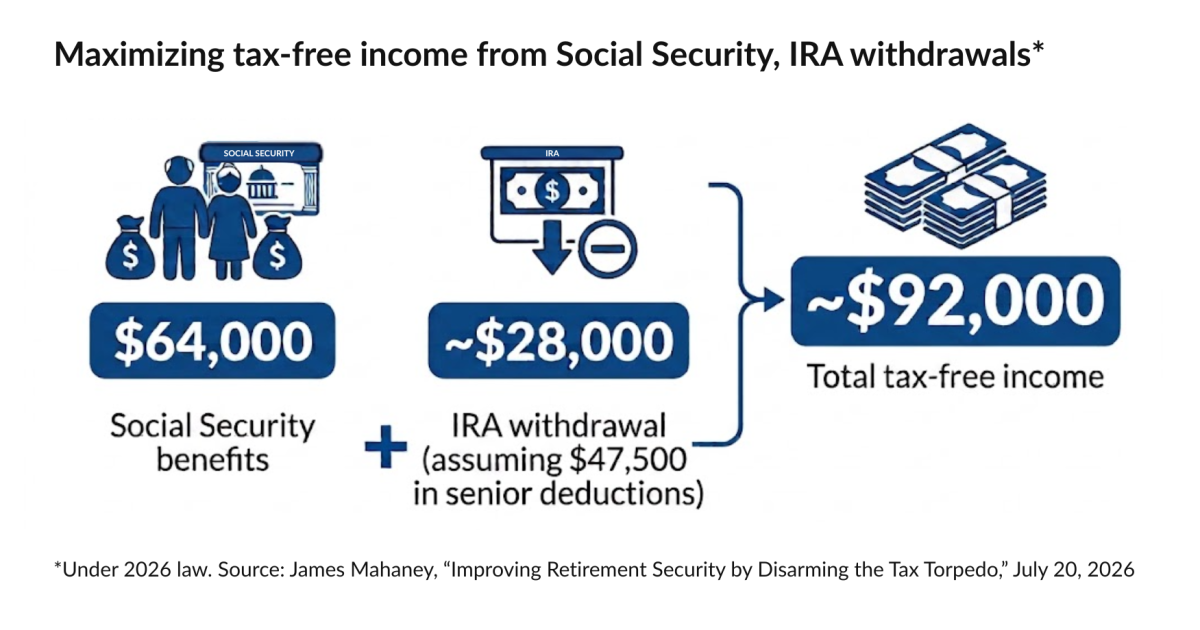
The strategy makes use of the IRS rule that says 15% of Social Security benefits are always tax-free, and the remaining 85% can also be tax-free, if the total of modified adjusted gross income and half of Social Security benefits does not exceed $32,000. For a married couple filing jointly, that total would be $64,000 in tax-free Social Security income.
Mahaney proposed that couples aged 65 could also withdraw about $28,000 from a traditional individual retirement account and use $47,500 in senior deductions. This approach would lead to about $92,000 in tax-free income. The numbers in the strategy are based on 2026 law.
This method wouldn’t work for taxpayers who are too wealthy because the senior deduction of up to $6,000 per person is phased out for single taxpayers with modified adjusted gross incomes of $75,000 to $175,000. Similarly, the senior deduction is phased out for married taxpayers filing jointly with $150,000 to $250,000 of modified adjusted gross incomes. In any case, the deduction is set to expire after 2028.
However, Mahaney said a version of his strategy could still work without the senior deduction. Taxpayers might have to take smaller IRA withdrawals or pay some taxes.
The senior deduction is “probably the point that’s going to be most brought up and challenged because it is scheduled to go away under law,” Mahaney said in an interview, suggesting this policy might be extended. “I’m just basing it on the fact that it’s a big voting bloc. It’s the bloc of voters that vote the most, the seniors, and it will come across as if it’s raising taxes on the seniors if it’s not renewed after 2028.”
What inspired this approach
Mahaney said he became interested in this topic when working on 401(k) product development at Prudential.
“It occurred to me that people really in the financial planning world were underappreciating all that Social Security could do for a client,” he said. “One of those aspects was that I thought that people really did not understand the tax benefits of creating larger streams of Social Security income by delaying them.”
Now, long after he first became interested in similar strategies, the factors at play remain the same. If clients start claiming Social Security benefits at a younger age, then they probably won’t be using their IRA savings and will end up keeping their IRA balances higher.
“In my mind … 20-some years later, it’s a choice: If you want to start your Social Security earlier, you’re choosing to take a higher amount of IRA withdrawals over your retirement — versus delaying Social Security, maybe taking some IRA withdrawals earlier, but over the lifetime, you’re not taking as much of your income in the form of IRA withdrawals,” Mahaney said. “There are significant tax benefits to that over time, and that’s what I wanted to prove out.”
READ MORE: A contrarian Social Security strategy for the ultrawealthy
Minimizing required minimum distributions
Required minimum distributions (RMDs) from traditional IRAs can bring costly tax bills. That’s especially true if the account size is large and requires larger RMDs.
A benefit of delaying the start of Social Security benefits to age 70 using the strategy he described is it can limit the size of RMDs. Clients can also limit the size of RMDs by doing Roth IRA conversions.
Partly because the required beginning date for taking RMDs was changed, in phases, to be older for people born later, RMDs are “really starting to bite a lot of people that have been good savers that aren’t drawing down their IRAs,” Mahaney said. They will be “much higher in nominal dollars … which will force people into higher tax rates.”
So, people will be better off if they lower their RMDs, “so they don’t run into this tax torpedo,” he added.
READ MORE: 1 in 3 retirees faces an RMD tax penalty. Here’s how advisors help fix it
Asset location
In addition to asset allocation choices, Mahaney’s paper included a discussion of asset location choices, which involves optimizing where to hold different types of assets based on how various accounts work. He suggested clients hold fixed-income assets in traditional IRAs and equities in Roth IRAs. This would limit the growth in traditional IRAs, which have taxable withdrawals, and maximize growth in Roth IRAs, which don’t have taxable withdrawals.
David Heilich, a partner who leads the estate, gift and trust group at international CPA firm Armanino, cautioned against prioritizing a goal of minimizing taxes, however.
“Be careful to not have the tax tail wag the dog,” Heilich said. “When you’re looking at allocation, No. 1, … [you’ve] got to have enough money to live the rest of your life, and that those investments are hedged against inflation.”
That said, Heilich said the paper had “good ideas” in it and added another one: having clients older than 70½ make qualified charitable distributions directly from an IRA to a charity. This strategy saves taxes compared to withdrawing and then giving to charity.
“The tax advisor’s got to be working with the investment folks to really integrate these two things together,” Heilich said. “I can see inside of the engine to know how all the parts work. I don’t know just how to drive the car.”
It is better to have larger net gains even if a portion of the total gain went to taxes than to have a smaller, tax-free gain, said Andy Panko, founder of Metuchen, New Jersey-based Tenon Financial.
Both Panko and Mahaney said another advantage to Mahaney’s strategy is that most states don’t tax Social Security income.
“Personal finance is often a lot more personal than it is finance,” Panko said. “Yes, the math and the projections and the assumptions may show objectively that delaying Social Security for both spouses, let’s say, makes the most sense, but subjectively, qualitatively, it’s all about helping clients sleep well at night. … In general, I think a lot of the industry overquantifies and overprojects a lot of this stuff when so much of it is really emotional and subjective.”
