


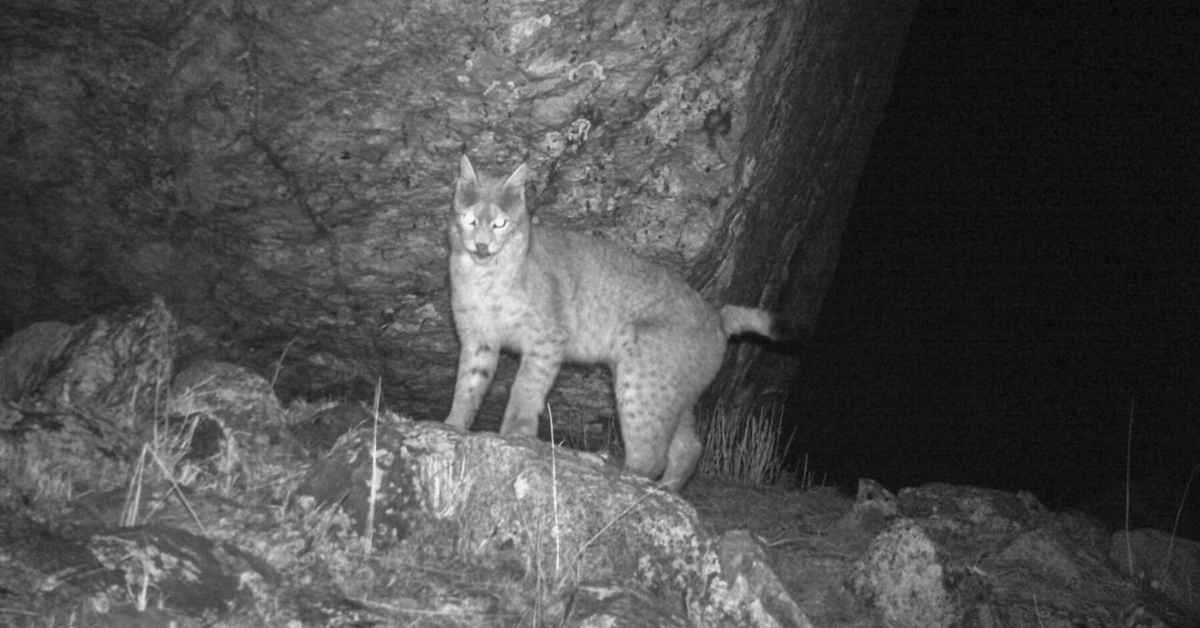
- A camera trap has recorded the Eurasian lynx at over 17,400 feet on Sikkim’s Tso Lhamo plateau, adding to limited evidence of the species in the Eastern Himalayas.
- Experts say the record highlights the ecological value of high-altitude rangelands often seen as barren cold deserts.
- Tso Lhamo supports snow leopard, Pallas’s cat, Tibetan wolf, sand fox, argali, gazelle, and kiang, suggesting a functioning predator-prey system.
A Eurasian lynx has been recorded in a camera-trap image from the Tso Lhamo plateau in Sikkim, India. This encounter marks the first confirmed photographic evidence of the species in the state. It is also the second such record from the Eastern Himalayas.
The image, captured in January 2026 at an altitude of over 17,400 feet in the Mangan district, shows the animal moving across a rocky, sparsely vegetated high-altitude slope.
The sighting comes from a long-term snow leopard and rangeland monitoring program led by the Sikkim forest department and WWF-India. The initiative tracks snow leopards and associated wildlife while studying the ecological condition of the trans-Himalayan rangelands.
The Sikkim record follows a 2025 photographic documentation of a Eurasian lynx in Arunachal Pradesh during a joint survey by WWF-India and the Arunachal Pradesh forest department.
“It highlights the ecological significance of our high-altitude rangelands and reinforces our commitment to protecting these fragile ecosystems. The cooperation of the Lachen Dzumsa (traditional local self-governance body) in facilitating access to these remote areas has been important to this work,” Sikkim’s Chief Conservator of Forests (Wildlife), Udai Gurung, said in a statement.
At the Tso Lhamo plateau in Sikkim, researchers captured camera-trap images of a Eurasian lynx, along with several other elusive species. High-altitude rangelands like this region have wrongly been dismissed as barren deserts of little ecological value. Courtesy of Forest & Environment Department, Sikkim, and WWF-IndiaThe images are part of a long-term snow leopard and trans-Himalayan rangeland monitoring program. Courtesy of Forest & Environment Department, Sikkim, and WWF-India
A meeting point of two biological worlds
For researchers, the record adds to the limited scientific understanding of Tso Lhamo, a high-altitude border landscape that remains difficult to study because of its terrain, weather, and location.
“Ladakh and Sikkim have similar trans-Himalayan elements. Ongoing monitoring exercises are evidence that forest departments and researchers are now getting such encouraging results. Since Sikkim shares an open international boundary with Tibet, and lynx are capable of long-distance movements, transboundary collaboration might reveal the overall picture for this region more clearly,” said Neeraj Mahar, a wildlife researcher who was not part of the WWF’s monitoring program and has worked on high-altitude landscapes and carnivores.
Rohan Pradeep Pandit, the associate coordinator at WWF-India works on species habitat conservation in Eastern Himalayas. According to him, the record challenges the perception that high-altitude rangelands are empty or ecologically unproductive.
“High-altitude rangelands like Tso Lhamo have long been dismissed as empty, barren, cold deserts of little ecological consequence. The presence of a wide-ranging predator like the lynx is direct evidence against that view. These are functioning, productive ecosystems, and Tso Lhamo in particular works as a biogeographic bridge between two very different biological worlds,” Pandit said.
The Tso Lhamo plateau lies in a transition zone where the steep trans-Himalaya meets the flatter Tibetan Plateau. This position allows species adapted to different high-altitude habitats to occur within the same landscape.
A Tibetan wolf. Courtesy of Forest & Environment Department, Sikkim, and WWF-India
“Geographically, the plateau sits at the juncture where the steep, vertical trans-Himalaya meets the flatter, rolling expanse of the Tibetan Plateau. Ecologists call this kind of transition an ‘ecotone’, a boundary zone where two distinct biological communities overlap. That location is what makes Tso Lhamo significant. Species adapted to sheer, rocky cliffs occur alongside species evolved for open steppe. The lynx is one more line of evidence that the plateau is not an isolated pocket but a corridor where the biodiversity of the Central Asian steppe meets that of the Eastern Himalaya,” Pandit said.
Camera traps in the landscape have also recorded snow leopard, Pallas’s cat, Tibetan wolf, Tibetan sand fox, Tibetan gazelle, Tibetan argali, and southern kiang.
Rishi Kumar Sharma, head of the Himalayas Program at WWF-India, said the presence of several predators and wild herbivores indicates that the lynx record should not be viewed in isolation.
“It is undeniable evidence that the Tso Lhamo Plateau supports a high-quality and largely intact trans-Himalayan predator-prey system. To have three distinct wild felids — the snow leopard, the Pallas’s cat, and now the Eurasian lynx — recorded in the same landscape points to a food web healthy enough to support multiple apex and meso-predators,” Sharma said.
What remains unknown
Despite the significance of the photograph, it does not establish whether Tso Lhamo hosts a stable lynx population. Researchers do not yet know whether the photographed animal was a resident, part of a breeding population, or an occasional visitor moving through from the Tibetan side.
“What we have so far is a single photographic record after several years of intensive camera trapping, which means we cannot yet say whether the lynx is a resident, breeding animal on the plateau, or an occasional disperser moving through from the Tibetan side,” Sharma said.
“The first task is to establish the species’ own status here — how widely it is distributed across Tso Lhamo and the adjacent valleys, a first estimate of how many animals the landscape actually holds, and whether there is evidence of residency and breeding, such as repeat captures of identifiable individuals or family groups,” he added.
A blue sheep, caught on camera-trap. Courtesy of Forest & Environment Department, Sikkim, and WWF-India
Pandit said knowledge of the Eurasian lynx in India has largely come from the western trans-Himalayan region, particularly Ladakh. Far less is known about its distribution, population, and habitat use in the Eastern Himalayas.
“This photographic record confirms that the lynx is very much an important predator in the Eastern Himalayan ecosystem, but it also highlights how little baseline data we actually have on them here. We cannot protect a species effectively if we are operating in the dark regarding its population size, movement patterns, and specific habitat preferences,” Pandit said.
Mahar said camera trapping should be combined with genetic research to study the species and the pressures affecting it.
“More insights could be obtained through intensive camera trapping across Sikkim trans-Himalaya, combined with non-invasive genetic identification techniques to decipher aspects of Eurasian lynx ecology and associated threats. It would be interesting to study how lynx is thriving amidst pastoralists and defense installations,” Mahar said.
Researchers look for signs of wildlife movement in the trans-Himalayan rangelands. Courtesy of Forest & Environment Department, Sikkim, and WWF-India
Conservation pressures in a border landscape
The Tso Lhamo landscape remains ecologically functional, but it faces pressures from tourism, road traffic, waste, free-ranging dogs, and infrastructure associated with its border location.
The WWF-India press release identifies wildlife-friendly traffic management, sustainable waste management, sterilization, and vaccination of free-ranging dogs, and livestock health camps as important conservation measures.
Sharma identified free-ranging dogs as one of the most immediate concerns. Packs can prey on wildlife, compete with wild carnivores, and transmit diseases.
“These dogs hunt in packs. They compete directly with wild carnivores for prey, actively attack smaller wild species, and act as vectors for diseases like canine distemper, which can wipe out wild feline populations overnight,” Sharma said.
Road traffic associated with tourism and border logistics also increases the risk of wildlife collisions. Open waste dumps can change animal behavior, attract predators, and heighten the possibility of conflict, Sharma added.
This article was originally published on Mongabay.
Featured Image: Courtesy of Forest & Environment Department, Sikkim, and WWF-India
