


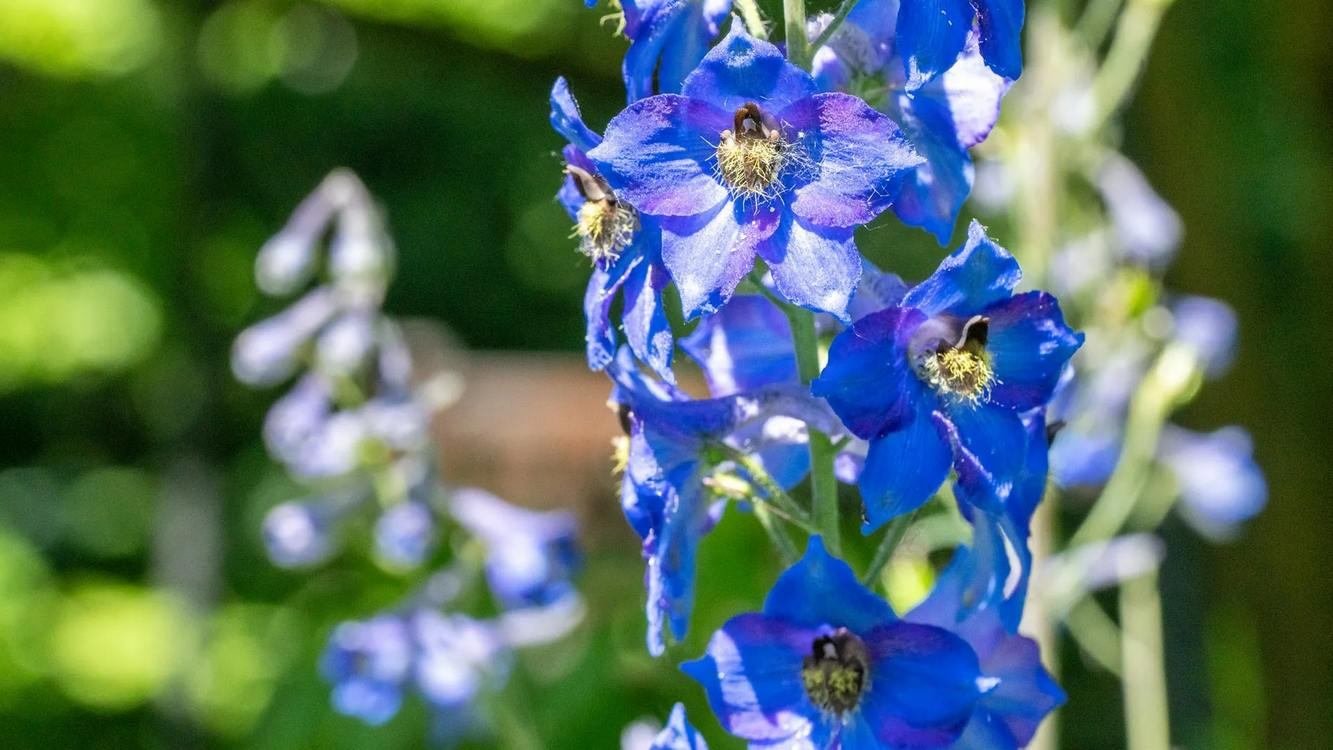
A larkspur specimen in bloom at Beal Botanical Garden – credit, Paul Henderson, released by MSU
2 famously toxic plants, know also to counter pain, malaria, cancer, and pests, may have had those medicinal properties synthesized in a lab for the first time.
The researchers behind the discovery hold that “plants are the best chemists,” and believe they’ve demonstrated that next-generation drugs don’t need to come from chemistry breakthroughs.
Centered on the plants wolfsbane and larkspur, the discovery comes about through a collaboration between scientists at Michigan State University and the Czech Academy of Sciences, and is published in the journal Molecular Plant.
“These plants have been used in different forms of medicine throughout the world for thousands of years,” said MSU alum Garret Miller, co-first author of the paper and now an assistant professor of biotechnology at University of Michigan-Flint.
“We know they interreact with our bodies in so many ways, and understanding how to create them can help provide totally new routes of testing.”
“Plants are the best chemists around, upgrading their arsenal of natural compounds over millions of years to help them survive,” said Björn Hamberger, study author an Endowed Professor in MSU’s Department of Biochemistry and Molecular Biology.
At MSU, the Hamberger Lab explores these diverse compounds, better known as specialized metabolites, and how they can be leveraged for the greater good. History has shown they’re more than capable of the opposite, with wolfsbane possibly at the seen of multiple historic assassinations, including Socrates, Alexander of Macedon, and Cleopatra’s sister.
In more recent years his team had set their sights on larkspur—also called delphinium for its dolphin-shaped flowers—wanting to know exactly how the plant produced a mix of toxic-yet-promising chemicals known as diterpenoid alkaloids.
Diterpenoid alkaloids are the intersection of the two oldest and largest classes of plant chemicals on the planet, and researchers have faced an uphill battle to determine their mind-bendingly complex structures.
Despite being isolated nearly 200 years ago, one of the best-known compounds, aconitine, still hasn’t been successfully synthesized in a lab. The genesis of that discovery began serendipitously.
While attending a research conference in Barcelona, Hamberger crossed paths with scientists from the lab of Tomáš Pluskal at the Czech Academy of Sciences.
The Pluskal Group, including Lana Mutabdžija, a graduate student at the Czech Academy of Sciences and co-first author of the latest paper, were pursuing the same tricky diterpenoid alkaloids in a notoriously poisonous larkspur relative, wolfsbane, otherwise known as monkshood.
The two labs decided to join forces, before beginning the task of identifying the exact chemical pathway the two plants took to produce their diterpenoid alkaloids.
Because plants naturally produce specialized metabolites slowly and in tiny amounts, discovering these pathways is a vital step toward engineering plant chemistries that can tackle real-world, large-scale challenges.
MORE STORIES LIKE THIS: A Deadly Tomb Fungus May Have Yielded a Killer Leukemia Treatment
After solving a pathway, the unique genetic blueprints for a compound can be inserted into a specially engineered host organism, such as yeast. Through this bit of biohacking, the organism will begin producing the compound on its own in larger quantities, paving the way for expanded testing and development.
“In an ideal scenario, this could eventually help create new drugs inspired by these natural products,” said Mutabdžija.
Once the team narrowed down a promising set of genes in wolfsbane and larkspur, those genetic codes were inserted into tobacco plants, which acted as ready-made biofactories.
FROM AGONY TO ANTIDOTE: Scorpion Venom May Provide the Next Breast Cancer Breakthrough
When these tobacco plants were analyzed for the chemicals they’d been producing after being given new genes, the team found 6 unique enzymes that successfully created a diterpenoid alkaloid called atisinium.
These enzymes helped the compound fold into its complex final shape, and they facilitated the addition of a crucial and unexpected nitrogen source.
Knowing the initial biochemical steps needed to produce atisinium gives researchers a new foothold on the path to unlocking the potent, medicinal qualities found across the larger diterpenoid alkaloid family.
SHARE This Clever Chemistry With Your Friends On Socials…
