


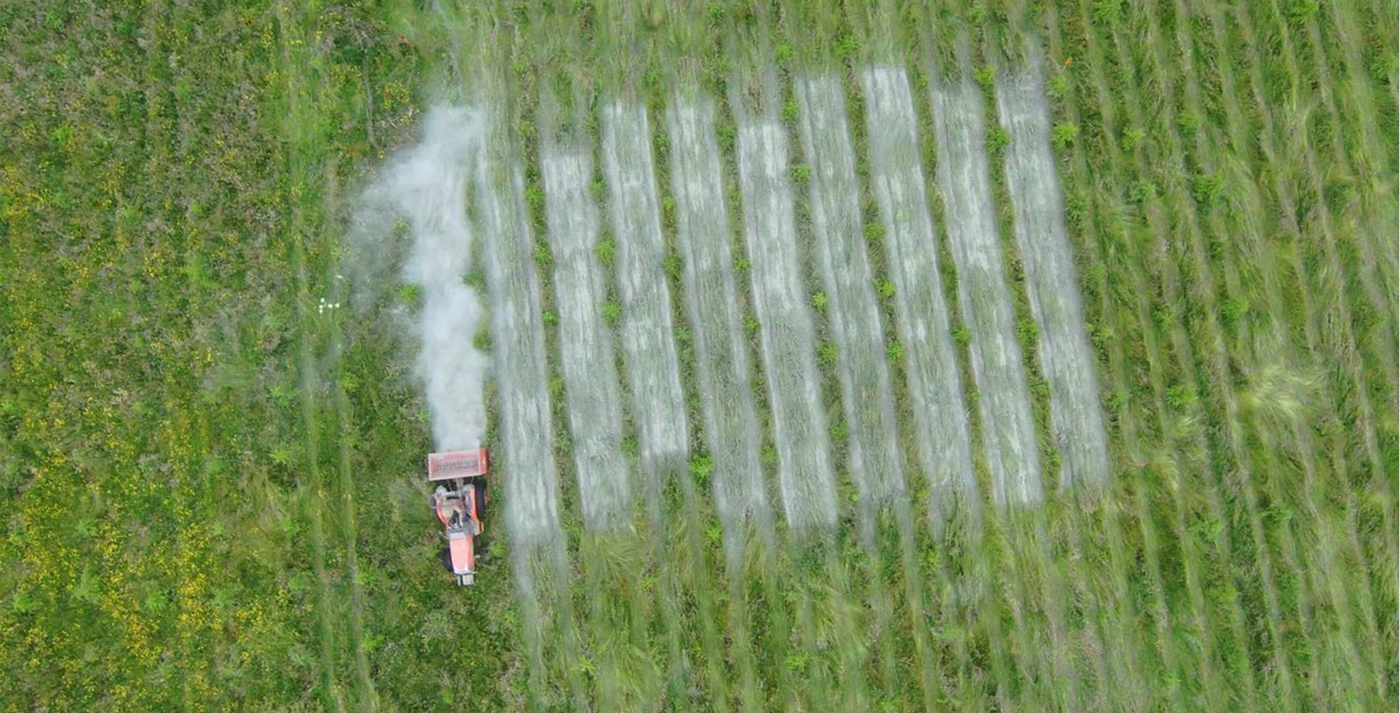
Basalt application back in 2023 – credit, the Carbon Community
A sprinkle of crushed basalt rock has turned out to be the fairy dust that newly planted forests need to develop faster and absorb more carbon.
That’s what scientists from Imperial College London are reporting in a new study from the largest field experiment studying how “enhanced weathering” and soil microbiome enrichment can potentially improve new forest establishment.
Forests are being planted in mass all around the world, with billions of trees at the same stages of life all rising in unison with the hopes that they will absorb extra CO2 emissions and restore wildlife habitat.
One of the biggest challenges is ensuring these juvenile forests develop in a way that sees them survive long enough for their carbon storage potential to meaningfully affect the current carbon cycle, and it’s well documented that mass tree-planting can go hand in hand with mass tree die offs.
In Wales, the Glandwr Forest Carbon Study is being carried out in partnership with the Royal Botanic Gardens Kew, the Carbon Community, Imperial College London, and the University of Sheffield. 25 acres of reforested woodland has seen 26,000 trees planted and monitored across 72 different plots.
The idea is to create a comprehensive case-control dataset on how trees respond to different reforestation techniques, in particular the dispersion of crushed basalt rock atop the soil, and the addition of soil microbes from mature, aged forests.
GNN has previously reported on crushed stone as a soil amendment. The idea is that as the silicate rock fragments weather away into dust, they release a compliment of minerals and change the soil pH levels in such a ways as to enhance the supply and uptake of key nutrients like nitrogen and phosphorous.
The researchers studying Glandwr forests have found that this technique significantly improves aboveground carbon storage potential of the soil and tree roots—by 27% according to early results.
Next, they wanted to see whether fungi and microbes contained within the nearby natural woodland would help accelerate the development of Glandwr trees’ root systems, as they are known to do in natural forest models.
WASTE ROCK WANTED: Researchers Invent Way to Turn Harmful Mine Waste into Healthy Soil
Though some plots of trees—particularly oak and spruce—saw a measurable benefit, variation across the whole project site rendered the technique statistically insignificant.
Lastly, the collaborators tested whether combining the two techniques would produce a greater or lesser benefit than either individually. This, however, also proved to be insignificant. The team hypothesized that it is perhaps too early in the forests’ life for these interventions to take effect, and that potentially longer monitoring periods could come to show a benefit.
MORE NATURE-BASED SOLUTIONS: ‘Living Breakwater’ Makes Room for Oysters and Tidal Pools In Award Winning Design off Staten Island
“Healthy new woodlands are essential for biodiversity, climate mitigation and resilient landscapes,” said Dr. Bonnie Waring, senior author of the paper presenting the results of two growing techniques.
“Our findings show that relatively simple, nature-based interventions can improve tree establishment and increase the carbon uptake of new woodlands during their earliest years.”
SHARE These Simple Nature-Based Solutions To Improve Forest Cultivation…
