


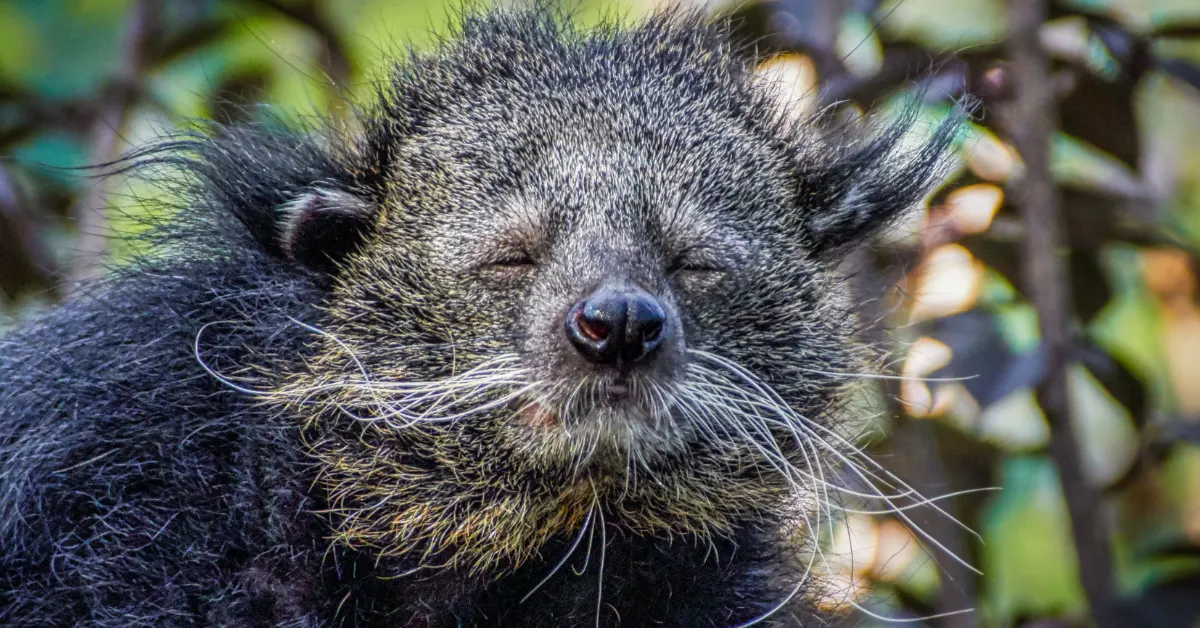
With the distinct appearance of a “maskless raccoon,” or a puppet from Jim Henson’s “The Dark Crystal,” the binturong is one of the animal kingdom’s more curious looking creatures.
Throughout the world, these mammals are colloquially called “bear cats,” due to their thick black bear-like coat and whiskered faces — but they are not related to bears or cats. Instead, they belong to a genus unto themselves, as the only species in the genus Arctictis.
They also bear a trait called reverse sexual size dimorphism, where females are larger than the males, weighing in at an average of 50 pounds, compared to their counterpart’s average of 20 pounds.
It’s an uncommon, but not unheard of, quality, in nature — a trait that can also be found in baleen whales, spotted hyenas, and orb-weaver Spiders (the last of which can be 10 times the size of its male counterpart).
Binturongs also have a prehensile tail — a tail that can grasp or hold onto objects. Other animals with prehensile tails include spider monkeys, chameleons, and seahorses.
Remarkably, binturongs are one of just two carnivores in the world that boast a tail like this (the other being the kinkajou, or “honey bear), and they use it as a “fifth limb” to balance in high tree branches.
Vassil/Wikimedia Commons (CC0 1.0)
Perhaps most bizarrely, binturongs emit a smell that is uncannily similar to buttery popcorn, a phenomenon that scientists traced to the a chemical in their urine called 2-acetyl-1-pyrroline, or 2-AP, the same chemical that forms in popcorn during the popping process.
In the wild, they can be found in the tropical forests of South and Southeast Asia, in countries such as Indonesia, Malaysia, and Thailand. They play a vital role in their ecosystem, eating fish, rodents, birds, worms, and insects and “germinating” more resilient plants as they eat and pass seeds.
But in the last 30 years, their population has been on the decline, due to their capture and trade for the exotic pet market.
“Tragically, binturongs’ striking appearance and quirky charm have made them increasingly popular as exotic pets,” the conservation nonprofit, Flora & Fauna, wrote on its website. “Poachers are all too prepared to meet this demand, setting traps to snatch them from the forests they call home.”
For years, the David Attenborough-backed group has been raising funds to protect binturongs from poaching and wildlife trafficking, by equipping rangers and patrol teams with the tools and resources they need to intervene.
Konrads Bilderwerkstatt/Wikimedia Commons (CC BY 2.0)
“Rangers are the front line of defense,” Flora & Fauna said in a statement. “They patrol the forest day in, day out, their constant presence warding off would-be poachers.”
“Their job is not an easy one, but the equipment that they need is surprisingly simple; new boots, when old ones wear thin. A raincoat, so they can patrol through any conditions. Rucksacks, to carry their rations to replenish their energy on long treks.”
Flora & Fauna is one of the world’s oldest conservation organizations — and their global efforts have had real-world impacts. In 1991, they helped establish the International Gorilla Conservation Program in Rwanda, Uganda, and the Democratic Republic of the Congo to safeguard mountain gorillas from poaching.
In the 1970s, only a few hundred remained in the wild. Today, mountain gorillas have rebounded to over 1,000, thanks to the IGCP.
Flora & Fauna said that its conservationists are applying the same tried-and-true approaches from programs like the IGCP to binturong protection efforts.
“We have been at the forefront of conservation in Southeast Asia for decades,” the nonprofit said on its website. “We know these forests. We know how to protect them. And with your support, we can stop the bearcat from vanishing forever.”
A monumental milestone for binturongs recently occurred in March, when the San Diego Zoo welcomed two binturong babies, or “binlets,” for the first time in 26 years.
The twin males, Pulong and Tau, were born to parents Nettle and Garret.
San Diego Zoo
As they get bigger, they’re exploring trees throughout the habitat and engaging in classic binturong behavior: snorting, purring, and chuckling when happy, and “screaming like a cat” when bothered.
“[They] are currently spending quality family time behind the scenes while mom keeps busy with round-the-clock cuddle puddles, grooming, and care,” the San Diego Zoo posted on Instagram.
“It’s a tree-mendous win for the future of this vulnerable species and supports conservation efforts both here and in their native habitats.”
You may also like: This giant snail is the size of a croissant. Conservationists are banding together to save it from extinction
Featured Image: Konrads Bilderwerkstatt/Wikimedia Commons (CC BY 2.0)
