

Close Menu

    Subscribe to Updates

    Get the latest creative news from FooBar about art, design and business.

    What's Hot

    How High Performers Navigate Unexpected Personal Crises

    July 26, 2026

    This Potential Social Security Fix Has Bipartisan Support, and It Won’t Cost Ordinary Americans

    July 26, 2026

    Some bees have tiny internal compasses, new study finds

    July 26, 2026
    Facebook X (Twitter) Instagram
    Trending
    • How High Performers Navigate Unexpected Personal Crises
    • This Potential Social Security Fix Has Bipartisan Support, and It Won’t Cost Ordinary Americans
    • Some bees have tiny internal compasses, new study finds
    • When Should You Start Collecting Social Security?
    • Last Circus Elephant in Portugal Can Now Romp-and-Roll on 1000-Acre Sanctuary After 40 Years of Work
    • Social Security COLA 2027 could raise retirees’ checks by $77 a month as experts push for formula change
    • Backline Marks 7th Mental Health Awareness Month With Record Growth, New Resources for the Music Industry
    • The Secret Behind Your Social Security Raise
    Moving MountainsMoving Mountains
    Facebook X (Twitter) Instagram
    Sunday, July 26
    • Home
    • Mental Health
    • Life Skills
    • Self-Care
    • Well-Being
    • Awareness
    • Inspiration
    • Workers Comp
    • Social Security
      • Injuries
      • Disability Support
      • Community
    Moving MountainsMoving Mountains
    Home » Some bees have tiny internal compasses, new study finds
    Community

    Some bees have tiny internal compasses, new study finds

    TECHBy TECHJuly 26, 2026No Comments4 Mins Read
    Facebook Twitter Pinterest LinkedIn Tumblr Reddit WhatsApp Email
    Search
    Share
    Facebook Twitter LinkedIn Pinterest WhatsApp Email

    A surprisingly large number and diversity of bee species — 74 out of 96 tested — have magnetic properties, according to research my colleagues and I recently published in the journal Science Advances.

    Some animals are able to use iron-based magnetic compounds, such as magnetite, to detect and navigate via the Earth’s magnetic field — a sense called magnetoreception. We considered magnetism in the insects we tested to be a proxy for which species might be magnetoreceptive.

    For decades, biologists have known that social, cavity-nesting honeybees exhibit magnetoreception. Most researchers assumed that this internal compass was tied to living in a colony; honeybees communicate the location of floral resources to other colony members through a dance that indicates direction relative to the position of the Sun and the geomagnetic field.

    Our study had two goals: to compare magnetism between bee species that live in groups versus on their own, and to track down the evolutionary origin of magnetoreception in bees.

    ‍

    Finding magnetism wherever we looked

    To test magnetic responses, we collected bee specimens from across the bee family Apidae, which includes social species such as honeybees,. along with solitary species such as chimney bees.

    We ground dried dead bees into a powder, then measured how magnetic this powder was in a magnetometer.

    To our surprise, we found that the magnetic response was strong in both bees that live in groups and those that live alone. This result forced us to reject our initial hypothesis that magnetism was necessary only for social bee species.

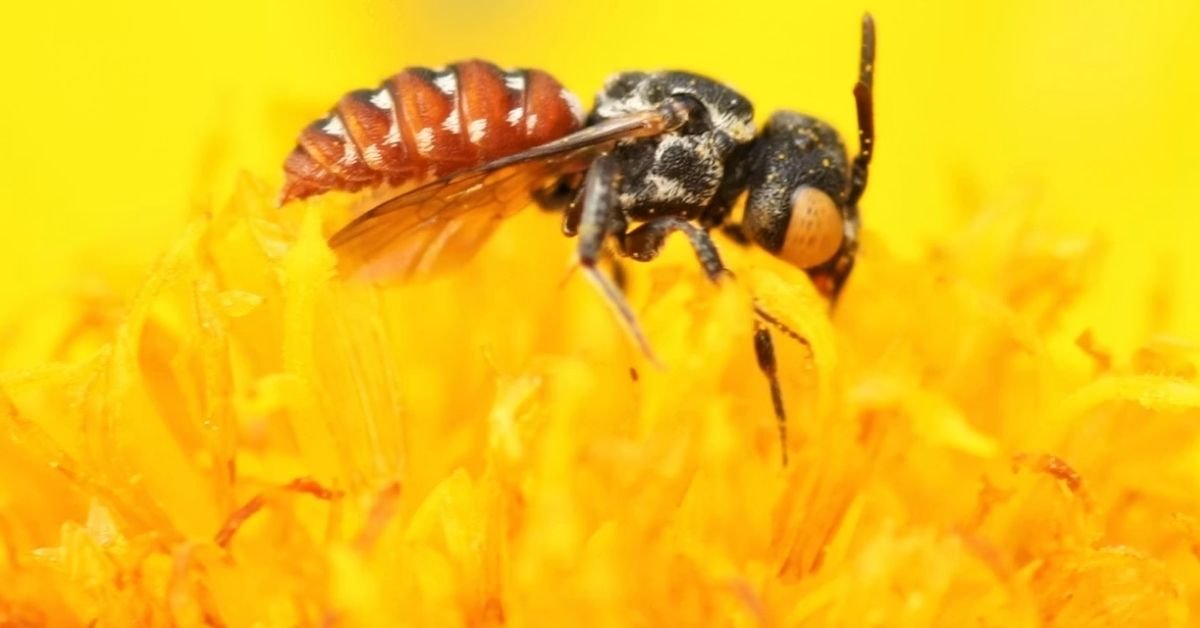
    A tiny, ground-nesting social sweat bee in the family Halictidae had a high magnetic response. Laura Russo/University of Tennessee

    Even more unexpected, a bee from a small social species in the family Halictidae was also strongly magnetic. We then broadened our search to include bees from across the bee evolutionary tree, suspecting that the evolutionary origin of magnetism could be found in older bee lineages.

    We identified some trends regarding the strength of the magnetic response of the bees in our study. Larger bees tested as more magnetic. Social bees did tend to be more magnetic than solitary bees. And cavity-nesting bees tended to be more magnetic than ground-nesting bees.

    Overall, though, we detected magnetism across all the different families of bees, for social and solitary bees, in nocturnal bees, and in bees that live in nests in the ground, as well as those that live above ground in hives.

    Insects from other groups we examined for comparison, including beetles, wasps and flies, were also magnetic.

    We again had to reject our hypothesis; this time, we demonstrated that magnetism probably predates the evolutionary origin of bees. We concluded that magnetism is probably an ancient, well-conserved trait.

    Some bees that live alone, including orchid bees, registered a high magnetic response. Laura Russo/University of Tennessee

    ‍

    What still isn’t known

    Our work leaves a lot of unanswered questions.

    For one, although we assume that the magnetic response is a proxy for magnetoreception, it is notoriously difficult to demonstrate this because it requires experiments with live organisms removed from their natural environment.

    Magnetoreception is one of the most controversial animal senses. While there is good evidence that some organisms have the ability to detect and navigate along the magnetic fields of the Earth, it is probably not the primary sense used, even for organisms that do have magnetoreception. That makes it a challenging sense to isolate and study.

    Even in bumblebees, which biologists believe are magnetoreceptive, there remain many questions and doubts about their use of this sense.

    Scientists are more certain that honeybees are magnetoreceptive — researchers have even trained them to discriminate between local magnetic anomalies. So we made the assumption that insects we tested that had stronger magnetic responses than honeybees are also magnetoreceptive. But we cannot prove it.

    Moreover, our work does not explain the function of magnetism, nor the mechanism behind magnetoreception.

    And while the strength of the magnetic signal varied among body parts, it was never restricted to a single body part in the bees we tested. This means that some of the hypotheses for how magnetoreception operates — for instance, through light-sensitive cryptochromes in the eyes — are not well supported by our results.

    ‍

    This article was written by Laura Russo from the University of Tennessee, and was originally published on The Conversation.

    ‍

    Featured Image: Laura Russo/University of Tennessee

    Bees compasses finds internal Study Tiny
    TECH
    • Website

    Related Posts

    Last Circus Elephant in Portugal Can Now Romp-and-Roll on 1000-Acre Sanctuary After 40 Years of Work

    July 26, 2026

    Can PM’s Gaza apology win back lost Muslim voters in Bradford?

    July 26, 2026

    Good News in History, July 26

    July 26, 2026
    Leave A Reply Cancel Reply

    Don't Miss
    Inspiration

    How High Performers Navigate Unexpected Personal Crises

    By TECHJuly 26, 20260

    Overcoming addiction is one of the most difficult and important decisions a person can make.…

    This Potential Social Security Fix Has Bipartisan Support, and It Won’t Cost Ordinary Americans

    July 26, 2026

    Some bees have tiny internal compasses, new study finds

    July 26, 2026

    When Should You Start Collecting Social Security?

    July 26, 2026
    Stay In Touch
    • Facebook
    • Twitter
    • Pinterest
    • Instagram
    • YouTube
    • Vimeo
    Our Picks

    How High Performers Navigate Unexpected Personal Crises

    July 26, 2026

    This Potential Social Security Fix Has Bipartisan Support, and It Won’t Cost Ordinary Americans

    July 26, 2026

    Some bees have tiny internal compasses, new study finds

    July 26, 2026

    When Should You Start Collecting Social Security?

    July 26, 2026

    Subscribe to Updates

    Get the latest creative news from SmartMag about art & design.

    About Us

    At Moving Mountains, we believe that every individual has strength, value, and purpose—regardless of mental health challenges or physical disabilities. This platform was created to inspire hope, promote understanding, and empower people to live meaningful and confident lives beyond limitations.

    Latest Post

    How High Performers Navigate Unexpected Personal Crises

    July 26, 2026

    This Potential Social Security Fix Has Bipartisan Support, and It Won’t Cost Ordinary Americans

    July 26, 2026

    Some bees have tiny internal compasses, new study finds

    July 26, 2026
    Recent Posts
    • How High Performers Navigate Unexpected Personal Crises
    • This Potential Social Security Fix Has Bipartisan Support, and It Won’t Cost Ordinary Americans
    • Some bees have tiny internal compasses, new study finds
    • When Should You Start Collecting Social Security?
    • Last Circus Elephant in Portugal Can Now Romp-and-Roll on 1000-Acre Sanctuary After 40 Years of Work
    Facebook X (Twitter) Instagram Pinterest
    • About Us
    • Contact Us
    • Privacy Policy
    • Terms & Conditions
    • Disclaimer
    © 2026 movingmountains. Designed by Pro.

    Type above and press Enter to search. Press Esc to cancel.