


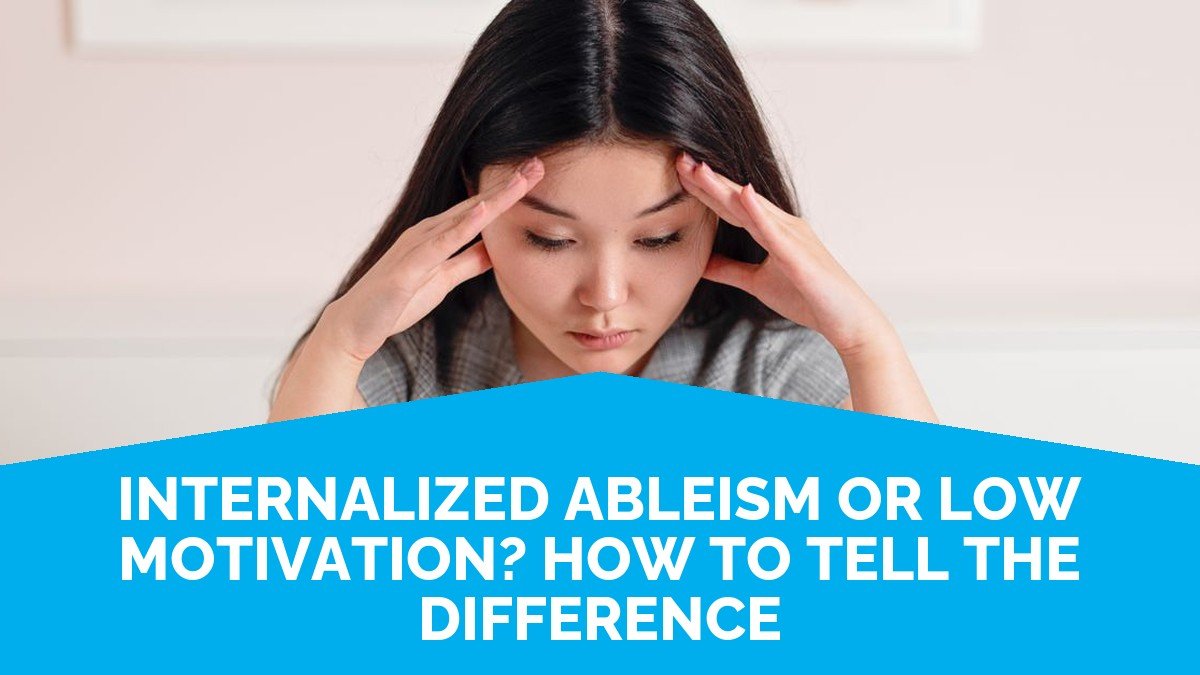
You blocked off the whole afternoon for the thing you said mattered. The project, the workout, the email you have been meaning to send for a week. The time came, and you did not move. You scrolled, or you cleaned something that did not need cleaning. And somewhere in the not-moving, a familiar verdict showed up: I must be lazy.
That verdict is worth a second look. A lot of what gets filed under “lazy” or “unmotivated” in a neurodivergent brain is something else that looks almost identical from the inside: internalized ableism. It is the set of ableist ideas about disability that you absorbed from the world growing up and, at some point, started aiming at yourself. And it can be very hard to tell apart from genuinely not wanting to do something.
I am an executive function coach with ADHD, and telling those two apart is one of the most common knots I help neurodivergent adults work loose. This article hands you a way to do it yourself: what internalized ableism actually is, the signs it is running the show, how to tell it from a real “no,” and what to do about it that does not involve trying harder.
TL;DR: The Short Version
If you have ever planned something out, failed to start, and decided the problem was your character, these are the questions worth sitting with:
- What is internalized ableism, in plain terms?
- How do I tell internalized ableism from genuinely not wanting to do something?
- Why does “just try harder” tend to make it worse?
- What does internalized ableism have to do with executive function?
- What can I do about it this week?
This is educational coaching content, not medical or psychological advice. If you are working through this with a professional, use it alongside that conversation, not instead of it.
What Internalized Ableism Actually Is
Ableism is the belief that being disabled is a worse, lesser way to be. Internalized ableism is what happens when you grow up inside that belief and, without ever agreeing to it, start applying it to yourself.
Researchers describe ableism not as ignorance but as a deeply ingrained way of thinking that treats disability as undesirable. When you are the neurodivergent person, that thinking does not stay outside. It becomes the voice that files your needs under “excuses” and your limits under “failures.”
The engine underneath it is shame. In a 2022 study of disabled young people, the researchers describe how repeated shame stops being about any single event and becomes part of how a person sees themselves, so the story shifts from “I did something bad” to “I am bad.”
That shift is the whole problem in miniature. A missed deadline stops being a thing that happened and becomes evidence about who you are. If that loop sounds familiar, the ADHD shame spiral is the same machinery running at speed.
There are two ways to look at disability. The medical model locates the problem inside the disabled person; the social model locates it in the mismatch between a person and an environment built for someone else.
Internalized ableism runs entirely on the first model: it assumes you are the part that went wrong. Almost everything useful in the rest of this article comes from switching to the second, from “what is wrong with me” to “what is this situation asking of me, and what would actually help.”
6 Signs Internalized Ableism Is Running the Show
Internalized ableism is sneaky, because it usually sounds like being responsible, humble, or realistic. These are the shapes it takes.
- You refuse accommodations you know would help. Captions, extra time, a quieter room, a written agenda instead of a verbal one. The support exists, you could ask, and something in you says you should manage without it.
- You call yourself lazy, broken, or too much. The labels are global and about your character, not the specific situation. “I am lazy” does more work in your head than “this task has no deadline and my brain runs on deadlines.”
- “Everyone else can do this.” The comparison is usually to an imagined person who has no trouble with the exact thing you find hard, and it tends to end with you coming up short against them.
- You feel guilty for needing support, as if there were a fixed amount in the world and someone more deserving should get yours. People on disability forums describe turning down a cane or tool they know would help, for exactly this reason.
- You push through situations that hurt, the fluorescent-lit room, the back-to-back meetings with no break, the sensory nightmare you white-knuckle, because leaving would mean admitting a limit out loud.
- You mask until there is nothing left. You perform “fine” all day, and by evening you cannot make a decision or answer a text, and you read that emptiness as more proof you are failing.
Internalized Ableism or Genuinely Low Motivation? How to Tell the Difference
Here is the distinction that actually sorts this out. “Low motivation” is not one thing: motivation has a quality to it, not just an amount.
Self-Determination Theory, the main research framework for motivation, sorts it along a line. At one end is intrinsic motivation, doing something because it genuinely interests you. Further back sits what researchers call introjected regulation: acting to avoid guilt or anxiety, or to protect your pride, driven by a rule you have partly taken in but never accepted as your own goal.
Read that again, because it is a photograph of internalized ableism. The neurodivergent adult forcing themselves to mask, to look productive the neurotypical way, to not need what they need, is not unmotivated. They are running on plenty of motivation, just pointed by shame from outside them. What looks like an empty tank is often a full tank aimed at the wrong target.
There is a second thing the “lazy” read misses. Running on shame for years is depleting, and that drains the executive function capacity you need for the goals you care about. So you end up with two problems at once: motivation aimed at the wrong thing, and a battery that is genuinely flat.
So when you cannot make yourself do something, run two quick checks.
Check one, want versus capacity. Did you ever want this? “I used to love this and now it feels impossible” points at capacity, not desire, because the wanting is intact and only the resource to act on it went missing. “I have never cared about this and only do it because I am supposed to” points somewhere else entirely.
Check two, whose “should” is this? Notice the feeling attached to the task. A real “no” tends to feel neutral, or even a little freeing, while an internalized “should” shows up with guilt, shame, or the sense that wanting out makes you a bad person. Shame attached to a “no” is the clearest sign you are looking at a borrowed should, not your own answer.
Put together, the two checks sort most cases:
What you notice
Leans toward internalized ableism
Leans toward a genuine no or a real capacity limit
The feeling
Guilt, shame, self-disgust; wanting out feels like proof you are lazy
Neutral and matter-of-fact, sometimes a small relief
Whose “should” it is
Borrowed from outside: a parent, a boss, “everyone else”
Your own values, or a limit you can name without apologizing
Desire over time
You still want it (“I used to love this”) but cannot get there
You never wanted it, or you genuinely want to rest
What your body is doing
Masking, forcing, hiding the strain
No hiding needed; you can choose freely
What moves it
Dropping the shame and the borrowed should
A concrete accommodation or tool, or a “no” that simply stands
If you want the mechanics of how the different kinds of motivation actually work, our guide to the difference between extrinsic and intrinsic motivation goes deeper than I can here without turning this into a psychology lecture.
The Executive Function Lens
Here is where my coaching bias shows. I think the most useful way for a neurodivergent adult to hold internalized ableism is as an executive function problem, not only an identity or self-esteem one.
Executive function is the set of mental tools you use to start things, plan, hold information in mind, and manage effort. It runs on a limited daily budget. Masking spends that budget, and so does refusing an accommodation to do the task the hard, “normal” way, or running a background argument about whether you deserve the support you need.
Every one of those is the same belief in action, and every one of them draws down the exact account you need for the goals that matter to you. That is the real cost, and it is bigger than feeling bad about yourself. The self-policing eats the capacity you were trying to protect.
That masking-and-hiding drain has a name in the ADHD world, the ADHD tax, and it connects straight to executive dysfunction and the kind of task paralysis where you cannot start even though you want to.
Flip it around and the move becomes clear. Accepting a support does not spend capacity, it hands some back. Every accommodation you let yourself use is executive function you get to spend on something you chose.
How to Spot It Without Over-Correcting
There is an opposite trap, and it is an easy one to fall into. If every limit is ableism, then resting is a failure, saying no is a failure, and having a plain preference is a failure. That is the same shame with a friendlier vocabulary, and it leaves you more anxious and self-monitoring, not less.
Not every limit is internalized ableism. Some things you skip because you do not want them, and that is a complete sentence. Some things you cannot do today because your capacity is spent, and pushing anyway is how you got depleted in the first place. A real “no” is allowed to be a real “no.”
This is internalized ableism: apologizing for needing captions, turning down a tool that would obviously help because “I should be able to do it without,” treating an ordinary human limit as a character flaw.
This is not: deciding to skip a loud event because you would rather be home, ending your workday when your focus is gone, or realizing a goal you inherited from someone else was never yours to carry.
The point of the two checks earlier is accurate self-location, not a new standard to fall short of. You are allowed to land on “I just do not want to.” And I am a coach, not a clinician, so hold all of this as a way to think, not a diagnosis of anything.
What to Do About It
None of this shifts because you decided to try harder. Trying harder is just more introjected pressure, more shoulds piled on a tired system. The moves that help go the other direction: less pressure, less hiding, more support. Here are the ones I come back to with clients.
Name the should out loud. When you catch yourself thinking “I should be able to do this,” finish the sentence out loud: according to whom? Often the answer is a specific person or standard you never actually signed up for. One of the most freeing things a client ever said to me was that she realized there was no “should,” there was just where she was at.
Catch the shame signal instead of obeying it. This kind of self-talk moves through feelings faster than thoughts, so it helps to name the feeling before it becomes a verdict. Our free Feel Wheel exercise gives you the vocabulary to spot “this is guilt, not truth” in the moment.
Ask for one accommodation, in one sentence. You do not owe anyone a diagnosis or a justification. A version that works in most settings:
“Would it be possible to [specific change]? It helps me focus and I will get you better work.”
If asking for things feels like the hardest part, you are not imagining it; that difficulty is often the belief doing its job. Our guide to real-world self-advocacy breaks the ask into smaller steps.
Let a tool carry the executive function load. Offloading planning to a timer, a task app, or a checklist is not cheating or a crutch. It is the same reason anyone uses a calendar: brains are for having ideas, not storing them.
Swap the self-blame thought for the mechanism. “I am lazy” is global and it is a dead end. “The tank is empty” or “this task has no external structure and my brain needs some” is specific, kinder, and, more to the point, true. Specific descriptions point at something you can change; global labels just sit there.
The writer KC Davis has a line I repeat to clients constantly: care tasks are morally neutral. Doing the dishes late does not make you a bad person; it makes you a person who did the dishes late. Her book How to Keep House While Drowning builds an entire practical method out of that one reframe.
Move toward the goals that are actually yours, and find your people. The research is unusually clear on this last one. Building a positive relationship with your own neurodivergence, and spending time around others who share it, is one of the most protective things you can do against it. Unmasking is slow and not safe in every room, so go at the pace your life allows.
How Internalized Ableism Differs From Masking, Burnout, and RSD
Internalized ableism overlaps with a few experiences it is easy to confuse it with, and knowing which one you are dealing with changes what helps. Each of these has a home on the site if you want the full picture.
- Masking is the behavior, hiding neurodivergent traits to pass as typical. Internalized ableism is the belief that makes masking feel mandatory. See ADHD masking and autistic masking examples.
- Neurodivergent burnout is the depletion that chronic masking and self-suppression cause over time. It is the flatness that gets misread as “no motivation.” See neurodivergent burnout.
- Rejection sensitive dysphoria is the intense pain of perceived rejection or criticism. It can feed the shame loop, but it is its own thing. See rejection sensitive dysphoria.
- Low intrinsic motivation is the genuine version of the thing this article helps you rule in or out: an activity that simply holds no interest for you, with no shame attached.
The Research Behind This, in One Place
A short, quotable summary of the evidence this runs on, for anyone who wants to check the sources.
Finding
What it means
Source
Repeated shame can become internalized, shifting the story from “I did something bad” to “I am bad.” (2022)
Explains why a single missed task can feel like proof about your whole character.
Johannsdottir et al., 2022
Introjected regulation is acting to avoid guilt or anxiety, driven by a rule not accepted as your own goal. (2016)
This is the motivation behind internalized ableism: driven, but from the outside.
Cook and Artino, 2016
Increased masking is associated with increased depression, anxiety, and suicidality in autistic adults. (2020, US)
Hiding your neurodivergence carries a measurable mental-health cost.
Raymaker et al., 2020
Autistic burnout is a lasting state of exhaustion and reduced function from a mismatch of demands and support. (2020, US)
The depletion that looks like low motivation has a name and a cause.
Raymaker et al., 2020
Positive contact with other disabled people is one of the most effective ways to resist internalized ableism. (2022)
Community with other neurodivergent people is protective, not just nice to have.
Johannsdottir et al., 2022
Frequently Asked Questions
What is an example of internalized ableism?
Turning down a deadline extension you are entitled to, because needing it feels like proof you are less capable than everyone else. Apologizing for your access needs is another.
How do I know if it’s internalized ableism or I just don’t want to?
Run two checks. First, did you ever want it? “I used to love this and now I can’t” points at a capacity problem, not a lack of desire, because the wanting is still there. “I have never cared about this” points at a genuine preference.
Second, notice the feeling. A genuine no tends to feel neutral, or even a little freeing. An internalized should shows up with guilt or shame, and a sense that wanting out makes you a bad person. Shame attached to a no is the clearest sign you are looking at a borrowed should rather than your own answer.
If it is still murky, that is normal. Sometimes it is both at once, a should you inherited sitting on top of a real limit, and you can work on both.
How do you unlearn internalized ableism?
Slowly, and mostly by changing your conditions rather than thinking your way out. Catch the shoulds and ask where they came from. Accept the accommodations and tools that give capacity back. Spend time around other neurodivergent people, which the research shows is genuinely protective. And give it time, because a belief you absorbed over decades does not leave in a week.
Is it internalized ableism to not call myself disabled?
Not on its own. What you call yourself is your choice, and plenty of people have thought-through reasons for the words they use or avoid.
The part worth checking is what sits underneath the choice. If you steer clear of the word because it feels accurate but shameful, or because claiming it would mean letting yourself accept support, that underneath part is worth a closer look. The label is yours to pick; the shame is the part to question. Our piece on whether ADHD is a disability sits right in that tension.
Is internalized ableism the same as low self-esteem?
They overlap, but they are not the same. Low self-esteem is a broad sense of not being good enough. Internalized ableism is specific: it attaches to your disability or neurodivergence and the supports you need, turning ordinary access needs into evidence of inadequacy. You can feel fine about most of your life and still flinch at asking for one accommodation.
Next Steps
If one thing here is worth acting on, make it the smallest one.
- Pick one “should” and question it this week. The next time you hear “I should be able to,” ask whose voice that is. You do not have to resolve it, just notice it.
- Request a single accommodation. One sentence, no diagnosis required, using the script above. One ask is enough to start loosening the belief that you should not need one.
- If the capacity drain is what has you stuck, get a hand with the executive function side. That is what executive function coaching for adults is built for: practical, skill-focused, and different from therapy. If you want a free starting point, the free executive functioning assessment maps where your capacity is going.
- Find your people. A neurodivergent community, online or in person, does more against it than any amount of talking to yourself in the mirror.
