


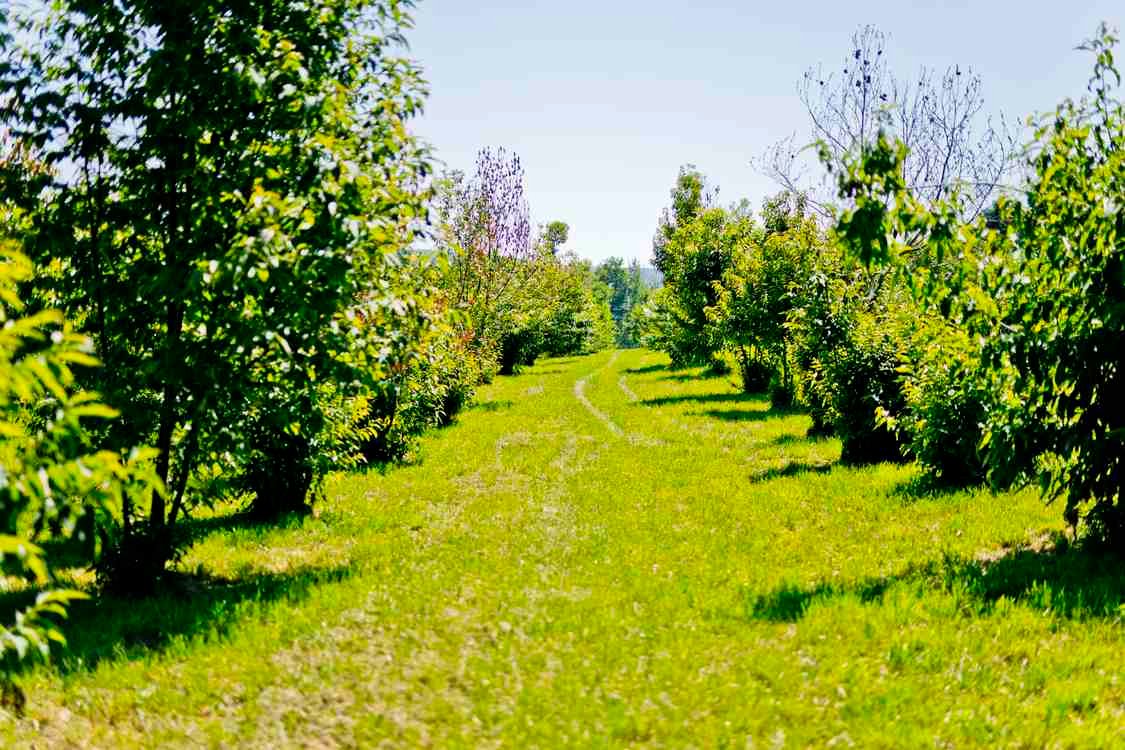
Darling cultivation in Syracuse – credit, John Carnessali
At the intersection of big data, forestry, and genomics, a biotech startup has birthed a generation of “elite” blight-resistant American chestnut trees without deep genetic tinkering.
The company is inspired by saving American hardwoods that have been ravaged by an introduced fungal disease, and says their proprietary approach could be replicated to help save American elm, ash, and white oak trees as well.
North American timber is a $350 billion industry. Hardwood forests support habitats and biodiversity, and anchor some 15% of all American carbon. Yet between chestnut blight, the emerald ash borer, and Dutch elm disease, many native species have experienced catastrophic declines.
“I grew up in northern Ohio on a street called Chestnut Ridge, named by early settlers after the dominant trees on the landscape, so there was always a kind of mystique around the chestnut in the back of my memory, even before I understood why,” Andrew Serazin, co-founder of SilvaBio, told GNN in an email correspondence.
Several concepts for protecting or immunizing American chestnuts from the blight which landed on American shores in the early 1900s from East Asia have failed or are being tested. Along with his partner and aptly-named entrepreneur Michael Bloom, Serazin and SilvaBio have approached the challenge by combining sophisticated predictive methods and knowledge of the chestnut’s genomics with their “Lightspeed” breeding process that avoids direct genetic engineering in favor of an enhanced form of propagation.
By analyzing genomic variance between plants, SilvaBio’s models were able to predict which ones would stand the best chance of tolerating the blight. These were then bred together to “stack” the OxO gene, which was found to best predict resilience.
“By analyzing DNA, we can identify which young seedlings are most likely to survive disease long before they would typically be tested in the field,” the co-founders told GNN. “In practice, this is similar to precision medicine, but applied to forests.”
“Through our proprietary speed-breeding process, carefully controlling high-intensity light, we can encourage trees to flower and reproduce much faster than they would in nature,” they continued. “This allows us to complete a breeding cycle in about a year, compared to 10 or more years using traditional approaches, overcoming one of the biggest bottlenecks in tree improvement.”
The result was “Darling54.” A double-blinded trial of this special American chestnut cultivar compared with common cultivars found that the “cankers” resulting from chestnut blight were orders of magnitude smaller on Darling54 both as a seedling and at 4 years.
On Arbor Day 2026, a Darling54 chestnut was planted at the White House.
“A foreign pathogen took the American chestnut from our forests. As we approach our 250th, American innovation, science collaboration and stewardship are bringing it back. That is a story worthy of this anniversary,” said Jessica Bowron, National Park Service Acting Director, in a speech to mark the occasion.
Before Darling cultivars can be cultivated on mass, however, detailed regulatory science has to be conducted to ensure that focusing Natural Selection so pointedly to a single purpose does not compromise other aspects of the American chestnut’s biology.
For example, in December 2023, the American Chestnut Foundation withdrew its support for a genetically engineered chestnut that was decades in development, after multiple documented research errors revealed the tree to be genetically defective. Discouraging field performance rendered them, in the Foundation’s opinion, unsuitable as the basis for species restoration.
THE OLD FASHIONED WAY: Once Wiped Out by Blight, Thousands of American Chestnut Trees are Thriving on Biologist’s Land in Maine
Since development in 2016, a science update on SilvaBio’s cultivars reads, numerous observations and environmental studies have been done on trees we now know are Darling 54 offspring, with no indication of compromised safety or risks that would affect pending regulatory approval. “More in-depth genome sequencing and additional analyses on Darling 54 are underway and will be submitted to regulators soon.”
NPS staff, Andrew Serazin and Michael Bloom plant a Darling 54 tree at the White House – credit Brien Aho
In their email, Serazin and Bloom addressed some misconceptions about their process, namely that their vision has “never” been to restore the American chestnut with “a single clone.”
“Healthy forests depend on genetic diversity. Our goal is to develop dozens, and eventually many more, blight-tolerant, regionally adapted lines,” they wrote.
COMBATING INVASIVE DISEASES: Aussie Man Invents Weapon in War Against Invasive Asparagus Fern–The ‘Asparagus Assassin’
“In the United States alone, an estimated 41% of our live forest biomass is threatened by just 15 non-native insects and diseases. The American chestnut is functionally extinct. We’ve lost roughly 75% of our mature elm trees. Ash is being devastated by the emerald ash borer, while beech, white oak, and walnut face their own emerging threats.”
“The American chestnut is our first application, but the same approach can be extended to other species facing similar challenges. Each new species builds on the scientific knowledge, propagation capabilities, and restoration partnerships we’ve already established.”
SHARE This Huge Step Towards Bringing Back This Legendary Tree…
