


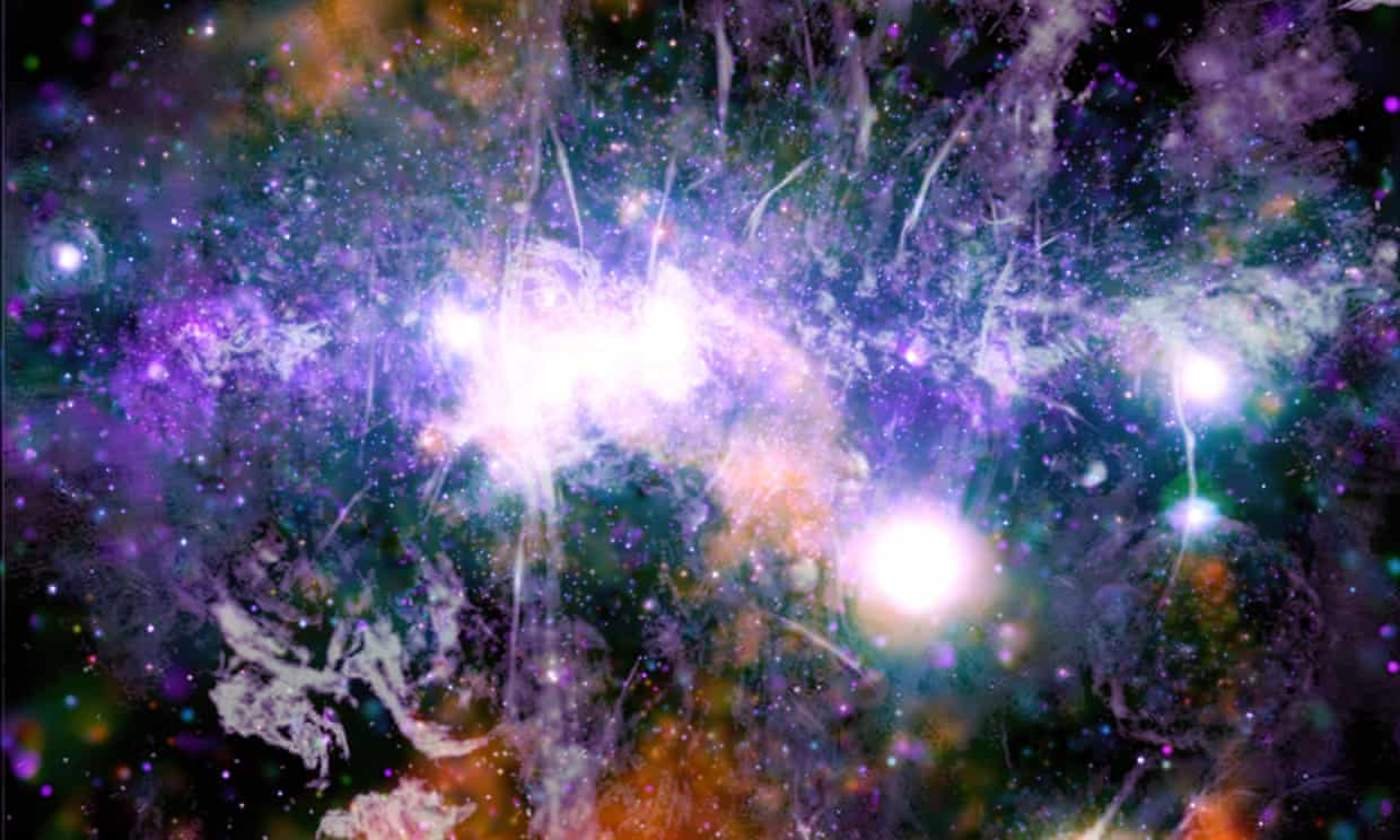
NASA/CXC/UMass/Q.D. Wang
Scientists have detected a simple sugar found in raspberries within the gas and dust at the center of the Milky Way.
It’s the first time a sugar molecule has been identified in interstellar media, having previously been found in our solar system on asteroids.
Called erythrulose, it’s found in raspberries and suntan lotion, but the authors of the paper describing the observation didn’t suggest there were pallid aliens working on their tan, rather, that a 4-carbon sugar can actually form in rather base mixtures of matter, before coalescing into planets.
The Spanish scientists at a research center called CSIC-INTA used 2 radio-wave telescopes in their own country to pick up signals from a large cloud of gas near the center of the Milky Way called G+0.693-0.027. The data returned by the telescopes was then subjected to spectroscopy analysis.
In spectroscopy, the spectrum of light reflecting off of molecules can be examined to the end of determining exactly what kind of molecule it is. In this case, the scientists say it’s erythrulose beyond any doubt.
“The detection of the first sugar in interstellar space suggests that the key ingredients for life can form in molecular nebula before stars and planets form,” study lead author Dr. Izaskun Jiménez-Serra from the CSIC-INTA Center for Astrobiology, said in a statement.
Sugars are not only sweeteners in our coffee and cakes, but building blocks for DNA, and the study detection shows that, leaving out a biological origin, “true sugars,” or sugars with 4 carbon molecules or more, can form abiotically—likely on the mantle of a dust particle.
SPACE ODDITIES:
Astrophysicists speaking with ABC News AU explained that in the freezing void of space, it’s very difficult for large molecules to form. Erythrulose, which has 4 carbon, 8 hydrogen, and 4 oxygen atoms, would therefore most likely have formed on the surface of a dust particle.
There, molecules could bump into each other and stick, rather than bounce off one another, by becoming embedded in the dust through electromagnetism. Once thusly embedded, stellar radiation might force larger molecules to shrink by releasing energy, and in that moment, create molecular fusion and turn simple molecules into more complex chemicals.
So far, and since 1937, 350 chemicals have been identified in interstellar space.
SHARE This Stellar Sugar Story With Your Friends Who Love Space…
