


When asked what she loves most about sea turtles, marine biologist Katherine Sayler told Good Good Good that she is constantly amazed by their sheer resilience.
“I think about how incredible their recovery has been in some parts of the world,” said Sayler, who serves as the southeast representative for Defenders of Wildlife, a nonprofit dedicated to protecting imperiled species.
According to Sayler, Kemp’s ridley sea turtles are the most globally endangered sea turtle in the world — and likely the rarest. Of the seven species of sea turtles, they are also the smallest.
Today, they primarily live in the warm, shallow waters of the Gulf of Mexico and the northwestern Atlantic Ocean, but at one point, they teetered on the brink of extinction.
Most of their nesting occurs on a singular Mexican beach: Rancho Nuevo in the state of Tamaulipas. There, they habitually engage in a phenomenon called arribada, or “arrival by sea,” where females emerge from the ocean by the thousands to nest en masse.
Jereme Phillips/USFWS (CC BY 2.0)
According to the National Oceanic and Atmospheric Administration, an amateur video from 1947 documented tens of thousands of Kemp’s ridleys nesting near Rancho Nuevo on a single day.
Decades ago, people collected eggs from the arribada to harvest them for food. That practice, coupled with coastal degradation and unintentional capture in fishing gear, caused their population to plummet in the mid-20th century.
Between the 1940s and 1985, Kemp’s ridley sea turtles declined by a staggering 99%.
“They went from over 121,000 nests to 702 nests,” Sayler emphasized. “Since the 1990s, they’ve been in recovery.”
USFWS (CC BY 2.0)
Today, there are an estimated 7,000 to 9,000 nesting female Kemp’s ridleys, which amounts to roughly tens of thousands of nests globally per year.
“Because of thoughtful people taking action on their own beaches, conservation organizations, protection under the Endangered Species Act, and international conservation, many of them have rebounded,” Sayler said.
“I think it’s just so incredible, some of the bottlenecks that these sea turtles have experienced … it’s pretty significant in terms of the swing in population abundance,” she added.
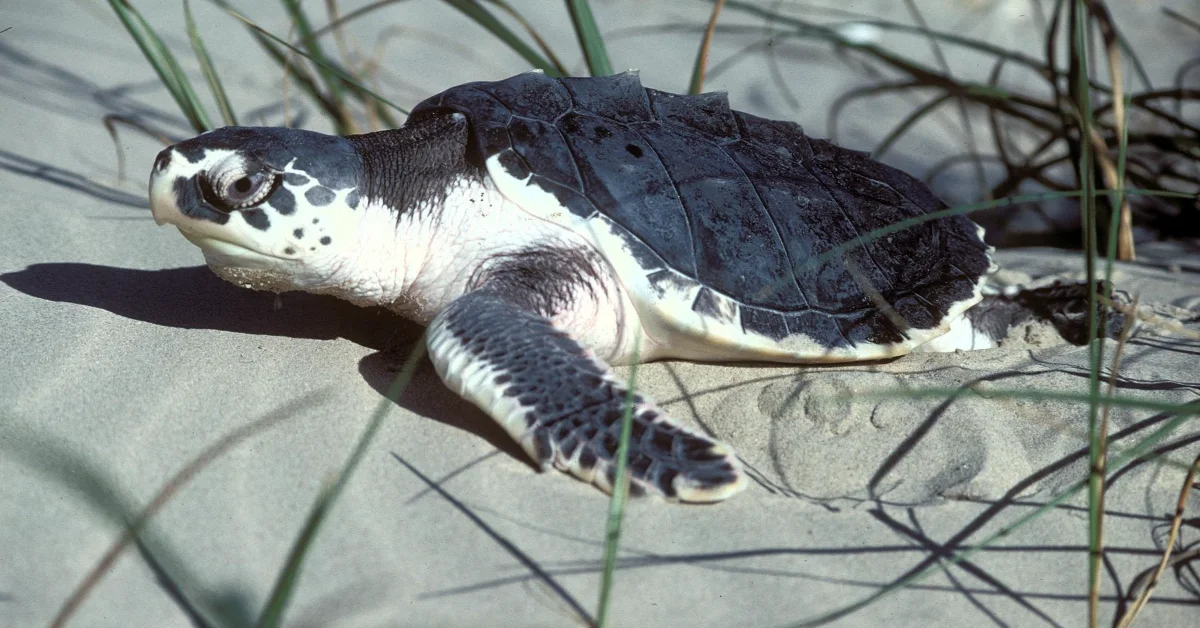
A juvenile Kemp’s ridley sea turtle. USEPA Environmental-Protection-Agency
Although the world’s rarest sea turtle is currently rebounding, they — and other sea turtle species — face an uncertain future. Fortunately, there’s a lot that we can do to help, beyond swapping out plastic straws and giving wildlife a wide berth.
“Keep beaches dark, flat, and clean,” Sayler said. “That’s really the action item that everyday people can do to really help sea turtles rebound and increase in abundance.”
You may also like: Do sea turtles only hatch during a full moon? Your top 5 questions about sea turtles, answered by an expert
Featured Image: USEPA Environmental-Protection-Agency
