


- Indonesia is developing a roadmap to recognize and protect Indigenous peoples’ and local communities’ (IPLCs) traditional knowledge in biodiversity conservation, aligning with its commitments to international frameworks.
- Indigenous communities in Indonesia already safeguard vast biodiverse areas — an estimated 29 million hectares (71.6 million acres) — through customary practices, though only a small portion has been formally documented or recognized.
- The lack of legal recognition of Indigenous territories and rights leave many communities vulnerable to having their conservation efforts overlooked or criminalized despite their role in protecting ecosystems.
- Experts and advocates argue the roadmap must be backed by stronger policy recognition and broad collaboration among government, Indigenous groups, experts and civil society.
JAKARTA — The Indonesian government is developing a roadmap to protect local wisdom in biodiversity conservation, a move aimed at strengthening the recognition and protection of Indigenous peoples and local communities (IPLCs) whose traditional practices have long safeguarded some of the country’s richest ecosystems.
The roadmap, the drafting of which began in June 2026, comes as Indonesia seeks to implement its commitments under the multilateral treaty Convention on Biological Diversity (CBD) and the Kunming-Montreal Global Biodiversity Framework (KM-GBF).
The KM-GBF is a global agreement adopted in 2022 that recognizes the important role of Indigenous peoples and local communities in achieving biodiversity conservation.
One of the framework’s targets, known as target “30×30,” calls for conserving 30% of the world’s land and sea by 2030 while respecting the rights, territories and knowledge of Indigenous peoples.
Indonesia is one of the world’s most biodiverse countries, harboring some of the planet’s highest levels of species richness and endemism. It is also home to an estimated 50 million to 70 million Indigenous people, or around one-fifth of the country’s population. Many of these communities inhabit forests, coasts and other ecosystems with exceptional biodiversity.
According to the Working Group on Indigenous Peoples’ and Community Conserved Areas and Territories Indonesia (WGII), a coalition of NGOs documenting community conservation, its spatial analysis identified more than 29 million hectares (71.6 million acres) of Indigenous territories and community-managed areas with the potential to qualify as Indigenous Peoples’ and Community Conserved Areas and Territories (ICCAs).
Nearly 70% of these areas overlap ecologically important ecosystems, including mangroves, natural forests, karst landscapes, peatlands, coral reefs and seagrass beds, according to WGII.
The coalition says Indigenous peoples and local communities have protected these ecosystems for generations through customary governance systems that long predate modern conservation models.
“Most of the success in protecting Indonesia’s nature has actually come from the hands of those who live together with nature itself — namely IPLCs,” said Cindy Julianty, WGII’s executive coordinator.
She cited traditional conservation systems such as sasi in Maluku, which temporarily closes areas or resources to allow them to recover, and awig-awig in Bali, customary village laws that include rules governing forests, water and other natural resources.
“Conservation is not only about protecting species; it is also about safeguarding the relationship between people and nature,” Cindy said. “This is something we often overlook. Too often, our agendas and programs seem to view nature merely as an object to be used and exploited by humans. Indigenous peoples, on the other hand, see nature as a subject.”‘
A man harvests crab from mangrove forest in Lipu Akat village, Banggai Islands, Central Sulawesi. Image courtesy of Arise! Indonesia
Muhammad Ihsan Maulana, WGII’s policy advocacy manager, said the findings demonstrate that Indigenous conservation deserves stronger policy recognition if Indonesia hopes to achieve its biodiversity targets in an equitable and inclusive way.
Yet Indigenous peoples have often been marginalized from formal conservation efforts because many of their territories remain legally unrecognized, even though they have managed them for generations.
So far, only about 1 million hectares (2.5 million acres) of ICCAs have been documented through WGII’s voluntary national registry, representing just a fraction of the group’s estimated 29 million hectares of potential ICCAs across Indonesia.
Without proper documentation and legal recognition, Indigenous communities risk having their conservation practices ignored or even criminalized, WGII say.
Against this backdrop, the Ministry of Environment and WGII began drafting the roadmap in June 2026.
As Indonesia’s CBD focal point, the ministry says biodiversity policy must move beyond science alone and better incorporate Indigenous knowledge.
“The CBD cannot address biodiversity solely from the perspective of science. It must also incorporate social dimensions,” said Inge Retnowati, the environment ministry’s director of biodiversity conservation.
She said the ministry is preparing a roadmap for the protection and promotion of local wisdom that goes beyond simply defining Indigenous peoples.
“The next question is what follows after that — how recognition should be provided, and what comes next,” Inge said. “The substance of this roadmap is something that we must develop together.”
According to the ministry, the roadmap is intended to guide policies on recognizing, protecting and promoting Indigenous peoples’ traditional knowledge and local wisdom in biodiversity conservation.
Rasio Ridho Sani, the ministry’s deputy for pollution and environmental damage control, acknowledged the vital role Indigenous peoples and local communities play in protecting ecosystems that face mounting pressure from deforestation, overexploitation of natural resources, pollution and climate change.
“Biodiversity is a vital natural asset for the sustainability of ecosystems and the well-being of society,” Rasio said. “Therefore, Indigenous peoples and local communities need to receive support, recognition, protection, and fair benefits for their contributions to conserving biodiversity.”
An integral part of incorporating Indigenous peoples and their traditional knowledge into biodiversity conservation is securing formal recognition of their rights.
However, only around 7.4 million hectares (18.3 million acres) of Indigenous territories have so far received formal government recognition through various legal mechanisms, leaving many communities without legal protection.
Legal scholars say the roadmap will only have lasting impact if it is accompanied by broader reforms to recognize Indigenous land rights.
“Documentation of local wisdom by regional governments together with communities can provide a strong foundation for accelerating the recognition and protection of local wisdom through more effective policies,” said Yance Arizona, a constitutional law lecturer at Indonesia’s Gadjah Mada University.
The roadmap also comes as Indonesia continues to lack a national Indigenous Peoples Law despite nearly 16 years of legislative debate. Indigenous organizations have long argued that the absence of such legislation leaves recognition of Indigenous rights fragmented across different sectors and government agencies.
Cindy said the roadmap should therefore be developed through broad participation rather than by the government alone.
“This roadmap must serve as a collaborative platform for the government, Indigenous peoples, academics, civil society organizations, and development partners,” she said. “We hope the document will not only serve as a policy guide but also encourage concrete action to strengthen the protection of rights, traditional knowledge, and local wisdom practices in Indonesia.”
Through the roadmap, WGII said it hopes Indonesia’s conservation model will gradually shift from focusing primarily on protecting species to recognizing the relationships Indigenous peoples have maintained with nature for generations.
“Conservation is not only about protecting species; it is also about safeguarding the relationship between people and nature,” Cindy said.
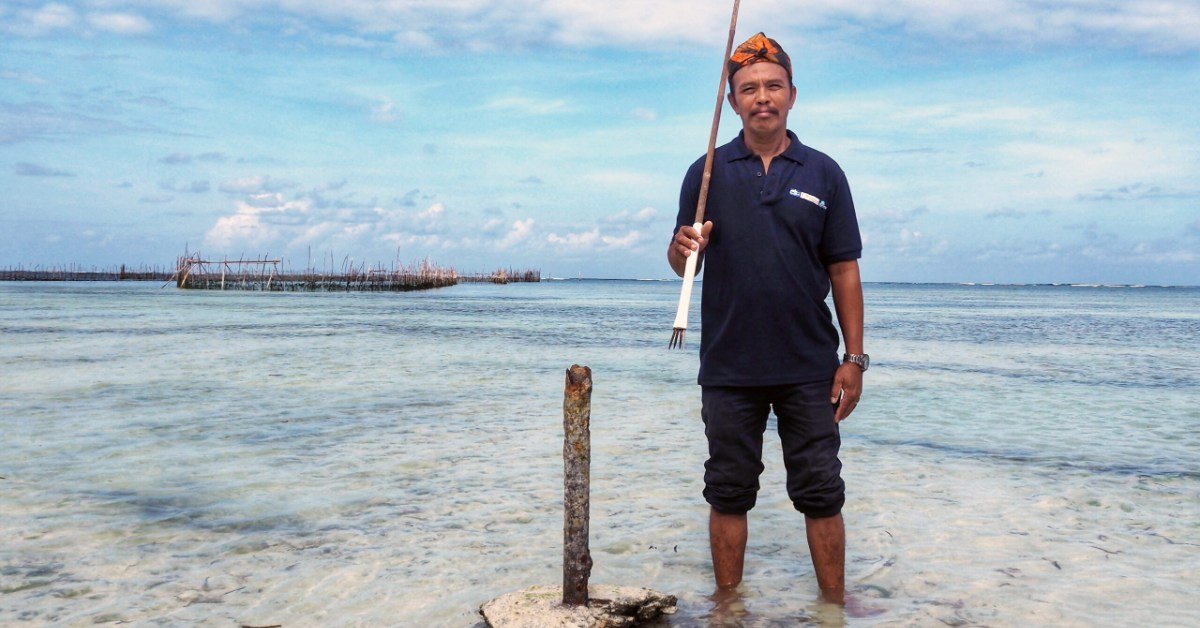
Header Photo: A villager in Buton guarding the sea using a customary system known as Kaombo, in which communities regulate access to marine areas, including coral reefs, seagrass beds and mangrove forests. Courtesy of SIEJ
Written by Hans Nicholas Jong. This article was originally published by Mongabay.
