


Discussion
This qualitative study examined how injury prevention is perceived and practiced across Luxembourg’s sport ecosystem. Grounded theory principles were used to guide the analysis. However, the present study does not aim to generate a formal grounded theory in the strict sense, but rather to develop an empirically grounded conceptual framework that helps explain how injury prevention is shaped by stakeholder interactions and implementation conditions. In this respect, the findings complement existing implementation approaches by providing a context-sensitive perspective on how prevention is translated into practice.16 18 20
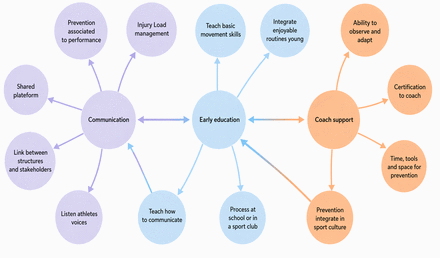
Through the voices of athletes, coaches, healthcare professionals, and institutional representatives, three key conditions emerged as critical for fostering injury prevention: clear and coordinated communication, early education and sustained coach support. These conditions are distinct but interact across different levels of the sport system.
Although prevention was often perceived as reactive or disconnected from performance, participants expressed a shared concern for athlete health and recognised the need for more integrated, proactive approaches.
Reframing prevention: from negative connotation to performance enhancement
Although the importance of injury prevention was widely acknowledged, several participants expressed discomfort with how it is typically framed in the field. The term ‘prevention’ itself was often perceived as negative, evoking images of fear, accidents and constraints. This perception contributed to its marginalisation in daily training routines, especially when prevention was understood as something external, medicalised or imposed. As highlighted in previous studies, the way injury prevention is framed significantly influences athletes’ and coaches’ engagement.19 32 Reframing prevention not as a reactive or risk-focused obligation but as an empowering strategy to enhance performance and longevity could support better adherence. Participants emphasised that injury prevention programmes must clearly demonstrate their contribution to performance-related outcomes. For many athletes, reduced injury risk represents a distant benefit, whereas improvements in performance, recovery and training availability are immediately meaningful. Unless prevention routines are explicitly linked to performance goals and their effects made visible, sustained engagement is unlikely. Communicating and evaluating injury prevention not only in terms of injury reduction but also in terms of performance-related outcomes aligns with value-based implementation approaches, which emphasise perceived usefulness and relevance for end users.15
Fragmented efforts despite proximity: specific features of the Luxembourg context
Luxembourg offers a unique context for injury prevention implementation. On one hand, its small size and centralised sports infrastructure could facilitate integration, communication and collaboration. However, participants described a fragmented ecosystem where institutions, clubs and educational structures often operate in silos. Multiple stakeholders, including school programmes, federations, clubs and high-performance centres, were said to act independently, leading to duplication of efforts and inconsistent messaging. This lack of coordination echoes challenges identified in other settings where fragmented governance and communication undermine prevention efforts.19 20 Additionally, Luxembourg’s multilingual and multicultural environment may amplify these challenges, especially when key actors differ in language, training background or institutional logic. As some participants noted, the same athlete could receive contradictory advice from different structures, with no system in place to monitor coherence or outcomes. These findings suggest that Luxembourg would benefit from shared platforms, aligned educational and improved communication between stakeholders.
Building the foundations: communication, early education and coach support
Three interrelated pillars emerged from the data as essential to fostering sustainable injury prevention practices: communication, early education and coach support. First, clear and coordinated communication among stakeholders is critical. Several participants highlighted the lack of feedback systems and collaborative frameworks between coaches, medical professionals and institutions. Without structured communication, trust erodes and injury prevention becomes inconsistent. This supports existing evidence that context-specific and system-level coordination is necessary to translate injury prevention from theory into practice.17 33
Beyond communication issues, the limited athlete voice described by participants also points to broader power dynamics within sport settings. In particular, fear of losing one’s place, selection pressure and hierarchical relationships may discourage athletes, especially younger or high-level athletes, from speaking openly about fatigue, pain or recovery needs. These findings align with athlete-centred and safeguarding-informed perspectives, which emphasise the importance of psychological safety, shared decision-making and progressive athlete autonomy in health-related matters.32 33
Second, early education and engagement were emphasised as foundational to long-term adoption. Participants advocated for introducing prevention as a natural component of youth training, making it playful, specific to sport contexts and age-appropriate. This is consistent with the Norwegian sport development model and related research, which demonstrates that early acquisition of motor control, functional movement and risk awareness is associated with a reduced risk of injury later in an athlete’s career.34 In addition, giving young athletes a voice and fostering safe communication around fatigue or pain were also seen as important for building trust and autonomy in health-related decisions.
Third, the role of the coach was consistently identified as central to implementation. Coaches act as the link between medical recommendations and daily training routines, and their beliefs strongly influence whether prevention strategies are applied. However, engagement varied greatly depending on personal experience and perception.35 While no formal certification in prevention exists for coaches in Luxembourg, several participants supported the idea of structured, context-specific education. Initiatives like the European SONAR project offer promising models, equipping coaches with tools to recognise, adapt and implement evidence-based prevention practices. Similar Scandinavian programmes have shown positive results in improving adherence and coach self-efficacy.34 36 Investing in coach education and aligning it with national sport priorities could help shift injury prevention from a discretionary task to an integrated part of coaching culture.
Limitations
This study has several limitations that should be considered when interpreting the findings. First, consistent with grounded theory methodology, sampling was guided by conceptual saturation rather than by a predefined sample size.25 While data saturation was assessed through an iterative constant comparative process across interviews and stakeholder profiles, the determination of saturation inevitably involves a degree of researcher judgement. Although multiple researchers contributed to the analytical process to enhance reflexivity and credibility, the identification of saturation remains partly subjective and may be influenced by the researchers’ perspectives and analytical frameworks.
Second, although the study included a range of stakeholder roles within the Luxembourg sport ecosystem, certain perspectives were not represented, such as those of younger athletes or high-level policymakers. As a result, insights into early sport experiences, athlete voice and the development of autonomy in health-related decision-making remain indirect. Inclusion of these groups may have provided additional insights into system-level decision-making and early sport experiences. In addition, the sample included proportionally more healthcare and institutional perspectives than coaches or athletes. This may have shaped the salience of themes related to coordination, communication and implementation support, and should be considered when interpreting the findings.
Finally, the findings are embedded within the specific structural, cultural and organisational context of Luxembourg. While this context provides a rich case for exploring injury prevention implementation in a small and centralised sport system, transferability to other settings should be considered in light of contextual similarities. The transferability of these findings is likely strongest for small, high-income sport systems where multiple actors operate in close proximity, but where coordination across sport, health and educational structures remains only partially integrated.
Implications for future injury prevention strategies and international relevance
Although grounded in the Luxembourg sport ecosystem, these findings have broader relevance for injury prevention in sport, particularly in high-income countries characterised by complex but well-resourced sport systems. Luxembourg’s small size and close-knit structures illustrate that proximity alone does not guarantee coordination, and that intentional system design is required to translate evidence-based prevention into coherent practice. Future efforts should therefore move beyond isolated initiatives towards integrated, system-level approaches that strengthen communication, governance and shared responsibility across stakeholders, while placing the athlete at the centre of prevention strategies. In practice, this may involve shared monitoring and communication systems across stakeholders, as well as more aligned coach education pathways integrating injury prevention into routine training.
Supporting implementation through ongoing guidance, and explicitly addressing practical, cultural and organisational barriers, appears essential to facilitate adoption and long-term use of prevention programmes. Demonstrating the impact of injury prevention on performance-related outcomes, alongside injury reduction, may further support sustained engagement by athletes and coaches. Embedding prevention early in youth sport through age-appropriate and engaging practices, and strengthening coach education and long-term support, can foster progressive athlete autonomy and emerge as key levers for building sustainable and transferable injury prevention systems across diverse sport contexts.
