


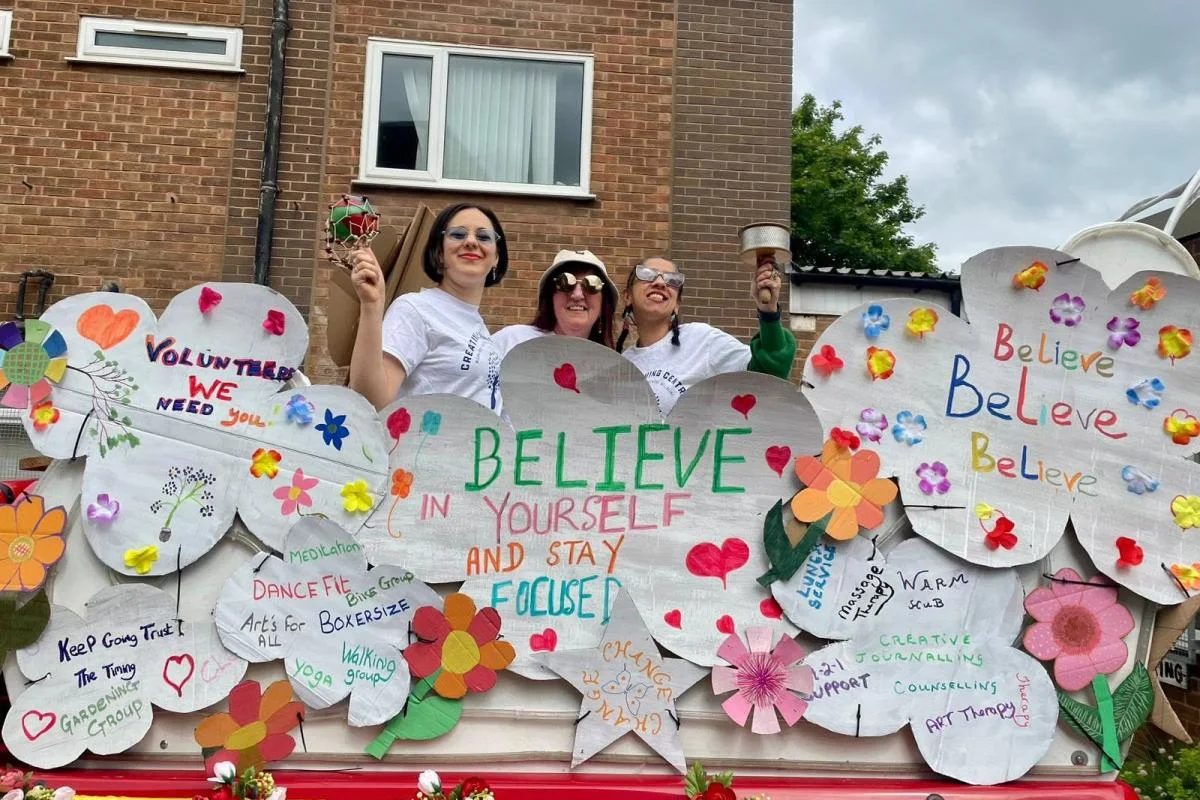
For more than 25 years, the Creative Living Centre in Prestwich has provided a vital service to people experiencing emotional and mental distress.
Offering a safe, non-judgmental space rooted in creativity and community, the charity has become a cornerstone of local support, helping members build resilience and improve their well-being in ways that go far beyond traditional mental health provision.
At the heart of the centre’s approach is its breadth of services.
Members can access one-to-one counselling, holistic therapies and tailored support from dedicated coordinators.
Alongside this, a varied programme of creative and physical activities – from art and music therapy to yoga, walking groups and exercise classes – ensures there is something to suit a wide range of needs.
Artwork completed by members at the Creative Living Centre. (Image: Newsquest)
Social spaces such as the Sunshine Cafe and regular drop-ins further foster connection, tackling the isolation so often linked to poor mental health.
Georgia Mulvaney, the centre’s Service Delivery Lead, oversees the day-to-day running of this extensive programme.
She explained how the organisation prioritises variety and accessibility.
“We’ve got a range of different activities to suit different people’s needs,” she said.
“Some people prefer the creative activities, like arts and crafts.
“Others prefer the more physical activities, like boxercise or Pilates which we’ve been able to run thanks to funding from Sport England.”
Georgia Mulvaney (right) is the centre’s centre’s Service Delivery Lead. (Image: Creative Living Centre)
The diversity of the timetable reflects an understanding that mental health support is not one-size-fits-all.
Rather than focusing on clinical interventions, the centre embraces a holistic model that supports well-being through creativity, connection and activity.
A key feature of the Creative Living Centre is its responsiveness to members themselves.
Through regular forums and ongoing feedback, those who use the service actively shape what is offered.
“It is a real member-led service,” says Interim Chief Officer Gareth Monger.
Gareth Monger is Interim Chief Officer at The Creative Living Centre. (Image: Newsquest)
“You come in here and you’re getting the opportunity to shape what we’re offering.
“That’s really important, because there’s no point in putting on a bunch of classes that nobody comes to.”
This collaborative approach extends to everything from daily sessions to larger events and trips.
Recent activities have included visits to RHS Bridgewater, bowling trips and an upcoming outing to MediaCity – all driven by what members want.
Staff at The Creative Living Centre. (Image: The Creative Living Centre)
“If members ask for something, we’ll try and make it happen,” adds Gareth.
“We’ll get creative. Even if we’re stretched, we’ll try and put something on.”
Therapeutic support is another crucial strand of the centre’s work.
Services such as counselling, art therapy and massage therapy are available at a significantly reduced cost, typically around £15 per session.
This affordability is vital at a time when many people face long waits for NHS support or cannot access private care.
“Being able to operate where somebody could be in counselling in four weeks rather than waiting months is really good,” Georgia explained.
“It means we’re catching people at that point where they’re not in crisis, so we’re able to prevent them getting to that point.”
The Creative Living Centre focuses on member-led activities, and holds regular forums. (Image: Newsquest)
This preventative ethos underpins much of the centre’s work.
By offering timely support, the charity helps people stabilise their mental health before problems escalate.
The centre’s accessibility is also reflected in its simple referral process.
Most members self-refer, either by calling or visiting in person.
A new member appointment introduces them to the services available, followed by a free week’s access to explore the centre.
From there, engagement is entirely flexible.
“There’s no pressure or expectation,” Georgia says.
“We’re led by what they want.”
Some members attend daily, while others drop in occasionally – the model adapts to individual circumstances rather than imposing rigid structures.
Importantly, the centre avoids intrusive assessments, instead focusing on building trust and comfort.
Beyond traditional therapies, the Creative Living Centre recognises that well-being can be nurtured in many different ways.
Activities such as gardening in the allotment, creative journaling or volunteering all contribute to a broader sense of purpose and connection.
The allotments at The Creative Living Centre are especially popular. (Image: Creative Living Centre)
“Talking isn’t for everyone,” Georgia points out.
“Mental health can be improved in so many different ways – it might be through arts and crafts, it might be through nature.”
This philosophy is reflected in initiatives like the centre’s community volunteering projects, where members prepare meals for local causes such as Prestwich Street Kitchen.
These opportunities allow people not only to receive support but to give back, which can be transformative for self-esteem and recovery.
The centre also boasts a well-equipped music room with a wide range of instruments for members. (Image: Newsquest)
“Giving to people can be massive for mental health,” she adds.
Despite its impact, the Creative Living Centre remains something of a hidden gem in Prestwich.
Both Georgia and Gareth emphasise the need to raise awareness so more people can benefit.
“It’s a great service that more people should know about,” Georgia says, noting that many people walk past the building without realising what it offers.
Funding remains an ongoing challenge, with the organisation relying on grants and community support to sustain and expand its work.
At any given time, multiple funding bids are in progress to enable new initiatives – including hopes to reintroduce animal therapy, a popular but costly programme.
Yet even within these constraints, the centre remains committed to its mission: providing accessible, person-centred support for anyone who needs it.
In a landscape where mental health services are often overstretched or slow to access, the Creative Living Centre offers something different: a flexible, welcoming space where people are empowered to take control of their well-being, supported by a community that listens and responds.
As Gareth puts it, the ethos is simple: “We are a team, and we try and just do it for the people that come here.”
For those who find their way through its doors, that ethos can make all the difference.
