


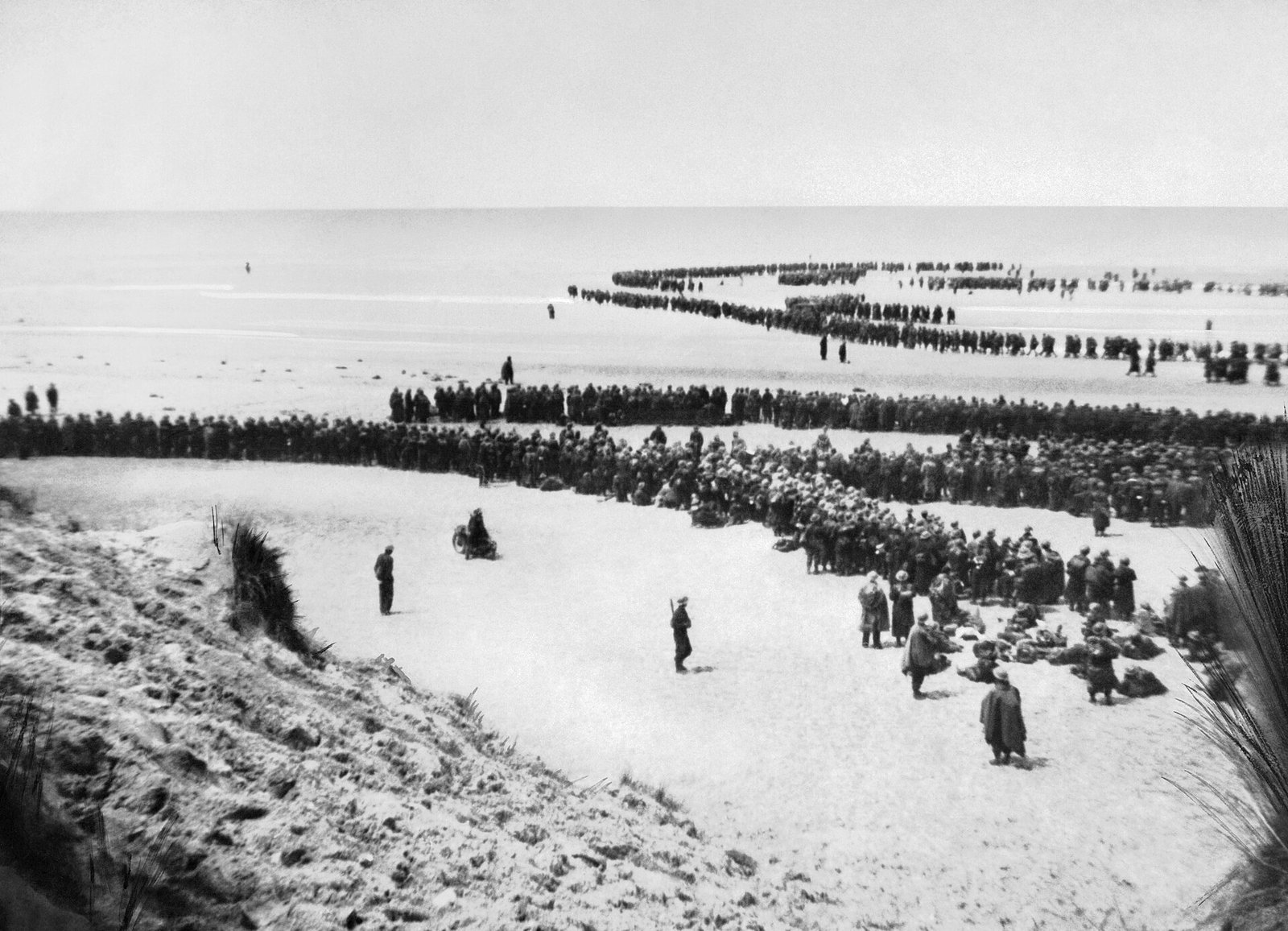
86 years ago today, the British Army completed the “Miracle of Dunkirk” by evacuating 338,226 Allied troops from France via a flotilla of over 800, mostly civilian vessels, including merchant marine boats, fishing boats, pleasure craft, and lifeboats escorted by Royal Navy destroyers. READ a quick summary of how it happened… (1940)
BEF and Allied forces que on the beaches of Dunkirk for evacuation
The Belgian Army surrendered to the Germans on May 28th, two days after an evacuation order was sent to the British Expeditionary Forces (BEF) in northern France, instructing them to make for Dunkirk. The Germans assigned their air force to pursue and attack the fleeing Allies of French, Belgian, and British troops who left without any of their vehicles or heavy weapons.
Military vessels were heavily damaged in the early evacuation, and Royal Navy losses were severe. On May 30th, Churchill received word that all British divisions were now behind the defensive lines, along with more than half of the French First Army.
On May 27th, 1940, the small-craft section of the British Ministry of Shipping telephoned boat builders around the coast, asking them to collect all boats with “shallow draught” that could navigate the shallow waters. The boats were checked to make sure they were seaworthy, fueled, and taken to Ramsgate to set sail for Dunkirk. They were crewed by Royal Navy officers, and a small number of experienced volunteers, mostly fishermen.
The first of the “little ships” arrived at Dunkirk on May 28th, and helped ferry soldiers from the beach or the concrete breakwaters to the larger vessels that could not get near the shore, hundreds more would eventually take on soldiers of their own.
The evacuation was hailed as a “miracle of provenance” by Winston Churchill, and the phrase “Dunkirk Spirit” is a popular British saying today to describe bravery and improvisation in the face of danger or challenges.
MORE Good News on this Day in History:
- The first public hot air balloon flight demonstration took flight over Annonay, France lasting ten minutes—it was presented by the Montgolfière brothers, inventors of the globe airostatique (1783)
- Massachusetts became the first state of the United States to set a minimum wage (1912)
- Li Na won the French Open’s women’s championship, becoming the first Chinese tennis player to win a Grand Slam singles title (2011)
- 50 French families opened their homes – and their hearts – to young American soldiers visiting France to commemorate the Normandy Landing 70 years earlier (2014)
37 years ago today, in the first modern elections in Poland, Lech Walesa’s Solidarity Party of trade unionists won 160 out of 161 seats in the government, triggering the Revolutions of 1989, and quite simply, the fall of Communism, freeing Eastern Europe to pursue self-government and market capitalism.
Fall of the Berlin Wall at Brandenburg CC 3.0. SA Lear 21
It started with two massive waves of worker/student protests, starting in September 1988, that shook the communist regime in Poland to its very foundations. An agreement was reached by the communist Polish United Workers’ Party (PZPR) and the Solidarity movement on April 4th 1989, ending communist rule in Poland.
Two elections were to be held in June. The first was for every seat available in the newly-recreated Senate, and the second was for 161 seats, or about 35% of the total, in the Sejm, or lower house. The other 65% were reserved for the PZPR and their satellite parties.
Pre-electoral opinion polls were inconclusive. Poland had not had a truly fair election since the 1920s, so there was little precedent to go by. Solidarity won all but one of the 100 seats in the Senate and all of the contested seats in the Sejm; the sole seat in the Senate which was not won by Solidarity was won by an independent candidate.
Some of the results were deeply demoralizing, with some communist candidates running against Solidarity candidates gaining just 10% of the vote. The communists let the results stand, feeling confident in their 65% majority in Sejm.
On July 19th the Sejm elected communist general secretary Wojciech Jaruzelski as president by only one vote. In turn, he nominated General Czesław Kiszczak for prime minister; they intended for Solidarity to be given a few token positions for appearances. However, this was undone when Solidarity’s leaders convinced the PZPR’s longtime satellite parties, the ZSL and SD to switch sides and support a Solidarity-led coalition government.
The PZPR, which had 37.6% of the seats, suddenly found itself in the minority. Abandoned by Moscow, Kiszczak resigned on August 14th, and Sejm had no choice but to appoint a Solidarity member as prime minister. (1989)
16 years ago today, the Falcon 9 rocket from SpaceX completed its maiden voyage after a launch from Cape Canaveral Florida. SpaceX used the launch to evaluate the aerodynamic conditions of the spacecraft and performance in a real-world launch scenario. It included a prototype of the Dragon spacecraft, and soon became one of the world’s premier rockets for all sorts of space missions.
The SpaceX Falcon 9 V.1 Flight 6 from Vandenberg Air Force Base, carrying the CASSIOPIE Satellite program
Dragon became the first US-made spacecraft used by NASA after over a decade of relying on the Russian-Soyuz ship, but Falcon 9 has taken plenty more up into the great beyond, including the CASSIOPIE satellite constellation, the Crew Dragon—the first reusable spacecraft by SpaceX, the Deep Space Climate Observatory, the RADARSAT satellite constellation, and numerous resupply missions to the ISS, including one that would demonstrate the vertical landing of the rocket on a sea-born autonomous ship.
Falcon 9 has also carried up DART, a mini-observatory that has a goal to smash into an asteroid to see if it can deflect one from a metaphorical Earth-bound trajectory, and Inspiration4, the first orbital spaceflight of an all-private crew.
As of May 25th 2022, the Falcon 9 has achieved 154 out of 156 full mission successes (98.7%), with several additional variants holding perfect records. (2010)
130 years ago today, Henry Ford unveiled his first ‘horseless carriage’, driving it through the streets of Detroit, with his assistant cycling ahead to alert pedestrians.
The ‘Quadricycle’ used four bicycle wheels and a chain powered by a two-cylinder, 4-horsepower engine running on ethanol.
Fabricated in a tiny workshop behind his home, Ford reportedly discovered the shed’s door wasn’t wide enough to get the vehicle out, so he broke through the wall with an axe.
After two years of experimentation, the 32-year-old rolled down Grand River Ave. with the 500-pound invention at speeds up to 20 miles per hour. Though the metal-framed vehicle was equipped with two driving speeds, there was no reverse and no brake—but Ford installed a doorbell ringer as a horn.
The charming success that day sparked the founding of the Henry Ford Company in 1901 which turned the Michigan man into one of America’s wealthiest and most emulated businessmen.
The original Quadricycle resides at The Henry Ford Museum in Dearborn, Michigan, which made the following video. (1896)
And, on this day in 1967, the Jimi Hendrix Experience played a performance at London’s Saville Theatre that was ‘bold as love’.
The Sgt. Pepper’s album had just been released several days prior, and two Beatles — Paul McCartney and George Harrison — were in attendance at the show, along with a roll call of UK rock stardom, including Eric Clapton, Spencer Davis, and Jack Bruce. In a courageous and brilliant display, Hendrix chose to open the show with his own rendition of Sgt. Pepper’s Lonely Hearts Club Band, crafted thirty minutes before taking the stage.
Fair Use
And on this day in 1984, Bruce Springsteen released “Born In The USA”, which became the best-selling album of the year in the US (and also Springsteen’s most successful album ever).
The LP produced a record-tying string of seven Top 10 singles–tied with Michael Jackson’s “Thriller” and Janet Jackson’s “Rhythm Nation 1814.” The seven chart-climbing singles were: “Dancing in the Dark, Cover Me, Born in the U.S.A., I’m on Fire, Glory Days, I’m Goin’ Down, and My Hometown.” Another well-known song from the LP is “No Surrender.” Finally, many people don’t know that the photographer who took the iconic cover was Annie Leibovitz.
Also on this day in 1919, the Nineteenth Amendment to the US Constitution was passed by Congress, prohibiting any local or federal government from denying women the right to vote based on sex. Several attempts to pass such an amendment failed until 1919, when suffrage activists, including Susan B. Anthony and Elizabeth Cady Stanton, swayed public opinion and pressed President Woodrow Wilson to call a special congressional session that could address the issue. The bill passed in the House 304–89, and in the Senate 37 Republican senators joined 19 Democrats to pass the amendment 56–25.
And, 85 years ago today, to rally the morale of his countrymen following a great military failure—when 338,000 British troops had to evacuate Dunkirk, leaving neighboring France in the grip of Nazi control—British Prime Minister Winston Churchill delivered his famous 12-minute “We shall fight on the beaches” speech.
The newly appointed prime minister needed to decide whether to negotiate with Hitler or fight on against incredible odds. His speech needed to balance the frightening reality with his desire to inspire hope and optimism—and his actions in the next four weeks of 1940 would cement his legacy as a courageous leader who changed world history. WATCH a portrayal of the speech by actor Gary Oldman who won an Oscar for playing Churchill in the 2017 film Darkest Hour… (1940)
SHARE The Milestones, Memories, and Music…
