


Chris Park lives on an organic farm in Oxfordshire, England, and he sees bees as a “blessing.”
“I’ve always had a fascination with bees and enjoyed them as a sacred creature,” Park said in an interview with Primal Gathering. “Bees have been here for 40 million years. Humans are toddlers in comparison.”
Park’s Instagram videos — which cover everything from beekeeping and basketmaking to his original music — typically average between 10,000 and 100,000 views.
But on May 31, he shared a post that quickly went viral, bringing in over 10 million views. In the video, Park calmly allowed a stinging honey bee to stay on his arm.
“This little honey bee is unwinding her sting,” the beekeeper said in the video. “It’s stuck in my wrist; she’s injected some venom. And that heat and that pain comes with it.”
“Our usual instinct is to lash out, isn’t it, and flick off the bee,” Park continued. “And she will then go into a frenzy, and try to fly away, and it will rupture her gut, and she’ll fly off with her stinger left behind, and often, the venom stays sort of there pumping away. And she dies.”
“But here,” Park said, “I’ve taken my arm to a more sheltered place, where she feels protected from potential predators, and I’ve tried to relax every single cell in my wrist, and calm my breath, and create this safe place for her, to calm down herself.”
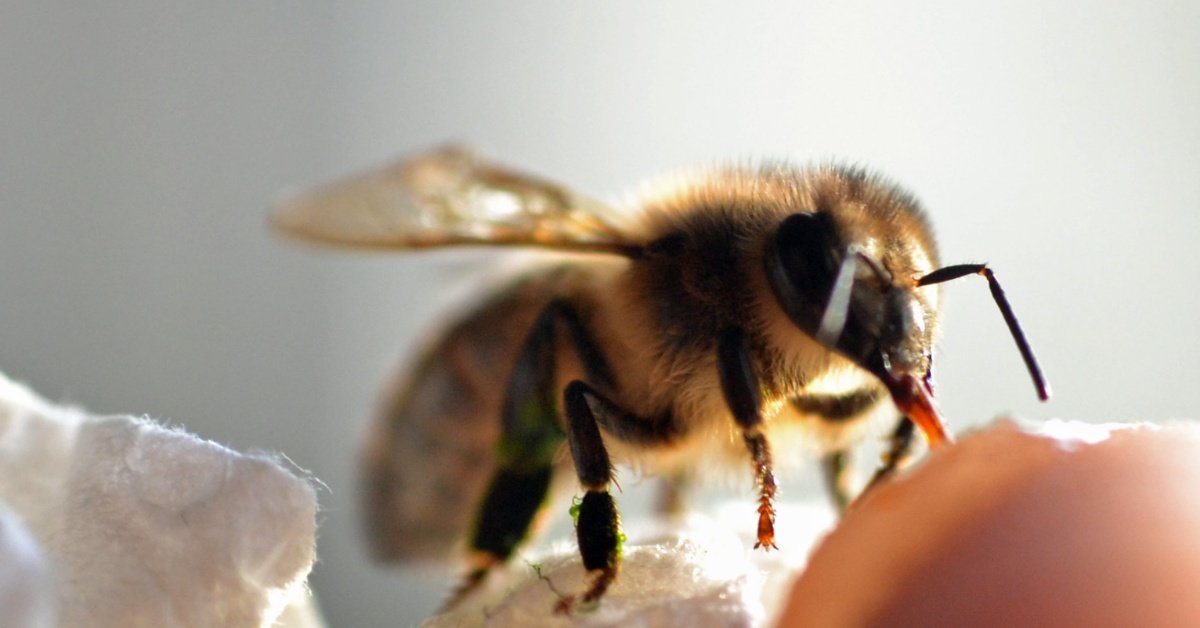
Throughout the video, the bee can be seen moving its body clockwise and counterclockwise, as it frees each barb of its stinger.
Image via Conall (CC BY 2.0)
“They can sting other insects and retract those things, so they’re used to doing it, but in our flesh, it often gets stuck,” Park added. “This is one of my first beekeeping lessons: that this can happen, but we can do this, and that it’s a metaphor for life, you know, often we feel stung and in great pain, and we lash out and cause a worse situation.”
“But,” Park countered, “if we try and endure the pain and relax — and it’s so much easier said than done — then a misadventure can be avoided, and in this situation, a life can be saved.”
At the end of the video, the honeybee finally flies off with its stinger seemingly intact. As soon as the moment went viral, Instagram users flooded the comments with praise and awe.
“You are officially the nicest human to ever exist on the planet,” one person said.
“This was magical to see,” one commenter wrote.
Another person exclaimed: “I didn’t know they could survive this!”
But the internet is rarely in agreement. On June 2, there were more than 3,600 comments on the Park’s video. And many of them were flippant or outright skeptical.
“Nope,” another commenter quipped.
“You should try snakes and sharks next,” one person egged on.
“Don’t try this at home,” warned another.
According to a study in the National Library of Medicine, a bee’s stinger is attached to its lower digestive tract by three sets of muscles— or, as Park put it, it’s “gut” — which is why it risks death every time it leaves its stinger behind.
“In order for a honeybee to extract its stinger without autotomy, it must rotate its body clockwise or anticlockwise around the sting site to pry the stinger loose; this behavior may successfully remove the stinger without autotomy but can be quite laborious,” observed co-authors Fiorella Ramirez-Esquivel and Sridhar Ravi.
The clockwise and anticlockwise behavior can be witnessed frequently in nature when a bee stings another animal with a thin exoskeleton and then attempts to retract its stinger.
However, is widely accepted that when a honey bee stings a human, it is incapable of pulling itself loose because the physical structure of the stinger is too deeply lodged in a human’s thick skin.
Even so, the belief that a bee can “unwind its stinger” is becoming more popular in the beekeeping community.
“Sometimes bees sting by accident,” fellow beekeeper Mirabai Nicholson-McKellar explained in a similar video that showed a honey bee moving in clockwise and counterclockwise motions. “If you stay calm and still, the bee might manage to pull her stinger out safely.”
Kate Hinkens, who runs Stinglab, a center for bee venom therapy and research, also backed the theory in her own video.
“If you let them try to unwind their stinger rather than swatting them away, sometimes the bee can unscrew her stinger by spinning around in circles,” she said. “Try it the next time you’re stung!”
Above all, Park’s demonstration of patience is kindness in action — and it shows that there is still a lot left to learn when it comes to bee behavior.
You may also like: New pollen-replacing ‘power bars’ give honey bees nutrients they need to survive
Header image via Conall (CC BY 2.0)
