


At a pay-as-you-can restaurant in Stroud, radical hospitality and good food are bringing strangers together
On a cool late winter evening in the heart of the English Cotswolds, I get my first glimpse of an old industrial building that I have heard so much about. The crumbling white brick walls and ivy that snake into the broken windows make it look isolated and desolate, but as I step inside Brimscombe Mill, it buzzes with life.
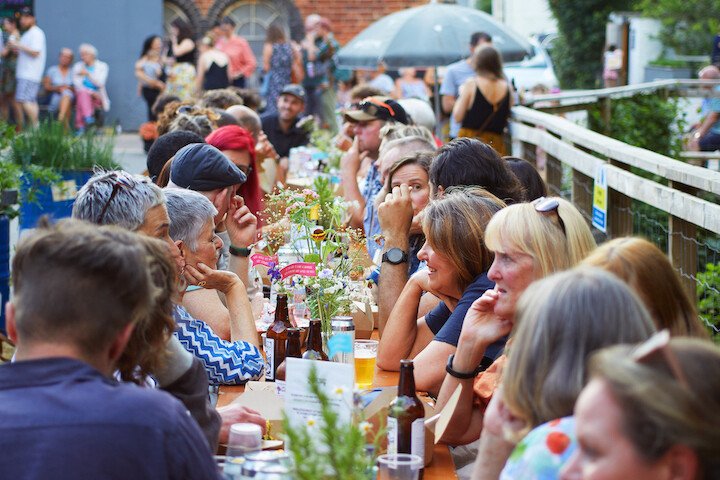
Children weave between benches. Cutlery clinks against enamel plates. A roaring fire kicks out steady heat. At one end of the vast hall, a local band, Ordinary Folk, tune their fiddles and guitars. Around the edges, community-oriented micro-businesses have set up stalls: a furniture scheme, a bike workshop, a clothes mending project and a children’s clothes shop. In the middle, two long wooden tables fill up with a mix of families, students, retirees and the after-work crowd.
This is The Long Table, a restaurant built on what it calls “radical hospitality”. The concept is straightforward. There are just one or two dishes on the menu, you sit wherever there is space, and you pay what you can afford.
No proof is required. Guests are accepted at face value. If you can pay more than the suggested price, you are invited to do so. If you need to pay less, or nothing at all, you are equally welcome. On the night I visit, the base price for a meal to cover their costs is £10.30.
In the middle of a cost of living crisis, when food prices remain high and eating out has become a luxury for many, that flexibility makes the difference between staying home and stepping out. But The Long Table is careful not to frame itself as charity. Emma Hurrell, its food resilience lead, is clear that they “function as a business” and not at the whims of funding. The aim is long-term resilience, not short-term thrills.
The numbers tell their own story. Last year, 38,305 meals were served. Around half were paid for at below cost price, and 10% were “community meals” with no charge. Those who are able to pay more effectively help to underwrite those who cannot.
There are just one or two dishes on the menu, you sit wherever there is space, and you pay what you can afford
Imad Hussein, a regular, sees the impact every week.“I come here because everyone can eat here –so you don’t just find one class of people. A lot of people sitting here are paying nothing, but I have just seen people in front of me paying double.”
The result is a rare kind of social mix. There is no separate queue, no visible distinction between who has paid what. You sit where there is room, shoulder to shoulder with whoever happens to arrive next.
Tom Freer, who I meet at the mill’s crooked pool table, values that openness. Eating in a traditional restaurant means you are allocated a table and that’s it. “Here, you sit with everyone,” he says. “I usually come with a few friends but end up chatting to at least a few other people. You can really make connections here.”
In most restaurants, privacy is part of what you pay for. Here, the long tables gently nudge people into conversation. Someone passes the bread, someone else recommends the homemade pesto. By the time plates are cleared, new introductions have been made.
The Long Table’s ethos rests on five pillars: championing local farmers and suppliers, building relationships with schools and businesses, cooking nutritious food from scratch, seating people together at long tables, and training young people through apprenticeships. The impact stretches beyond a single meal.
None of that would matter if the food felt like an afterthought, but here it is very much front and centre. On the blackboard that evening there is a single option: panzerotti, the southern Italian deep-fried cousin of a calzone. It arrives blistered and golden, served with caper-jewelled caponata and a peppery rocket salad, finished with a lovely bright green oil. There is homemade pesto to spoon as generously as you like, and thick slices of bread for mopping up every last trace.
I come here because everyone can eat here – some are paying nothing, others are paying double
It is generous and beautifully presented, closer to a small independent trattoria than a community canteen. The care is evident in the seasoning, the balance of textures, and the confidence of the kitchen. Paying what you can does not mean lowering the bar. If anything, the standard reinforces the dignity at the heart of the model.
For founder Tom Herbert, that dignity is personal. A fifth-generation baker, he grew up immersed in food. “I grew up above a bakery,” he says. “My grandad hired people who were fresh out of prison, and ended up with 22 hot bread shops.” What made his grandfather’s chain of bakeries unique was that he put the names of the people he had trained up – and given a second chance to – above the door. “We had Ian’s Bakery, John’s Bakery and so on,” he says.
The belief that food businesses can be engines of inclusion runs through The Long Table. And in a hospitality sector often defined by staff shortages and high turnover, there is a sense of shared purpose among the team.
“We don’t have a problem hiring and we certainly don’t have a problem with people leaving,” says Herbert. “The team is largely made up of people who have experienced being our customer, and then fallen in love with what we do and wanted to join in.”
Herbert once imagined shipping containers serving his brand of radical hospitality opposite every McDonald’s in the world. The reality is that after years of trial and error, there are now two sites, the original at Brimscombe Mill and a newer space in Cirencester. These days, Herbert’s ambition is less on mass expansion and more on helping others adapt the model for their own communities. “To take that lively, fizzy, sourdough culture and give it to people where they are, so they can start something,” he says.
Across Europe and the UK, variations on the theme are taking root. In Copenhagen, Absalon, a former church turned communal dining hall, hosts affordable long table dinners several nights a week. Community gardens, like the Manchester Urban Diggers, serve culturally relevant, low-cost meals to their local community. Research-led pilots such as Dished in Dundee and Nottingham are exploring the idea of ‘public restaurants’ as accessible alternatives to fast food.
Paying what you can does not mean lowering the bar — the standard reinforces the dignity at the heart of the model
Each project responds to its own context, yet they share a belief that eating together can be a public good rather than a private luxury.
As the evening draws on at Brimscombe Mill, plates are cleared and the band begins a rendition of Wild Mountain Thyme, an old folk song. Voices rise from the tables, some sure of the melody ,others tentatively following. Glasses are refilled, chairs scrape back as people prepare to get up to sing and dance.
The chorus drifts up towards the rafters, folding strangers into something that feels momentarily collective. “And we’ll all go together,” they sing. In a winter that has felt hard for many, the simple act of sharing food at a long table offers warmth of more than one kind.
Main image: Hatty Bell
Be part of the solution
At Positive News, we’re not chasing clicks or profits for media moguls – we’re here to serve you and have a positive social impact. We can’t do this unless enough people like you choose to support our journalism.
Give once from just £1, or join 1,800+ others who contribute an average of £3 or more per month. Together, we can build a healthier form of media – one that focuses on solutions, progress and possibilities, and empowers people to create positive change.
Support Positive News
