


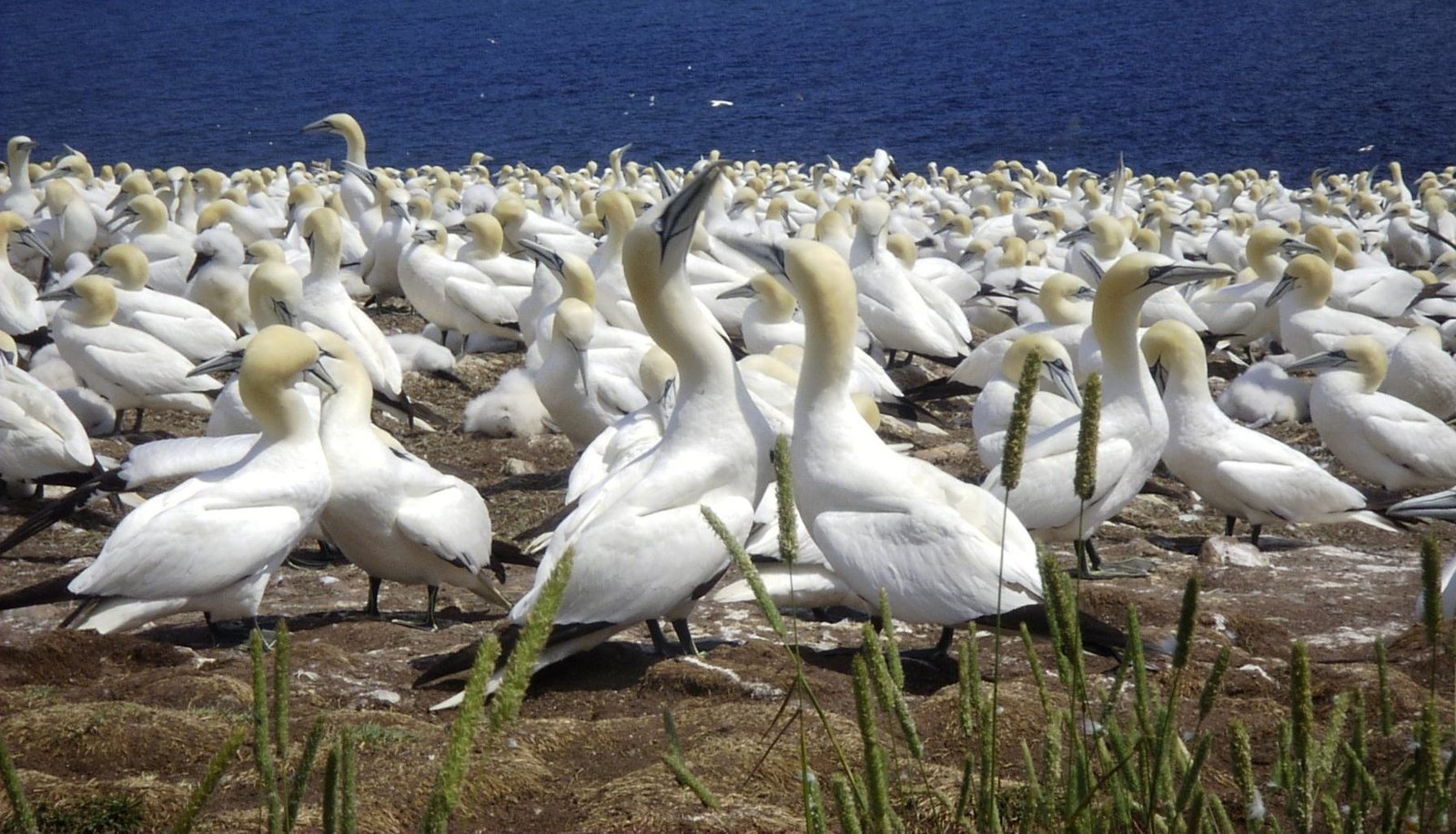
Northern gannets on Bonaventure Island – credit, CC 3.0. BY-SA Bodoklecksel
Content of several “forever chemicals” in seabird eggs were found to have sharply decreased over the last 55 years by a team of scientists.
While first rising exponentially from during the 1960s, the chemicals, classed as PFAS, peaked in the 1990s before decreasing in line with regulatory oversight by North American governments.
PFAS are a class of chemicals that form water, stain, and heat-resistant coatings in multiple products which substantially contaminate environments around the world, and are linked to multiple detrimental health outcomes.
A study published in the journal Applied Toxicology that looked at PFAS concentrations in the eggs of northern gannets on Bonaventure Island found that the content of some of the most commonly used PFAS has fallen 70% and sometimes more.
These include perfluorooctanesulfonic acid (PFOS) and perfluorooctanoic acid (PFOA), which fell 74% and 40% respectively. Concentrations of perfluorohexanesulfonic acid, (PFHxS) another of these chemicals, was also 70% lower from baseline.
“We see this incredible rise to a peak where concentrations seem to be higher than toxicological threshold for those birds, then it really decreases in a nice way,” Raphael Lavoie, a co-author and ecotoxicologist with Environment and Climate Change Canada, told the Guardian. “The regulations are having a good effect.”
The seabird subjects and the long study period were notable strengths. The 55 years of data spans the rise in PFAS production, and the eventual decline as the environmental groups and regulators caught on to the toxicity in the late 90s and early 2000s.
Bonaventure Island is the world’s largest northern gannet breeding colony. These pescatarian birds are directly exposed to PFAS contamination due to the island’s position near the St. Lawrence Seaway, which, being connected to the Great Lakes manufacturing centers north and south of the border, was exposed to substantial amounts of PFAS during the 20th century.
ALSO CHECK OUT: After 40 Years and $84 Million, Lake Muskegon Flourishing Free from Pollution and Sawdust
The PFAS got into the fish which got into the gannets and then into their eggs. Tom Perkins for the Guardian wrote that in the late 90s, the chemical corporation M3 dramatically scaled back its production of commercial PFAS in the face of regulatory scrutiny. In 2015, the chemical sector struck an agreement with the EPA to phase out production of PFOA and PFOS, while 6 years earlier at the United Nations’ Stockholm Convention, several of the chemicals tested for in the study were subjected to elimination.
This included PFOA and PFHxS, while PFOS was restricted in everything but firefighting foam.
MAKING TEMPORARY FOREVER CHEMICALS: France Bans Forever Chemicals in Cosmetics, Fashion, and Ski Wax
The study is a comprehensive demonstration of how these regulations are working to reduce the toxic load presented by PFAS in the environment. PFAS are referred to shorthanded as “forever chemicals,” however, and so the authors stress the need for continual environmental and regulatory vigilance, since any similar chemicals entering the environment today will remain, presumably forever.
SHARE This Great Environmental News With Your Friends…
